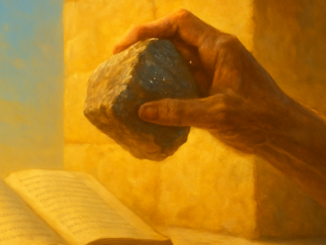
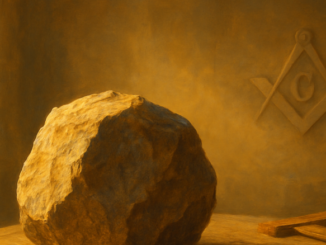
An open antique book with Masonic square and compasses in candlelight
Freemasonry & Connection

Montaigne on Intentions: The True Measure of Our Inner Work

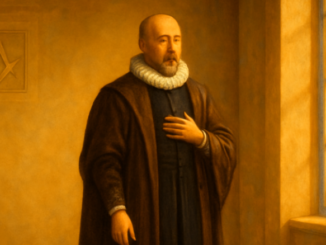
It is late in the evening. A Freemason sits alone in his study, a yellowed book open before him. He reads a passage by a sixteenth-century French thinker and feels the words reaching across the centuries, as though they were written for him personally. The question that surfaces is at once simple and unsettling: not what he has done, but why he did it. In that moment, two traditions touch — separated by four hundred years, yet united in the same search for sincerity. The Heart of Montaigne‘s Essay In one of his brief but penetrating essays, Montaigne argues that our actions cannot be separated from the intentions behind them. The results of what we do may shine in the eyes of the world, but the true value lies in what moved us when we began. A good deed performed out of vanity carries a very different weight than the same act born of genuine compassion. Montaigne invites us to look beyond the surface — past the praise and criticism of others — into the quiet chamber of our own conscience. This is no idle thought experiment. Montaigne warns that we are remarkably skilled at deceiving ourselves. We construct noble […]

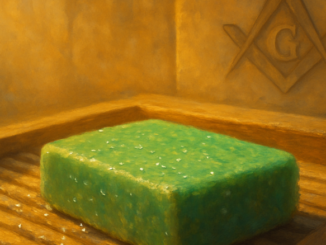
Block of green soap symbolizing purification and inner work in Freemasonry
Symbolism & Rituals

Green Soap: Purification as a Symbol for Inner Work

Tucked away in the cupboard beneath the kitchen sink sits an unassuming block. Yellowish-green, greasy to the touch, carrying a scent that calls to mind washdays at your grandmother’s house. Green soap. A product so ordinary that we scarcely give it a second thought. And yet, hidden within this simple cleansing agent lies a wealth of symbolism that teaches us about purification, transformation, and the daily labor we must perform upon ourselves. An Ancient Craft Green soap has a history stretching back well before the Industrial Revolution. In the Low Countries, it was made from vegetable oils and ash — a process that demanded patience and craftsmanship. Soap makers formed their own guilds, with their own rules, their own trade secrets, and their own hierarchy from apprentice to master. They understood that purification is never accidental; it is the result of careful labor and deep knowledge of one’s materials. In this respect, the soap maker’s craft bears striking parallels with other building traditions. Just as the stonemason works the rough ashlar, the soap maker transformed raw ingredients into something that cleanses and restores. The process itself — the slow saponification in which oil and lye become something entirely new — […]

Open book of Montaigne's essays with Masonic square and compass symbol
Michel de Montaigne – The Essays

Montaigne on Intention: How Purpose Judges the Work

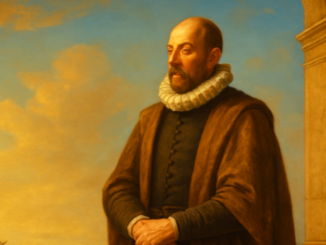
In 1580, a remarkable book appeared in Bordeaux. Michel de Montaigne — a nobleman who had withdrawn from public life — published his first collection of essays. Among them was a short but profoundly rich piece: “That Our Actions Should Be Judged by Our Intentions.” With that single title, Montaigne touched on a question that had occupied philosophers for centuries. It is not what we do, but why we do it, that determines the true value of our actions. Rooted in Stoic and Aristotelian traditions, this idea would become a cornerstone of Western ethical thought — and it carries a special resonance for anyone engaged in the inner work of Freemasonry. The Legacy of Seneca and Stoicism Montaigne was a voracious reader of the Roman Stoics, and no thinker influenced him more deeply than Seneca. In his famous letters to Lucilius, Seneca had already argued that the intention behind an action matters more than its outcome. A deed may appear good on the surface, yet remain morally hollow if driven by self-interest or vanity. Montaigne eagerly adopted this view and applied it to even the smallest aspects of human conduct. The Stoics drew a crucial distinction between what lies within […]

A solitary chair on a windswept barrier island beach at golden hour
Spiritual Traditions

The Coast as Temple: Spiritual Lessons from a Barrier Island

A chair slowly sinks into the sand as the eyes wander across the water. In the distance, boats approach — tiny specks growing larger on the horizon. Other vessels sail away, shrinking until they vanish entirely. Behind the dunes, the land shields against the wind, while barefoot walkers stroll along the shore and the occasional brave soul takes a quick plunge into the cold sea. This simple scene on a barrier island holds more spiritual wisdom than many a thick volume of philosophy. The Beach as a Contemplative Space There is something extraordinary about sitting on a beach, gazing at the endless horizon. The boundary between water and sky blurs, time seems to slow, and the mind comes to rest. This is no accident. For centuries, people have sought out places where the elements converge — where land gives way to water and the heavens touch the earth. In many traditions, such places are regarded as threshold spaces, liminal areas where ordinary life pauses and room opens up for deeper reflection. Freemasonry understands this principle well. The lodge itself is precisely such a set-apart space, deliberately separated from the outside world to make reflection possible. But beyond the ritual environment, […]

A darkened chamber with Masonic symbols representing reflection and inner wisdom
Freemasonry & Society

The Power of Departure: Why Walking Away Can Be the Best Move

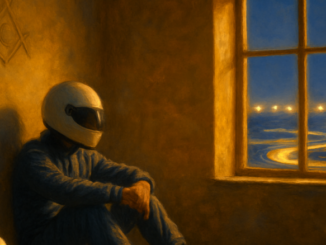
A race car sits idle in the pit lane. The driver climbs out, leaves the circuit, and seeks silence. Hours later, he returns and delivers the qualifying lap of his lifetime. The story made headlines around the world yesterday: sometimes you have to leave in order to truly arrive. For those familiar with the symbolism of Freemasonry, an ancient truth resonates here — one that reaches far deeper than any racetrack. The Circuit as a Mirror of Society A racing circuit is more than asphalt and crash barriers. It is a closed system where pressure, expectation, and performance converge in a relentless rhythm. Lap after lap, second after second — everything is measured, compared, and judged. In many ways, this mirrors the society in which we all operate: a world of deadlines, targets, and the unceasing demand for more, faster, better. The driver who chose to temporarily step away from this system did something that defies every rule of our performance-driven culture. He stopped when pushing forward was expected. He sought distance when proximity was demanded. And yet, it was precisely this departure that became the key to his finest performance. The Chamber of Reflection: The Symbolism of Withdrawal In […]