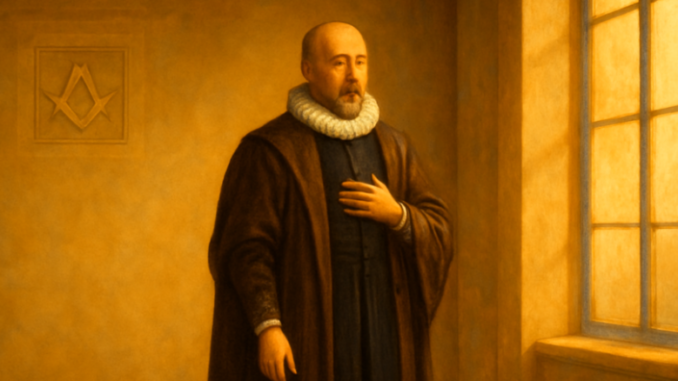
In 1580, a remarkable book appeared in Bordeaux. Michel de Montaigne — a nobleman who had withdrawn from public life — published his first collection of essays. Among them was a short but profoundly rich piece: “That Our Actions Should Be Judged by Our Intentions.” With that single title, Montaigne touched on a question that had occupied philosophers for centuries. It is not what we do, but why we do it, that determines the true value of our actions. Rooted in Stoic and Aristotelian traditions, this idea would become a cornerstone of Western ethical thought — and it carries a special resonance for anyone engaged in the inner work of Freemasonry.
The Legacy of Seneca and Stoicism
Montaigne was a voracious reader of the Roman Stoics, and no thinker influenced him more deeply than Seneca. In his famous letters to Lucilius, Seneca had already argued that the intention behind an action matters more than its outcome. A deed may appear good on the surface, yet remain morally hollow if driven by self-interest or vanity. Montaigne eagerly adopted this view and applied it to even the smallest aspects of human conduct.
The Stoics drew a crucial distinction between what lies within our power and what does not. The results of our actions often depend on circumstances, chance, and the behavior of others. But the intention with which we act belongs entirely to the domain of our own will. From this followed a revolutionary conclusion: a person’s moral worth lies not in their successes, but in the purity of their purpose.
Aristotle and the Virtue of Character
Alongside Stoicism, Montaigne drew heavily from Aristotle’s Nicomachean Ethics. The Greek philosopher had argued that an action is only truly virtuous when it springs from a settled character. Someone who happens to do something good — without understanding why it is good — does not act with real virtue. Intention must be rooted in knowledge, deliberate choice, and a steadfast inner disposition.
It is not enough to do what is right; one must will to do it because it is right.
This Aristotelian emphasis on the inner life dovetailed perfectly with Montaigne’s own philosophical project. His essays were, after all, attempts to understand himself — to uncover the hidden motives behind his own behavior. The essay on intentions thus forms a link in a long chain of self-examination stretching all the way back to Greek antiquity.
Renaissance Humanism and the Revival of the Classics
Montaigne wrote during a period of extraordinary intellectual rebirth. The Renaissance had made the texts of antiquity widely accessible once more, and humanists such as Erasmus and Petrarch had cultivated a new kind of scholarship. These scholars read the classics not as rigid authorities, but as living conversation partners. Montaigne followed their example wholeheartedly, quoting Seneca, Plutarch, and Cicero as though they were contemporaries, engaging them in dialogue on the great questions of human existence.
Humanism also brought a fundamental shift in thinking about what it means to be human. Where medieval scholasticism had emphasized universal truths and divine order, humanism turned its gaze toward the individual. Montaigne pushed this further by making his own person the subject of philosophical inquiry. His question about the role of intentions was therefore also a deeply personal one: what motives truly drive me, and how can I refine them?
Plutarch as Moral Guide
Another vital source for Montaigne was the Greek writer Plutarch. His Moralia and Lives of Noble Greeks and Romans offered a treasury of examples — of virtuous and less-than-virtuous conduct alike. Plutarch relentlessly examined the motives of his historical figures. Was a general courageous out of genuine bravery, or out of a hunger for glory? Did a benefactor give from sincere generosity, or to inflate his own reputation?
Montaigne read these stories as mirrors for his own age. The examples drawn from antiquity were not merely of historical interest — they offered moral lessons that could be applied directly. In his essay on intentions, this method echoes clearly: by asking about the purpose behind an act, we reveal the true nature of the action itself.
Builders of the Inner Temple
The question of intention resonates deeply within traditions dedicated to inner development. In Freemasonry — which would emerge in its modern speculative form some decades after Montaigne’s death — the building of the inner self stands at the very heart of the Craft. The rough ashlar that must be shaped into a perfect cube represents the imperfect self, gradually formed through labor, study, and honest self-reflection. Here too, the outward action gains its true value only through the inner disposition with which it is performed.
A Freemason does not merely perform charitable acts or observe ritual for the sake of appearance. The work is meaningful only when it proceeds from a genuine desire for self-improvement and service to others. In this sense, the Masonic tradition and Montaigne’s philosophical inquiry share common ground: both insist that the invisible motive behind the visible deed is what truly matters.
Converging Streams of Thought
Montaigne’s essay stands at the intersection of several rich intellectual traditions. The Stoics taught that intention outweighs result. Aristotle argued that virtue flows from a settled character. Plutarch investigated the motives behind the deeds of great historical figures. Renaissance humanism turned the philosophical spotlight on the individual. All of these currents flow together in a single urgent question: what truly drives us when we act?
The answer to that question determines not only the moral value of our actions, but the very direction of our lives. It is a question that was as pressing in sixteenth-century Bordeaux as it is in a Lodge room today.
Montaigne’s brief essay on intentions brings centuries of philosophical thought into sharp focus. From Seneca’s Stoic wisdom to Aristotle’s ethics of character, from Plutarch’s moral portraits to the humanistic self-inquiry of the Renaissance — all of these traditions converge in the question of what lies behind our actions. That question invites us to look beyond the surface of what we do and to examine honestly what moves us. In this way, Montaigne’s essay is not a finished text but an open invitation to continuous self-examination — a labor that is never complete, yet always profoundly worthwhile. For those who work with mallet and chisel upon the rough stone of their own nature, this invitation is not merely philosophical. It is the very essence of the Craft.
Copyright text & image: devrijmetselaar.nl
Texts are based on the ideas and content of the author of devrijmetselaar.nl, reviewed, corrected, and supplemented with the assistance of OpenAI. Images are created based on the ideas of the author of devrijmetselaar.nl using OpenAI/DALL-E.
Frequently Asked Questions
What is the main connection between Montaigne's philosophy and Freemasonry?
Montaigne's emphasis on intention and inner purpose directly parallels Freemasonry's focus on inner work and self-improvement. Both traditions teach that true value comes not from external accomplishments, but from the purity of one's intentions and the deliberate cultivation of virtue and character. This alignment makes Montaigne's essays particularly meaningful for Freemasons engaged in personal development and moral refinement.
How does the Stoic idea of intention relate to Masonic practice?
The Stoic distinction between what lies within our control (our intentions and will) and what does not (external outcomes) is fundamental to Masonic teaching. Freemasons learn to focus on their own moral conduct and pure intentions rather than seeking recognition or material rewards, which embodies the Stoic principle that true worth lies in our inner character and purpose.
Why does Aristotle's concept of virtue matter for understanding Freemasonry?
Aristotle taught that virtue comes from a settled character and deliberate choice, not mere chance—a principle central to Freemasonry's emphasis on building character through ritual and study. Masonic initiation is designed to help candidates develop a steadfast inner disposition toward virtue and goodness, transforming them from the inside out rather than simply prescribing external rules.
What can Freemasons learn from Montaigne's self-examination?
Montaigne's essays demonstrate the power of honest self-reflection to uncover hidden motives and understand one's true character—a practice deeply encouraged in Freemasonry. By examining ourselves with the same philosophical rigor Montaigne applied, Masons can ensure their actions spring from genuine virtue and right intention, fulfilling the fraternity's promise of authentic self-improvement.

Be the first to comment