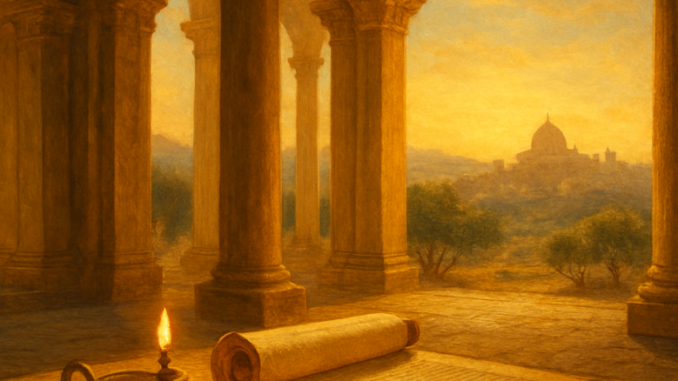
Imagine you’re finally starting that great project you’ve been dreaming about for years. The building blocks are ready, the plans have been drawn, but now the real work begins. That must have been exactly how King Solomon felt when he received the charge to build the Temple. In the Book of First Kings, we find far more than a story about stone and cedar — we encounter a deeper truth about how to build something lasting, something greater than yourself.
A Kingdom in Transition
First Kings opens with the close of an era. King David — the shepherd who rose to become a ruler — passes his mantle to his son Solomon. This moment of succession is more than a political handover. It is a deeply human turning point: the moment you receive the torch from those who came before you and realize that the responsibility is now yours alone.
You may recognize this feeling from your own life. A mentor stepping aside, a parent letting go, a role that suddenly falls on your shoulders. In every transition like this, there is both fear and possibility. When Solomon is given a choice, he does not ask for wealth or power. He asks for wisdom. That choice still carries profound meaning today: what do you ask for when you stand at the threshold of a new beginning?
The Temple as a Life’s Work
The heart of First Kings is undoubtedly the construction of the Temple in Jerusalem. For seven years, skilled craftsmen labored over this edifice. Cedars from Lebanon, hewn stone, gold, and bronze were brought together to create a sanctuary meant to serve generations. But what makes this building project so extraordinary?
The Temple was never just a building. It was the tangible expression of a people striving to serve something higher than themselves. Every detail carried meaning: the two pillars at the entrance, the seven-branched candlestick, the Holy of Holies where the Divine was said to dwell. For anyone reading this with a Masonic eye, these symbols are immediately recognizable. The two pillars, the emphasis on craftsmanship, the labor directed toward a higher purpose — these are themes that live and breathe within the lodge as well.
“He built the temple in seven years, and the whole work was completed.”
The Craftsman as a Model
In First Kings, we also encounter the figure of the master craftsman who created the bronzework for the Temple. This skilled artisan has become, across many traditions, a powerful symbol of dedication and expertise. He did not work for fame or recognition — he worked for the work itself. His hands gave form to what his mind had conceived.
There is a concrete lesson here for everyday life. What does it mean to be a craftsman of your own existence? It’s not about perfection — it’s about devotion. About showing up each day and working on something greater than the moment. Whether you’re building a relationship, honing a skill, or shaping your own character, the craftsman’s attitude invites patience, presence, and attention to detail.
Wisdom as the Foundation
Solomon is renowned as the wise king, and First Kings shows how that wisdom manifests in the fabric of daily life. The famous story of the two mothers both claiming the same child reveals how true wisdom looks beyond the surface. Solomon searches for the truth behind the words — not the obvious answer, but the right one.
That search for truth is timeless. In your own life, you encounter situations where the correct course of action is far from obvious. Wisdom in those moments is not a trick or a formula. It is an attitude of listening, weighing, and having the courage to act. It is the willingness to look past the first layer of appearances.
Listen for what is left unspoken. Weigh competing interests without putting your own first. Have the courage to make a decision, even when it is unpopular. These are the marks of a wisdom that never grows old.
The Shadow Side of Glory
First Kings is not an uncomplicated success story. After the glory of the Temple’s construction comes decline. Solomon himself strays from his path, led astray by vanity, and forgets the very wisdom he once sought. After his death, the kingdom tears itself in two. This is not a minor detail — it is an essential part of the message.
Growth is never linear. Even the wisest among us can lose their way. Building your inner temple is not a project with a completion date. It demands continuous vigilance, honesty with yourself, and the willingness to start again when you’ve gone astray. That vulnerability is what makes the story so deeply human and recognizable.
Building Blocks for Today
What can you take with you from this ancient story? First Kings invites you to reflect on your own building project — not the house you live in, but the life you are constructing. What foundations are you laying? What spaces are you creating for the things that truly matter? And are you willing to do the maintenance, even after the initial shine has faded?
Solomon’s Temple no longer stands. What remains are stories, symbols, and an invitation to take up the work yourself. In the lodge, Freemasons speak of working the rough stone — shaping yourself into something that fits within a greater whole. First Kings extends the same invitation, wrapped in a narrative of kings and craftsmen, of cedar and gold, of wisdom and human failing.
The stories in First Kings are older than most traditions we know, yet their essence remains strikingly relevant. You don’t need to be a king to build a temple. Every day offers you the chance to lay a stone, create a sacred space, or strengthen a foundation. The question is not whether you are building — you always are. The question is what you are building, and with what devotion. Let the wisdom of this ancient book inspire you to take up your work today with purpose and awareness.
Copyright text & image: devrijmetselaar.nl
Texts are based on the ideas and content of the author of devrijmetselaar.nl, reviewed, corrected, and supplemented with the assistance of OpenAI. Images are created based on the ideas of the author of devrijmetselaar.nl using OpenAI/DALL-E.
Frequently Asked Questions
What is the connection between the Temple of Solomon and Freemasonry?
The Temple of Solomon serves as a powerful symbolic blueprint in Freemasonry, with its architectural elements like the two pillars, the emphasis on skilled craftsmanship, and the pursuit of higher purpose deeply reflected in Masonic teachings and lodge rituals. These symbols remind Masons that their work, like the ancient craftsmen, is directed toward building something greater than themselves and developing their own inner character.
How can the story of King Solomon's Temple apply to my personal life?
Just as Solomon faced a transition of responsibility and chose wisdom over wealth, the Temple's construction teaches us that lasting personal growth requires dedication, patience, and attention to detail in whatever we build—whether that's relationships, skills, or character. The craftsman's approach of showing up daily to work on something meaningful, without seeking recognition, provides a timeless model for personal development and spiritual growth.
What does the Masonic concept of 'the craftsman' really mean?
In Freemasonry, the craftsman represents someone devoted to excellence and continuous improvement, working with intention and presence rather than for fame or external reward. This ideal encourages Masons to approach life's work with the same care and dedication that master builders brought to the Temple—treating personal and spiritual development as a sacred craft that benefits both the individual and the greater community.
Why is wisdom important in Freemasonry?
Freemasonry emphasizes wisdom as a foundational principle, just as Solomon chose wisdom when given the choice between wealth and power, recognizing that true strength comes from understanding and insight. Within the fraternity, wisdom guides Masons in making ethical decisions, mentoring others, and building lives and communities based on lasting principles rather than temporary gains.

Be the first to comment