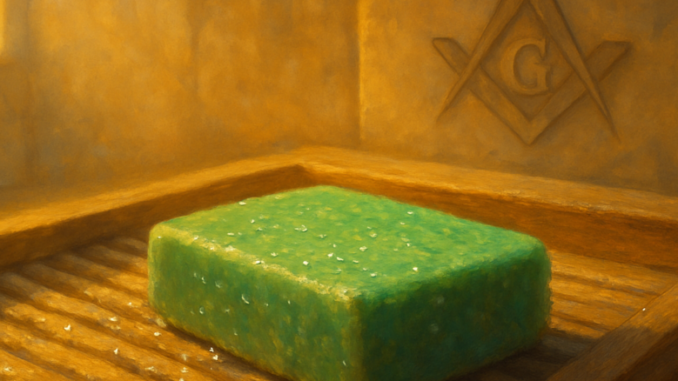
Tucked away in the cupboard beneath the kitchen sink sits an unassuming block. Yellowish-green, greasy to the touch, carrying a scent that calls to mind washdays at your grandmother’s house. Green soap. A product so ordinary that we scarcely give it a second thought. And yet, hidden within this simple cleansing agent lies a wealth of symbolism that teaches us about purification, transformation, and the daily labor we must perform upon ourselves.
An Ancient Craft
Green soap has a history stretching back well before the Industrial Revolution. In the Low Countries, it was made from vegetable oils and ash — a process that demanded patience and craftsmanship. Soap makers formed their own guilds, with their own rules, their own trade secrets, and their own hierarchy from apprentice to master. They understood that purification is never accidental; it is the result of careful labor and deep knowledge of one’s materials.
In this respect, the soap maker’s craft bears striking parallels with other building traditions. Just as the stonemason works the rough ashlar, the soap maker transformed raw ingredients into something that cleanses and restores. The process itself — the slow saponification in which oil and lye become something entirely new — speaks powerfully to anyone who recognizes transformation as a central theme of life.
The Green That Isn’t a Color
Why is this soap called “green” in the first place? Its actual color is more yellow than anything truly green, yet the name has persisted through the centuries. The green does not refer to what the eye sees, but to what the mind understands. Green has always stood for growth, for the living, for that which germinates and develops. In the alchemical tradition, green represents the first phase of new life — the moment when something appears dead but is, in reality, in the process of being reborn.
Purity is not a state — it is a movement. Whoever stops cleansing begins to soil.
The soap thus carries a promise in its very name. It does not merely cleanse the outer surface; it points toward a deeper process of renewal. Its green is the green of hope, of a fresh start that becomes possible only when the old is washed away.
Cleansing as Ritual
In virtually every spiritual tradition, purification plays a central role. Water and soap are not mere practical tools; they mark a transition from the profane to the sacred. The washing before prayer, the ritual bath, the ceremonial cleansing of hands at significant moments — again and again we see how a physical act points toward an inner purification.
Freemasonry knows this principle well. The preparation of the candidate, the care of the working tools, the conscious attention paid to one’s own person — these are all moments where an outward gesture carries an inward intention. The block of green soap by the kitchen sink thus becomes a daily reminder of this principle. Every time we wash our hands, we can ask ourselves: what am I truly trying to cleanse? What stains do I carry that are invisible to the eye?
The Rough Ashlar and the Soap Block
There is a compelling parallel between the block of green soap and the rough ashlar that stands so central in Freemasonry. Both are unworked material filled with potential. Both require labor before they can fulfill their purpose. And both wear down through use — growing smaller as they do their work.
The rough ashlar is hewn until it fits within the larger structure. The soap block slowly dissolves as it cleanses. Both gradually disappear in service to something greater than themselves.
This may be the deepest lesson green soap has to offer: true purification costs something. It demands that we invest ourselves, that we wear down, that we become less so that something else may become cleaner. It is a lesson in selfless service hidden within the most commonplace of objects.
The Scent of Labor
Anyone who has ever worked with green soap knows the smell. It is not perfume, not seduction, but the honest scent of labor and result. This fragrance reminds us that purity need not be glamorous. The most beautiful temples were built with sweating hands; the purest thoughts emerge only after painstaking deliberation.
In an age when everything must be quick and fragrant, when superficial air fresheners mask the real state of affairs, green soap is something of a rebel. It does what it promises, without embellishment, without pretense. And perhaps that is precisely what we need in our inner work: less perfume, more soap. Less outward appearance, more genuine purity.
A Daily Reflection
How do we make all of this practical? It begins with awareness. The next time you wash your hands, pause for a moment. Feel the water, notice the soap, and ask yourself what you would like to cleanse today. Perhaps it is a prejudice you have been harboring. Perhaps a grudge that has lingered far too long. Perhaps simply the mental clutter of an overly busy day.
Green soap asks nothing extraordinary of us — only that we use it. It reminds us that purification is not a one-time event but a daily ritual. That each day we may begin again, wash our hands anew, and with clean fingers continue building what matters most to us.
Within that unassuming block of green soap beneath the kitchen sink lies an entire world of symbolism. It speaks of craftsmanship and transformation, of growth and hope, of cleansing as a daily ritual, and of selfless labor that gives itself away in service. Perhaps that is the ultimate wisdom it offers: that ordinary life is full of hidden meaning, waiting for those willing to look. And that purity does not begin with grand gestures, but with the simple act of washing one’s hands and starting again.
Copyright text & image: devrijmetselaar.nl
Texts are based on the ideas and content of the author of devrijmetselaar.nl, reviewed, corrected, and supplemented with the assistance of OpenAI. Images are created based on the ideas of the author of devrijmetselaar.nl using OpenAI/DALL-E.
Frequently Asked Questions
What is the symbolic meaning of green soap in Freemasonry?
Green soap represents purification and inner transformation, with its color symbolizing growth and renewal rather than literal greenness. In Masonic practice, the physical act of cleansing with soap mirrors the spiritual work of self-improvement and the removal of our inner impurities. The soap serves as a daily reminder that purification is an ongoing process requiring conscious effort and intention.
How does the soap maker's craft relate to Freemasonry?
Both the soap maker and the Freemason work through careful knowledge, skill, and patience to transform raw materials into something refined and useful. Like stonemasons working rough ashlar into finished stone, soap makers understood that meaningful creation requires dedication, proper technique, and respect for one's craft. This parallel demonstrates that Freemasonry's emphasis on self-improvement through labor mirrors the methodical transformation found in traditional guilds and trades.
Is purification a one-time event in Masonic teaching?
No—Freemasonry teaches that purification is an ongoing practice, not a final destination. Just as one must wash regularly to maintain cleanliness, a Mason must continuously work on self-improvement and moral refinement throughout life. This principle reminds us that spiritual growth requires consistent, daily attention and recommitment to our higher principles.
How can I apply the lesson of green soap to my daily life?
You can use ordinary moments of washing your hands as opportunities for reflection on your inner work—asking yourself what habits, attitudes, or influences you wish to cleanse from your life. By bringing conscious intention to this simple ritual, you transform a mundane task into a meaningful practice that aligns your daily actions with your spiritual aspirations. This demonstrates how Freemasonry integrates profound teachings into the simplest moments of our existence.




Be the first to comment