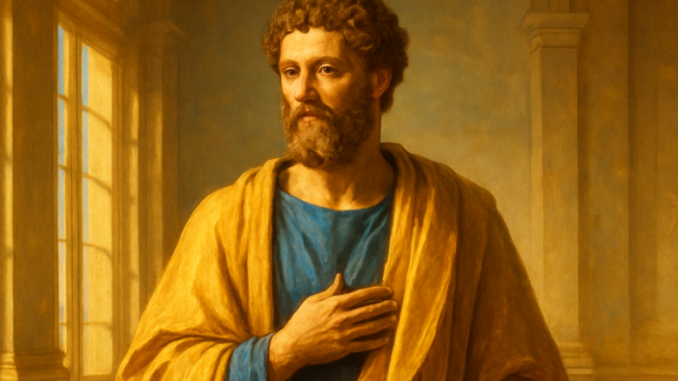
In the year 170 AD, somewhere along the northern frontier of the Roman Empire, an emperor wrote words that still resonate almost two millennia later. Marcus Aurelius — the philosopher on the throne — was not keeping a diary for posterity. He was writing for himself, as an exercise in self-discipline and wisdom. Book III of his Meditations offers a profound exploration of what it means to live well according to the laws of nature. This text provides not only a window into the mind of a Stoic emperor, but also a mirror for anyone searching for meaning and inner peace.
The Historical Context of Book III
Marcus Aurelius composed his Meditations during one of the most turbulent periods of his reign. The Marcomannic Wars raged along the empire’s borders, plague devastated the population, and the emperor found himself far from Rome, stationed at the Danube frontier. It was precisely amid this chaos and uncertainty that Book III came into being — a collection of reflections on the transience of life and the urgency of living each moment with full awareness.
The Meditations were originally titled Ta eis heauton, which translates literally as “to himself.” This deeply personal character is what gives the text its power. Here we find not a preacher addressing a crowd, but a man speaking to his own conscience.
The Core Idea: Living According to Nature
The central theme of Book III is the understanding of “the good” as that which is in harmony with nature. In this, Marcus Aurelius followed the Stoic tradition established by Zeno of Citium, Cleanthes, and Chrysippus. For the Stoics, nature was not merely the physical universe — it was a rational ordering principle pervading all things. To live well meant acting in harmony with this cosmic order, using reason as your guide, and accepting external circumstances as part of a greater whole.
Throughout Book III, Marcus Aurelius repeatedly emphasizes that true freedom does not lie in controlling the external world, but in mastering your own thoughts and reactions. The good life does not depend on what happens to you, but on how you inwardly respond to what nature brings your way.
Impermanence as a Teacher
One of the most striking elements in Book III is the continuous reflection on death and impermanence. Marcus Aurelius explicitly names the great figures of the past — Alexander the Great, Pompey, Julius Caesar. Where are they now? Their fame, their conquests, their worries — all swept away in the current of time.
These meditations on death are far from morbid. They serve as a practical tool. By remaining aware of life’s finitude, you learn to distinguish between what truly matters and what is merely illusion. The emperor reminds himself that he could die at any moment, and that this very awareness should spur him to live well now — not tomorrow.
The Inner Sanctuary
One of the most compelling images in Book III is that of the inner citadel — the sanctuary of the mind. Marcus Aurelius describes how a person can withdraw into themselves at any moment to find calm and clarity. This inner refuge is invulnerable to external circumstances. No enemy, no illness, no misfortune can breach this sanctuary unless you yourself allow it.
This image has inspired thinkers across the centuries, from Boethius writing in his prison cell to Montaigne reflecting on solitude. It is a universal theme that retains immense practical value for anyone struggling with stress, pressure, or uncertainty today. For those who walk a path of self-improvement and moral development, the concept of an inviolable inner space where reason and virtue reign is especially meaningful.
Duty Toward the Community
While much attention in Book III is devoted to inner freedom, Marcus Aurelius also emphasizes the social dimension of the good life. According to Stoic philosophy, human beings are inherently social creatures, made to live and work together. The pursuit of personal virtue cannot be separated from one’s responsibility toward others.
True wisdom, the emperor argues, reveals itself precisely in how you treat your fellow human beings — even those who oppose or insult you. He urges himself toward patience, gentleness, and understanding. This ethic of brotherhood and mutual responsibility resonates powerfully with the values upheld in many traditions of moral cultivation, where the bond between individuals and their commitment to each other’s growth forms the very foundation of a meaningful life.
Key Images and Metaphors
Marcus Aurelius makes frequent use of vivid metaphors throughout Book III to drive his points home. He compares life to a stage play in which you must perform your role to the best of your ability, regardless of how long the play may last. He speaks of the river of time that carries everything along, the brief flame of human existence, and the immensity of the universe in which our worries are mere ripples.
These images are not mere rhetorical flourishes. They function as meditation exercises, designed to help the reader step back from daily concerns and gain a broader perspective:
The actor on the stage: Fulfill your duty in whatever role you have been given.
The river of time: Everything flows past; nothing is permanent.
The inner sanctuary: Your mind as an inviolable space of peace.
The brief flame: Life is short — make it count.
Universal Relevance
What makes Book III so remarkable is the universal applicability of its insights. Marcus Aurelius wrote for himself, yet his words speak to anyone grappling with the question of how to live amid uncertainty and adversity. The Stoic emphasis on inner freedom, virtue, and a sense of community offers a timeless compass.
Whether you are leading an empire or managing your own household, the principles remain the same: act with integrity, accept what you cannot change, and direct your energy toward what lies within your power. These are not abstract philosophical ideals — they are eminently practical guidelines for daily life, as relevant in our age of distraction and rapid change as they were on the banks of the Danube nearly two thousand years ago.
Book III of the Meditations of Marcus Aurelius is far more than a historical document — it is a living text that invites genuine self-reflection. Its lessons on impermanence, inner freedom, duty, and living according to nature offer a profound framework for anyone committed to moral growth and the examined life. In a world that constantly pulls our attention outward, Marcus Aurelius gently but firmly reminds us that the most important work always begins within.
Copyright text & image: devrijmetselaar.nl
Texts are based on the ideas and content of the author of devrijmetselaar.nl, reviewed, corrected, and supplemented with the assistance of OpenAI. Images are created based on the ideas of the author of devrijmetselaar.nl using OpenAI/DALL-E.
Frequently Asked Questions
What is the historical context of Marcus Aurelius' Book III of Meditations?
Marcus Aurelius wrote Book III during the Marcomannic Wars along the Roman Empire's northern frontier around 170 AD, while stationed at the Danube. The empire was facing significant turmoil including warfare, plague, and social upheaval. Despite these challenging circumstances, the emperor composed deeply personal reflections on life, wisdom, and self-discipline, not intended for public audience but written for his own moral development.
What does Marcus Aurelius mean by 'living according to nature' in Book III?
According to Stoic philosophy that Marcus Aurelius followed, living according to nature means acting in harmony with a rational ordering principle that governs the universe. True goodness is found by using reason as a guide and accepting external circumstances as part of a greater cosmic order. The good life depends not on controlling external events, but on mastering one's own thoughts and reactions to what happens.
Why does Marcus Aurelius focus on death and impermanence in Book III?
Marcus Aurelius uses reflections on death and impermanence as a teaching tool to emphasize the transience of life and the importance of living each moment with full awareness. By naming great historical figures like Alexander the Great, Pompey, and Julius Caesar and noting how their fame and conquests were swept away by time, he illustrates that worldly concerns are temporary and encourages readers to focus on inner virtue rather than external achievements.

Be the first to comment