In Dan Brown’s thriller The Lost Symbol, a mysterious building in Washington, D.C. takes center stage: the so-called Temple of Washington. As protagonist Robert Langdon unravels secrets allegedly hidden within the architecture of the American capital, readers are left wondering — how much of what Brown writes is actually true? And where does the fiction begin? In this fact-check, we explore the real history behind the building, its Masonic connections, and the symbolic claims made in the novel.
The House of the Temple: A Very Real Building
Let’s start with the most concrete fact: the building Dan Brown calls the Temple of Washington in The Lost Symbol actually exists. Located at 1733 16th Street NW in Washington, D.C., it is officially known as the House of the Temple. This imposing structure has served since 1915 as the headquarters of the Supreme Council of the Scottish Rite, Southern Jurisdiction — one of the oldest Masonic organizations in the United States.
Architect John Russell Pope designed the building in a neoclassical style, drawing inspiration from the Mausoleum at Halicarnassus, one of the Seven Wonders of the Ancient World. This is well documented and confirmed by architectural historians. The building features thirteen columns on each side, a deliberate reference to the original thirteen American states. This, too, is a matter of public record and not an invention of the novelist.
The Sphinxes and Their Symbolic Meaning
Two large sphinxes guard the entrance of the House of the Temple. Dan Brown describes them in The Lost Symbol as bearers of deep mystical significance. This is partially accurate: the sphinxes do exist and, according to Masonic tradition, represent the duality of wisdom and power — often referred to as “Power” and “Wisdom.” They were sculpted by Adolph Weinman and installed in 1915.
What Brown adds to this symbolism, however — the suggestion that the sphinxes guard the entrance to secret underground chambers containing lost knowledge — cannot be verified. There is no historical or archaeological evidence of hidden rooms beneath the building containing such treasures. The building does have basement levels, but these are used for archives and administrative purposes, nothing more.
The Temple Room and Its Ritual Use
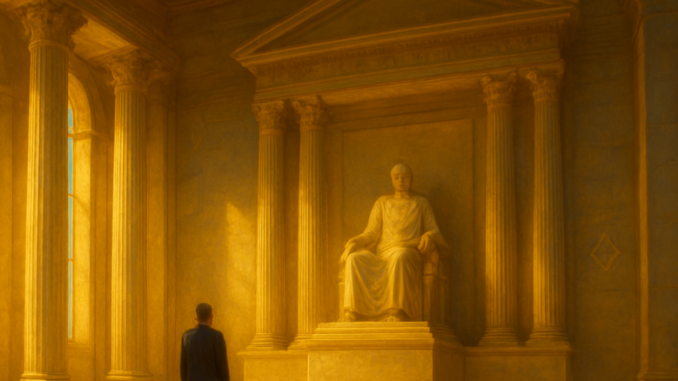
The central Temple Room, where some of the most dramatic scenes in The Lost Symbol unfold, is also a real space. This hall is used for ceremonies of the 33rd Degree, the highest degree within the Scottish Rite. Its interior does indeed contain symbolic elements such as an altar, constellations painted on the ceiling, and a throne for the Sovereign Grand Commander. These details are publicly accessible — the House of the Temple offers guided tours to visitors.
The House of the Temple is not a secret society lurking in the shadows. It is an architectural monument that opens its doors to the public.
What Brown suggests in his novel about bloody initiation rites and occult practices taking place in this hall finds no support whatsoever in historical sources. Masonic rituals are symbolic ceremonies focused on moral development, not esoteric secrets or magical practices. Albert Pike, whose name features prominently in The Lost Symbol, wrote extensively about this in his 1871 work Morals and Dogma, where he emphasizes that the rituals are allegorical in nature.
George Washington and Freemasonry
In The Lost Symbol, Dan Brown suggests that George Washington played a central role in embedding Masonic symbolism throughout Washington, D.C. This is partially true. George Washington was indeed a Freemason — he was initiated into the Fredericksburg Lodge in Virginia in 1752. In 1793, as President, he laid the cornerstone of the U.S. Capitol while wearing Masonic regalia. This is thoroughly documented and confirmed by the Library of Congress.
However, the claim that Washington personally devised a hidden plan to encode secret knowledge into the city’s architecture is purely speculative. The designer of Washington’s street plan was Pierre Charles L’Enfant, who did collaborate with Freemasons but whose own membership in the fraternity has never been proven. The geometric patterns in the city’s layout, which some interpret as Masonic symbols, can just as easily be explained by the influence of Baroque urban planning traditions common in 18th-century Europe.
What Is True and What Remains Fiction
In summary, Dan Brown uses a real building with genuine symbolic elements as a backdrop in The Lost Symbol, but layers onto it a degree of mystery that is not supported by the facts. The House of the Temple exists, the sphinxes stand at its entrance, and Scottish Rite ceremonies take place within its walls. But hidden chambers containing lost wisdom, secret founding documents, and occult practices belong firmly to the realm of imagination.
Fact: The House of the Temple has been the headquarters of the Scottish Rite since 1915.
Fact: George Washington was a Freemason and laid the cornerstone of the U.S. Capitol.
Exaggeration: The geometric symbolism of Washington, D.C. was a deliberate Masonic master plan.
Fiction: Hidden chambers beneath the building containing lost ancient knowledge.
For anyone fascinated by the symbolism behind architecture, the real story of the House of the Temple offers more than enough food for thought. The power of symbols lies not in their secrecy, but in their ability to connect people with timeless ideals of brotherhood, wisdom, and moral growth.
The Lost Symbol has introduced millions of readers to Freemasonry and its rich symbolism. That is a valuable contribution — as long as we continue to distinguish between literary suspense and historical reality. The House of the Temple is open to visitors who wish to discover for themselves what lies behind those imposing doors. Not hidden treasures or ancient conspiracies, but a living tradition devoted to the betterment of humankind.
Copyright text & image: devrijmetselaar.nl
Texts are based on the ideas and content of the author of devrijmetselaar.nl, reviewed, corrected, and supplemented with the assistance of OpenAI. Images are created based on the ideas of the author of devrijmetselaar.nl using OpenAI/DALL-E.
Frequently Asked Questions
Is the House of the Temple in The Lost Symbol a real building?
Yes, the House of the Temple is a real building located at 1733 16th Street NW in Washington, D.C. It has served as the headquarters of the Supreme Council of the Scottish Rite, Southern Jurisdiction since 1915. Architect John Russell Pope designed it in neoclassical style, inspired by the Mausoleum at Halicarnassus, and it features thirteen columns on each side representing the original thirteen American states.
What do the sphinxes at the House of the Temple actually represent?
The two sphinxes guarding the entrance were sculpted by Adolph Weinman and installed in 1915. According to Masonic tradition, they represent the duality of wisdom and power. However, Dan Brown's fictional claim that they guard secret underground chambers containing lost knowledge cannot be verified and has no historical or archaeological evidence supporting it.
Is the Temple Room in the House of the Temple used for secret rituals?
The Temple Room is a real space within the House of the Temple that is used for ceremonies of the 33rd Degree, the highest degree within the Scottish Rite. However, the dramatic secret revelations depicted in The Lost Symbol are fictional additions by Dan Brown. The building's basement levels are used for archives and administrative purposes, not for hiding ancient secrets or treasures.

Be the first to comment