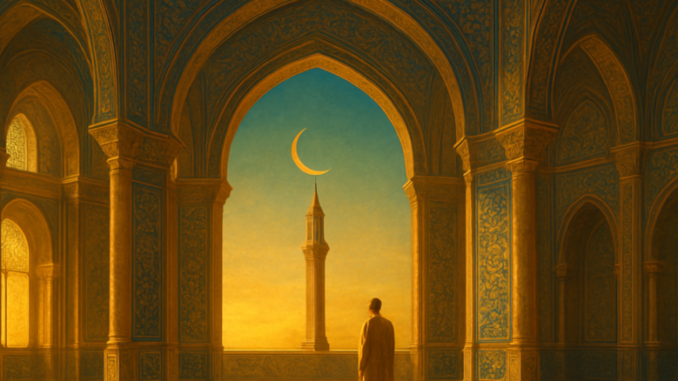
What does it mean when a sacred text describes itself as ‘clearly expounded’? Surah Fussilat, the forty-first chapter of the Quran, carries its name for a profound reason. The word refers to something that has been made clear, unfolded, and rendered accessible to those who truly wish to understand. This idea touches on a fundamental question that also lies at the heart of Freemasonry: how do we unveil the hidden truth concealed within ourselves and within the world around us?
Why Is This Surah Called ‘Clearly Expounded’?
The name Fussilat derives from an Arabic verb meaning ‘to explain in detail’ or ‘to clearly distinguish.’ The opening verses speak of a book whose signs have been expounded — an Arabic proclamation for a people who truly listen. Here we already find a striking parallel with Masonic thought: truth is not automatically accessible. It demands unfolding, and a willingness to listen beyond the superficial.
The text invites the reader to look beyond the obvious. Just as a Freemason does not regard the rough stone as a finished product, but rather as raw material for refinement, Fussilat presents revelation as something that must be understood step by step. It is a spiritual pedagogy that requires patience and introspection.
What Does Creation Tell Us About Ourselves?
A remarkable passage in Fussilat describes the creation of the heavens and the earth in six periods. The text points to signs in nature, on the horizon, and within ourselves. This dual gaze — outward and inward — is precisely what Freemasonry advocates. The cosmos is a teacher, but the true edifice resides in the human heart.
The truth that is being expounded is not merely knowledge about the world; it is a mirror that reveals our own inner landscape. The surah reminds us that we must not remain passive when observing the world. There is a responsibility embedded in seeing. In Masonic terms: the light that reaches us demands a response. We are not mere receivers — we are co-builders of a moral universe.
How Does Listening Relate to True Insight?
Fussilat contains a penetrating warning against those who close their ears and harden their hearts. It speaks of a veil between the proclaimer and those who refuse to hear. This image raises a compelling question: what prevents us from truly listening? Freemasonry poses similar questions within its rituals. The candidate entering the temple is asked to let go of prejudices and to become receptive to what will unfold before them.
This is not merely about intellectual knowledge. The surah suggests that genuine hearing is an act of the entire being — a surrender that encompasses both mind and heart. The philosopher Baruch de Spinoza wrote centuries later about the distinction between rational understanding and intuitive insight. Fussilat appears to point toward a similar tension: knowledge that has not been lived through remains superficial.
What Does It Mean to Answer Evil with Something Better?
One of the most frequently cited verses from Fussilat states that good and evil are not equal, and that one should repel evil with something better. The result, the text asserts, is that an enemy may become a close friend. This verse goes to the very heart of brotherhood as Freemasons pursue it — not by avoiding conflicts, but by transforming them.
The call is far from naive. The verse acknowledges that this capacity ‘is only granted to those who exercise patience.’ Moral growth is labor, not an automatism. The comparison with Masonic work is unmistakable: refining the rough stone demands perseverance and the willingness to begin again each time the chisel slips.
Why Does the Unfolding Remain Unfinished?
Fussilat does not end with a definitive conclusion. The surah points forward, toward future signs that will yet be revealed. This open ending reflects a deeper spiritual truth: the unveiling is never complete. The Freemason who believes there is nothing left to learn has already departed from the path. The search for light is, by definition, infinite.
In the Islamic tradition, this is understood as an invitation to lifelong reflection. The same holds true for Freemasonry: the temple we build is never completed in this lifetime. It is the building itself that gives meaning, not the finished result.
Connecting Themes Between Fussilat and Freemasonry
When we step back and consider the surah as a whole alongside Masonic philosophy, several connecting threads emerge with remarkable clarity:
Light as a metaphor for knowledge and moral clarity. Both traditions use light as a central symbol for understanding and ethical awakening. In Fussilat, the expounding of truth brings illumination; in Freemasonry, the candidate journeys from darkness toward light.
The inner journey as a prerequisite for outer change. Fussilat insists that the signs within ourselves are as important as those on the horizon. Freemasonry teaches that the refinement of the self is the foundation upon which all meaningful external work is built.
Patience and perseverance as spiritual virtues. The surah explicitly connects moral transformation with patience. Masonic ritual and practice similarly emphasize that the work of self-improvement is gradual, demanding sustained effort over a lifetime.
Transforming opposition into brotherhood. The powerful verse about repelling evil with something better resonates deeply with the Masonic ideal of meeting adversity with grace, and finding common ground even in the midst of disagreement.
The unfinished search as a way of life. Perhaps most profoundly, both Fussilat and Freemasonry embrace the idea that the quest for truth never reaches a final destination. The journey itself — the continual asking, seeking, and building — is where meaning resides.
Surah Fussilat reminds us that truth is not simply given — it is expounded, unfolded for those willing to listen. For the Freemason, this text offers deeply recognizable resonance: the building of the inner temple, the transformation of conflict into connection, and the endless search for light. Perhaps the most profound lesson is that the unfolding itself is the journey. Not the answer, but the continued willingness to ask.
Copyright text & image: devrijmetselaar.nl
Texts are based on the ideas and content of the author of devrijmetselaar.nl, reviewed, corrected, and supplemented with the assistance of OpenAI. Images are created based on the ideas of the author of devrijmetselaar.nl using OpenAI/DALL-E.

Be the first to comment