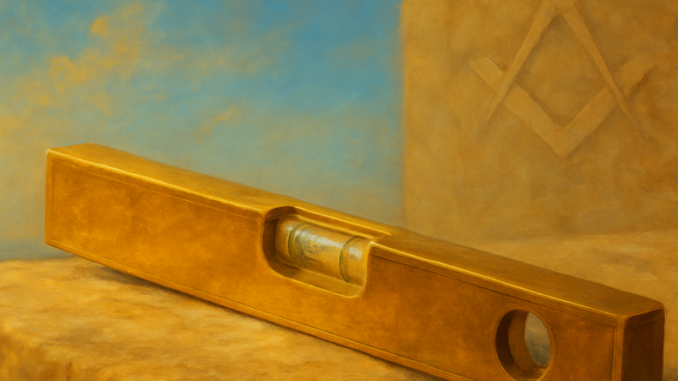
When someone is suddenly struck by the loss of hearing or balance, it shakes the very foundation of daily life. Recent news about a well-known television personality being sidelined by an inner ear disorder raises a deeper question: what does it truly mean to be in balance? And what does the moment we lose that balance reveal about who we really are? From a Masonic perspective, equilibrium is far more than a physical condition — it is a symbolic cornerstone for the development of character and personality.
The Level as a Mirror of the Self
In Freemasonry, the level is one of the most essential working tools. This simple instrument, which indicates the horizontal plane, points toward the necessity of equality and balance in human conduct. But the level is more than a moral compass for how we treat others. It also directs our gaze inward, toward the equilibrium each person must cultivate within themselves. When physical balance suddenly fails — as with disorders of the inner ear — the fragility of that inner stability becomes painfully visible.
Aristotle wrote about the golden mean as the ideal for a virtuous life. Not the extreme, but the middle path leads to good character. This philosophical principle resonates deeply with what the level symbolizes: a continual search for balance, not as a final destination, but as an ongoing process. When that balance is disrupted — through illness, loss, or adversity — we are compelled to recalibrate who we are.
What Imbalance Reveals About Character
There is a remarkable paradox in the human experience: we come to know ourselves best in moments of disruption. Seneca, the Stoic philosopher, argued that adversity does not break character — it simply makes visible what was already there. A period of enforced rest, such as that imposed on those dealing with balance disorders, can serve as an unexpected mirror. Without the usual distractions of work and social obligations, a fundamental question surfaces: who am I when I can no longer function as I normally do?
True personality reveals itself not in maintaining equilibrium, but in the way we respond when that equilibrium falls away.
In Freemasonry, personality is understood as a rough stone — an ashlar — that must be continually shaped and refined. This is not a one-time task but a lifelong endeavor. Moments of imbalance, however unwelcome, offer the opportunity to look at that rough stone anew. Which edges are still sharp? Which surfaces call for further refinement? Forced stillness, as painful as it may be, can become a period of profound inner growth.
The Ear as a Gateway to the World
Hearing is one of our most intimate senses. Through the ear, we receive not only sounds but also the words of others, the music that moves us, and the silence that invites introspection. In Masonic ritual, the spoken word plays a central role. Obligations are given orally, and instruction is passed from mouth to ear. This principle — the oral character of the tradition — underscores the importance of listening as an active, deliberate act.
Ludwig van Beethoven, himself a Freemason and composer of monumental works, gradually lost his hearing. Yet he continued to create music. His deafness forced him to listen differently — to the inner sound, to the music that already lived within him before it ever reached the outside world. His example illustrates how the loss of a sense can sometimes lead to a deeper connection with the inner self.
The Forgotten Art of Waiting
In our fast-paced world, waiting has become almost a forgotten art. Yet patience is one of the cardinal virtues cultivated within Freemasonry. The Entered Apprentice begins at the bottom and ascends only step by step through the degrees. This process cannot be rushed. It requires surrender to time and trust that growth has its own rhythm.
When someone is struck by a condition that demands rest and patience, this virtue is tested in the most personal way. The temptation is to force a return, to push back toward the old routine too quickly. But perhaps the waiting itself holds a lesson. Marcus Aurelius wrote in his personal meditations that we should not wish for a different fate, but learn to carry our present one with wisdom. Circumstances change, but how we respond to them defines who we become.
Balance as Perpetual Motion
Perhaps the most important lesson that moments of imbalance teach us is that equilibrium is never a static state. A tightrope walker does not maintain balance by standing still, but by making constant small corrections. The same is true of personality: it is not a finished product but a dynamic interplay of adjustments, reflections, and choices.
Consider these principles that Masonic philosophy illuminates through the experience of imbalance:
Equilibrium demands ongoing attention, not a one-time effort. Setbacks reveal aspects of ourselves that would otherwise remain hidden. Patience and acceptance are the keys to inner growth. The work of shaping the rough stone is a lifelong calling.
The Freemason sees in every working tool a symbolic guide for living. The level reminds us that balance is not a final destination but a direction. And when that direction is temporarily disrupted, it offers the chance to dig deeper into the question of who we truly are.
The story of someone forced to step away from work due to balance problems touches on something universal. We all know moments when the ground beneath our feet gives way — literally or figuratively. It is precisely in those moments that personality is forged and tested. Freemasonry offers no quick fixes, but it does offer a perspective: see disruption as an invitation to go deeper, and stillness as an opportunity for reflection. Because in the end, it is not the balance we achieve that defines us, but the way we navigate the imbalance.
Copyright text & image: devrijmetselaar.nl
Texts are based on the ideas and content of the author of devrijmetselaar.nl, reviewed, corrected, and supplemented with the assistance of OpenAI. Images are created based on the ideas of the author of devrijmetselaar.nl using OpenAI/DALL-E.

Be the first to comment