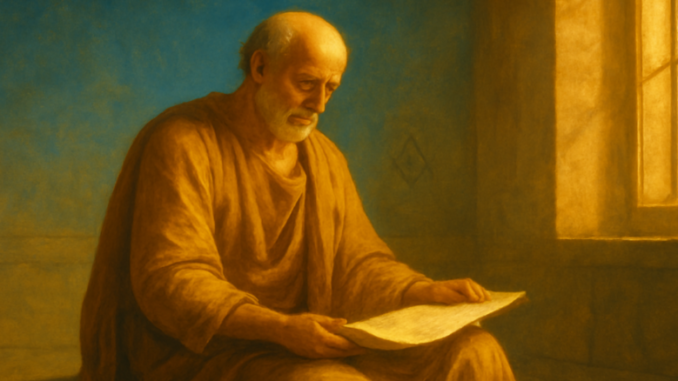
There are moments when life confronts us with an emptiness that no words can fill. An empty chair at the table, a voice that no longer speaks, a hand we can no longer hold. In his sixty-third letter to his student Lucilius, the Roman philosopher Lucius Annaeus Seneca addresses precisely this subject: how to face grief and loss. Written nearly two thousand years ago, the letter still speaks to us because the sorrow of losing someone we love is timeless. The Stoic philosopher offers no easy comfort — instead, he invites us into a deeper reflection on the nature of human connection and the proper measure of mourning.
The Heart of Letter LXIII
Seneca writes this letter in response to the death of Flaccus, a mutual friend he shared with Lucilius. He acknowledges that Lucilius is grieving, but gently asks whether the intensity of his sorrow is proportionate to what is fitting. This is not a cold question — it is an invitation to self-reflection. The philosopher fully recognizes the value of tears and the right to mourn. At the same time, he warns against the danger of excessive or contrived grief, which he argues neither honors the dead nor serves the living.
The central theme of the letter is the search for balance. Seneca does not advocate for emotional numbness — far from it. He describes how he himself grieved for friends and how deeply that pain cut. But he draws a clear distinction between natural sorrow and sorrow that is prolonged or even performed for the sake of appearance. The question he puts before Lucilius is a piercing one: Are you mourning the one who has died, or are you mourning yourself? This distinction forms the philosophical backbone of the entire letter.
The Tear as Symbol
When we read Seneca’s letter through a symbolic lens, the tear becomes more than a physiological reaction. It becomes a single drop in which the essence of a relationship is condensed — everything shared, everything left unspoken, every future moment that will never come to pass. Seneca understands this. He writes that tears may flow, provided they come from within and are not forced by convention or the expectations of others. The genuine tear is a symbol of love; the forced tear is a symbol of vanity.
Grief that springs from love honors the dead; grief that springs from self-pity honors only one’s own sorrow.
This insight resonates deeply with the symbolic traditions that play such an important role in Freemasonry. In the lodge, death is neither denied nor hidden away — it is ritually acknowledged. The skull and crossbones, the moments of silence when departed brethren are remembered — these are not macabre decorations but invitations to contemplation. They remind us that life is finite, and that this very finitude gives meaning to our actions and relationships.
Examples Seneca Draws Upon
Seneca supports his argument with concrete examples drawn from his own life and from Roman society. He refers to people who dress in black for years, not out of genuine sorrow but out of habit or a desire to impress. He also mentions the opposite extreme — those who suppress their tears entirely because they consider mourning a sign of weakness. He rejects both.
One of the most powerful images he offers is that of memory as a source of joy rather than only of pain. He suggests that we can cherish the time we spent with the person who has died, rather than focusing exclusively on what we have lost. This is not shallow optimism — it is a profound revaluation of the relationship. The dead are not entirely gone as long as we carry them in our thoughts with love.
The Proper Measure of Grief
One of the most challenging passages in Letter LXIII concerns the question of how long one may — or should — grieve. Seneca acknowledges that no universal answer exists, but he emphasizes the importance of returning to life. He compares excessive mourning to a wound we keep open by constantly scratching at it. Healing is not promoted by endless dwelling on loss, but by a gradual integration of grief into our continuing existence.
This idea of a “proper measure” will be familiar to anyone acquainted with the symbolism of the square and compasses. These working tools, so central to Freemasonry, represent the ability to set boundaries and maintain proportion — including in emotional matters. Grief without measure loses its meaning; measured grief transforms pain into wisdom. It is not the absence of feeling but the conscious engagement with feeling that elevates the individual.
Loss as a Mirror of Connection
Perhaps the deepest layer of Seneca’s letter is the realization that loss is only possible where genuine connection has existed. Those who have never loved cannot truly grieve. In that sense, sorrow is a confirmation of the value of the relationship. It is not an enemy to be fought, but a companion that reminds us of what truly matters.
For the Freemason, this insight connects naturally with the principle of brotherhood. The bond between brethren is not casual — it creates responsibilities and mutual vulnerability. When a brother passes, the entire chain is affected. The grief that follows is not a personal weakness but a sign of the strength of the fabric that holds the brotherhood together.
What We Can Learn
Letter LXIII is not a manual for banishing grief. It is an invitation to engage more consciously with one of the most universal of human experiences. Seneca teaches us that mourning is deeply human, but that we have a choice in how we meet it. We can allow ourselves to be swept away and lost in endless sorrow, or we can give grief a place that does justice both to the person who has died and to our own ongoing life.
The symbols Seneca weaves between the lines — the tear, the memory, the measure — speak a language that reaches far beyond the first century AD. They invite us to pause, to reflect, and to recognize that the way we grieve says as much about who we are as the way we love. In a world that often rushes past death and discomfort, Seneca’s ancient words remain a quiet, powerful call to live — and to mourn — with intention and integrity.
Seneca’s Letter LXIII remains remarkably relevant for anyone navigating the difficult terrain of loss. Whether read through a Stoic, Masonic, or simply human lens, its message endures: honor your grief, but do not let it consume you. Remember those who have gone with love rather than only with pain. And above all, let the depth of your sorrow be a testament to the depth of your connection — a reminder that to have loved is the greatest privilege of a finite life.
Copyright text & image: devrijmetselaar.nl
Texts are based on the ideas and content of the author of devrijmetselaar.nl, reviewed, corrected, and supplemented with the assistance of OpenAI. Images are created based on the ideas of the author of devrijmetselaar.nl using OpenAI/DALL-E.




Be the first to comment