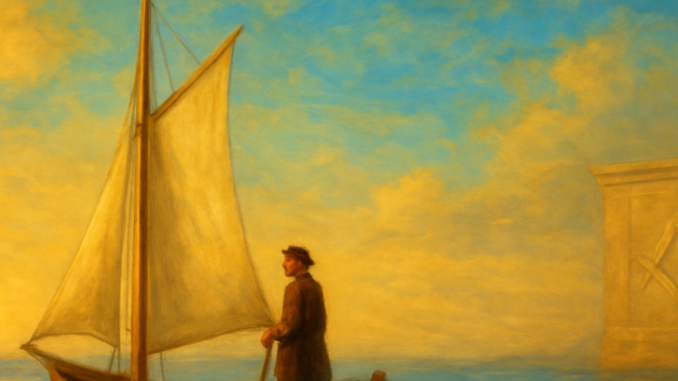
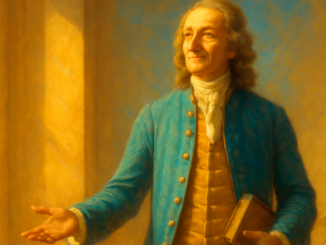
Picture a die rolling across a table. It comes to rest on a number no one could have predicted. Was it chance? Or did this seemingly random moment serve a deeper purpose we can only recognize in hindsight? Michel de Montaigne, the sixteenth-century philosopher who invented the essay as a literary form, posed a daring thesis in his thirty-third essay: fortune often acts in the service of reason. This idea strikes at the very heart of what Freemasons have been exploring in their lodges for centuries.
The Language of Chance
When we talk about chance, we tend to reach for words like “luck” or “misfortune.” But Montaigne invites us to look beyond these surface-level labels. In his essay, he describes how events that appear chaotic at first glance often reveal a logical order when viewed in retrospect. It is as if the universe operates according to its own grammar — one we can only read in fragments.
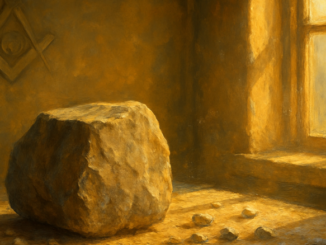
This vision aligns seamlessly with Masonic thought. In the lodge, the Brother learns that the Great Architect of the Universe has a plan, even when the individual building blocks of our lives seem disconnected and incoherent. The rough ashlar is not shaped into a perfect cube by accident. Every seemingly random moment of sorrow or joy, failure or success, contributes to the greater edifice of our character.
Hidden Order Behind the Veil
Montaigne was no naive optimist. He fully acknowledged suffering and the apparent injustice of existence. Yet across the sweep of history — and within his own life experiences — he discerned patterns pointing toward a hidden rationality. An enemy who dies unexpectedly before he can strike. A storm that destroys a fleet but thereby saves a nation from invasion. These examples from his essay do not suggest that fate is just by human standards, but rather that it frequently serves what we can, in hindsight, recognize as reasonable.
Where chance speaks, the wise listen for the voice of reason that echoes through it.
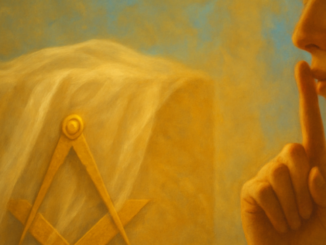
For Freemasons, this idea feels familiar. The ritual work in the lodge is steeped in symbolism that points toward hidden truths. The blindfold worn by the candidate during initiation symbolizes not only ignorance but also the trust that light awaits beyond the darkness. In a similar way, Montaigne invites us to see fate not as an adversary, but as a mysterious ally whose intentions reveal themselves only gradually.
Self-Reflection as the Key to Understanding
One of the core values Montaigne shared with the Masonic tradition is the importance of self-reflection. His essays were experiments in self-examination — attempts to map the winding paths of his own thinking. He did not write to prescribe rules for others but to understand himself. And it was precisely through this process that he discovered connections that would otherwise have remained hidden.
The Freemason knows this process intimately through the silence of the lodge. There, he learns to turn inward, to examine his own motives, and to confront his shortcomings honestly. It is in that inner stillness that the apparent randomness of life begins to speak. Events that were viewed for years as misfortune turn out to be building blocks of wisdom. Encounters that seemed coincidental reveal themselves as crossroads where the course of a life changed decisively.
Brotherhood and Shared Destiny
Montaigne’s philosophy was far from purely individualistic. His celebrated friendship with Étienne de La Boétie demonstrates how deeply he understood the value of human connection. When he writes about fortune acting in the service of reason, he also implies that fate binds us to one another. The chance encounter becomes a lifelong bond. Shared adversity forges a brotherhood stronger than words can express.
This resonates powerfully with the Masonic ideal of brotherhood. In the lodge, men find each other who might never have crossed paths outside the temple walls. A banker sits beside a carpenter, a physician next to an artist. Fate brought them together, and the reason behind that convergence becomes visible in the growth they experience as Brothers. The chain they form is not accidental — it is an expression of a deeper order.
The Search for Truth as a Life’s Work
Montaigne rarely ended his essays with firm conclusions. He understood that truth is not something one possesses but something one pursues. This intellectual humility is a virtue that also stands at the center of Freemasonry. The search for light, for knowledge, for moral perfection is a journey without a final destination. It is the journey itself that holds value, not the arrival.
Consider how these elements work together: Fate provides the circumstances in which we learn. Reason helps us interpret those circumstances. Self-reflection connects fate and reason into personal insight. And brotherhood shares and deepens that insight among those who walk the path together.
Seen in this light, Montaigne’s essay is far more than a philosophical curiosity from a distant past. It is an invitation to approach life the way a Freemason enters the lodge: with openness to the unexpected, with trust in a deeper order, and with the willingness to seek a lesson in every experience. Fate and reason are not opposites. They dance together — and we are invited to move with them.
Michel de Montaigne wrote more than four hundred years ago about the mysterious connection between fate and reason. His insights remain strikingly relevant because they touch on a timeless human experience: the longing to find meaning in the apparent chaos of existence. Freemasons recognize in his words the echo of their own quest. Where others see only chance, the wise look for the hidden thread that binds all things together. And perhaps the greatest secret is not that fate serves reason, but that through self-reflection and brotherhood, we can learn to recognize that service — and find our place within its unfolding design.
Copyright text & image: devrijmetselaar.nl
Texts are based on the ideas and content of the author of devrijmetselaar.nl, reviewed, corrected, and supplemented with the assistance of OpenAI. Images are created based on the ideas of the author of devrijmetselaar.nl using OpenAI/DALL-E.

Be the first to comment