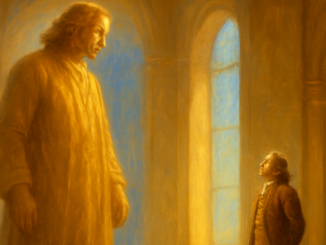
Cosmic perspective and Freemasonry symbols inspired by Voltaire's Micromégas
Symbolism & Rituals

Voltaire’s Micromégas and the Humble Gaze of the Freemason

What if a being eight miles tall, hailing from a star in the constellation of Sirius, looked down upon the Earth and discovered its inhabitants? In 1752, Voltaire wrote a philosophical tale that brings this thought experiment to vivid life. Micromégas is no children’s story — it is a razor-sharp satire on human arrogance. And the question Voltaire implicitly poses is the very same question every Freemason should ask himself: how significant am I really, and what justifies my judgment of others? A Giant Discovers Tiny Creatures Voltaire’s story opens with Micromégas, an inhabitant of a planet orbiting Sirius. He is so immense that our tallest mountains would barely reach his ankles. Accompanied by a companion from Saturn — himself a giant by earthly standards at roughly a thousand meters tall — he embarks on a journey across the cosmos. When the two travelers finally reach our planet, they initially see nothing remarkable. Only through a magnifying glass do they spot ships, and within those ships, minuscule creatures that apparently think, speak, and philosophize. The scene is comic, but the underlying message cuts deep. These microscopically small beings — humans — turn out to be utterly convinced that the universe […]
Voltaire's Micromégas giant observing Earth, symbolizing Masonic humility
Symbolism & Rituals

Voltaire’s Micromégas: Philosophical Roots of Humility

An enormous figure, eight hundred feet tall, descends upon our tiny planet. He leans forward, raises a magnifying glass to his eye, and only after a long search discovers the minuscule creatures who call themselves the crown of creation. This vivid image, which Voltaire crafted in his 1752 tale Micromégas, draws on a philosophical tradition stretching back millennia — one that reminds humanity of its modest place in the universe, and one that carries powerful resonance for Freemasons to this day. The Legacy of Stoicism When Voltaire’s giant travels from the star Sirius to Earth, we immediately recognize the cosmic perspective that the Stoics cultivated two thousand years earlier. In his Meditations, Marcus Aurelius urged the wise person to observe themselves from the vantage point of the stars, a mental exercise through which earthly worries lose their apparent weight. Seneca encouraged his readers to regard the Earth as a dot in the infinite — a practice in intellectual humility that echoes directly through Voltaire’s satirical masterpiece. The Stoic tradition taught that true greatness lies not in physical size or social standing, but in the virtue of the soul. Voltaire translates this principle with playful wit: his colossal visitors from outer […]

Voltaire's Micromégas gazing down at Earth symbolizing Masonic humility
Symbolism & Rituals

Voltaire’s Micromégas and the Masonic Lesson of Humility

In 1752, Voltaire published a remarkably short story that continues to captivate philosophers and readers to this day. Micromégas tells the tale of an enormous being who descends from the stars to visit Earth and encounters humanity. What Voltaire achieved with this seemingly lighthearted adventure was nothing less than a radical reassessment of our human self-image — a philosophical fairy tale that forced his contemporaries to reconsider their assumed greatness. For Freemasons, the story holds a particular resonance: humility and self-knowledge stand at the very heart of the Masonic tradition. A Giant from Sirius Visits Earth The story opens with the introduction of Micromégas, an inhabitant of a planet orbiting the star Sirius. This being stands an astonishing 120,000 feet tall — a height utterly beyond our comprehension. Voltaire describes how Micromégas travels the universe driven by scientific curiosity and philosophical inquiry. Along the way, he meets a resident of Saturn who, at 6,000 feet, is considerably smaller but still gigantic by earthly standards. Together, these two beings journey to our planet. When they reach Earth, they initially see nothing remarkable. The oceans appear as tiny puddles, the mountains as insignificant hillocks. Only after a lengthy search, using a magnifying […]