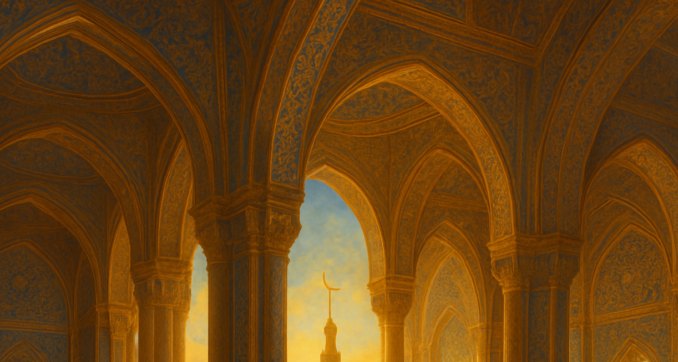
If you have ever stood in total darkness and looked up at the night sky, you know the moment when the first star becomes visible. Not as decoration, but as a point of orientation — a promise that direction exists even when everything around you has disappeared into shadow. In Surah An-Najm, the fifty-third chapter of the Quran, the star carries precisely this meaning: a celestial sign inviting us to look beyond the visible and begin the inner journey toward truth.
The Star as a Concrete and Cosmic Symbol
A star is, first and foremost, a physical phenomenon — a burning sphere of gas, millions of miles away. Yet since the dawn of civilization, humanity has gazed at the stars with a feeling that reaches far beyond astronomical curiosity. The star became a compass for sailors, a calendar for farmers, and a symbol of hope for prisoners. In Freemasonry, the Blazing Star holds a special place as a sign of the divine light present within every human being.
Surah An-Najm opens with an oath sworn by the star as it descends. This opening line immediately places the reader in a state of heightened attention. The descent of the star refers to the moment of revelation — the instant when heavenly knowledge touches earthly reality. For those familiar with the Masonic tradition, this resonates deeply with the central theme of illumination: the receiving of light that comes from beyond, yet can only be understood through inner receptivity.
The Journey to the Boundary of the Knowable
Surah An-Najm describes a remarkable spiritual journey. The Prophet approaches to within two bow-lengths — a mystical nearness to the Divine that expresses both intimacy and distance simultaneously. This paradox touches on a fundamental question that also stands at the heart of Freemasonry: how can a human being approach the transcendent without ever fully grasping it?
Plato wrote about the cave in which people see only shadows of a higher reality. Spinoza spoke of the knowledge of God as the highest good of the human mind. In Islamic mysticism, and specifically in this surah, we find a comparable movement: the acknowledgment that there is a limit to what we can directly perceive, but that this limit is not an endpoint. It is, in fact, an invitation to keep searching.
The star does not only point the way across the heavens — it also points the direction within the human heart.
Personal Responsibility and the Weight of Our Deeds
An-Najm contains a passage that resonates profoundly with Masonic ethics: each person carries only what they themselves have earned. No one can bear another’s burden, and every individual’s effort will ultimately be seen. This principle of personal responsibility forms a cornerstone of both the Quranic message and Masonic teaching.
In the work of the Lodge, a Freemason is continually invited to labor upon himself — to shape the rough ashlar into a perfect ashlar that fits within the greater edifice. This work cannot be outsourced or delegated. Just as An-Najm states that every soul receives only what it has sown, Freemasonry teaches that moral growth is an individual path that no one else can walk for us.
The Capacity to Laugh and to Weep
A striking verse in this surah states that it is God who causes laughter and causes weeping, who causes death and gives life. In this simple enumeration lies a profound recognition of the completeness of human existence. Spirituality from a Masonic perspective encompasses not only the striving toward higher ideals but also the acceptance of the full spectrum of human experience.
The brotherhood of the Lodge offers space for both: joy is shared at festive Table Lodges, and sorrow is borne when a Brother passes to the Eternal East. This wholeness mirrors what An-Najm expresses — that the sacred does not reside solely in the sublime, but also in the tear and in the laugh.
The Blazing Star as a Living Symbol
In Masonic Lodges around the world, the Blazing Star is displayed — often with the letter G at its center. This star refers to Gnosis, to God, to Geometry, depending on the interpretation. But above all, it refers to the light that the seeking individual can receive when they open themselves to it.
Surah An-Najm and Masonic symbolism share this fundamental conviction: that a higher order exists which speaks to the human soul — not through coercion but through beauty, not through burden of proof but through inner recognition. The star in the heavens and the Blazing Star in the Lodge are both invitations to look upward, to lift our heads from the concerns of daily life and ask: where am I pointing my compass?
Looking and Being Seen
There is something deeply humbling in the realization that the same stars we see tonight were also observed by Aristotle in Athens, by Goethe in Weimar, and by nameless Bedouins in the Arabian desert. The star connects generations and cultures in a shared experience of wonder. Surah An-Najm reminds us that we do not merely gaze upon the star — we are also seen. The surah speaks of a return to the Lord, an accounting of what we have done with our lives.
For the Freemason, this is not a thought that inspires fear but rather an invitation to honesty. The question is not posed by an external judge but by one’s own conscience — by the inner mirror that always knows, in silence, what we truly are. The star is therefore not only a guide but also a witness.
Surah An-Najm speaks of revelation, of the boundaries of knowledge, of personal responsibility, and of the completeness of human existence. For those who read with Masonic eyes, a familiar landscape unfolds: the star as a symbol of divine light, the journey toward truth as a lifelong calling, and the recognition that genuine spirituality is never something imposed from without. It is a flame kindled within — a blazing star that illuminates not because someone commands it, but because the seeker has learned to look up and receive the light that was always there.
Copyright text & image: devrijmetselaar.nl
Texts are based on the ideas and content of the author of devrijmetselaar.nl, reviewed, corrected, and supplemented with the assistance of OpenAI. Images are created based on the ideas of the author of devrijmetselaar.nl using OpenAI/DALL-E.


Be the first to comment