
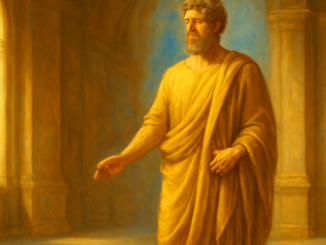
Why do we cling so desperately to what is inevitably passing away? This question runs like a golden thread through Book IV of the Meditations of Marcus Aurelius. The Roman emperor and Stoic philosopher invites us to see the constant flow of existence not as a threat, but as a fundamental truth capable of bringing deep inner peace. In this article, we explore the core ideas of this timeless work and discover how its wisdom on change can still guide us today — particularly those walking the Masonic path.
What Is the Central Message of Book IV?
Marcus Aurelius wrote his Meditations as private reflections, never intended for publication. That very fact gives them a sincerity that few philosophical works can match. In Book IV, everything revolves around one fundamental insight: change is not something that happens to us — it is the very essence of existence itself. Everything flows; nothing remains. The emperor returns to this theme in various ways, as though he needs to convince himself that this truth must not only be understood intellectually but felt in the marrow of one’s bones.
But why should this insight offer comfort rather than despair? Marcus Aurelius answers by pointing to the liberation that comes when we stop fighting the inevitable. Those who accept the constant flow lose their fear of loss. Those who understand that fame is fleeting stop chasing recognition with desperate energy. Those who see that even pain passes can bear suffering with greater serenity.
The Power of Marcus Aurelius’ Examples
The emperor illustrates his thoughts with concrete images that remain striking nearly twenty centuries later. He points to the river as a metaphor for life: the water we see now is not the water of a moment ago, yet we still call it the same river. In the same way, we are not the same person we were yesterday, and yet we experience continuity. This image, which Heraclitus used before him, gains a deeply practical application in Marcus Aurelius’ hands. It reminds us that clinging to a fixed self-image is as futile as trying to hold water in your hands.
Another powerful example concerns the generations that came before us. Marcus Aurelius mentions the court of Emperor Augustus, with all its intrigues, ambitions, and passions. Where are all those people now? Forgotten, dissolved into time. He names philosophers like Heraclitus and Democritus, kings and generals. All have vanished. This is not cynical pessimism but an invitation to gain perspective. If even the most powerful and famous figures fade from memory, why should we torment ourselves over lesser concerns?
How Impermanence Relates to Inner Freedom
Here, Marcus Aurelius touches on a deeper truth that deserves careful consideration. Many people seek security in external circumstances — possessions, position, relationships. But all of these are subject to the constant flow. Anyone who builds their peace of mind on such foundations builds on shifting sand. The Stoic philosopher therefore directs our gaze inward. The only real freedom lies in our attitude toward what happens to us. Events themselves are neutral; it is our judgment that makes them good or bad.
As Marcus Aurelius puts it, change is not the opposite of stability — it is the only true ground upon which inner peace can be built. This thought has influenced thinkers across the centuries. Spinoza would later write about overcoming the passions through understanding. Montaigne, in his celebrated essays, wrestled with similar questions about death and impermanence. It is no coincidence that this wisdom resurfaces time and again among those who seek an authentic art of living.
What Can We Learn from These Reflections Today?
Is it not remarkable that a Roman emperor from the second century still has something meaningful to say to us? The constant flow that Marcus Aurelius describes is something we may experience even more intensely than he did. Our world changes faster, information flows ceaselessly, and the pressure to keep up seems greater than ever. Precisely for these reasons, his message remains profoundly relevant.
Marcus Aurelius encourages us to distinguish between what lies within our power and what does not. We cannot control the external world. But our reaction, our interpretation, our inner attitude — these belong to us. This distinction forms the heart of Stoic ethics and offers a practical tool for anyone struggling with uncertainty or change. It is a form of mental discipline that, once cultivated, transforms how we meet the inevitable upheavals of life.
Why This Resonates So Deeply with Freemasons
Within Freemasonry, the theme of change and transformation plays a central role. The journey from Entered Apprentice to Fellow Craft to Master Mason mirrors an inner process of growth and deepening. Just as the rough ashlar is shaped into a perfect cube, the Freemason works upon himself. This process acknowledges that change is not only inevitable but desirable. Without change, there is no growth; without flow, there is no renewal.
The symbolism of water, which Marcus Aurelius employs so effectively, resonates with the Masonic ideal of purification and refinement. The work within the Lodge invites reflection on impermanence — not to breed discouragement, but to discover what is truly of value. What remains when all externals fall away? Virtue, brotherhood, and truth. These are the unchanging principles that endure amid the constant flow.
Consider the key principles that emerge from this convergence of Stoic philosophy and Masonic thought: change as a natural law rather than a threat; impermanence as a source of perspective and humility; inner freedom as the only genuine certainty; and self-improvement as the answer to the fleeting nature of existence. Each of these ideas finds expression both in Marcus Aurelius’ private journal and in the symbolic language of the Craft.
Book IV of the Meditations of Marcus Aurelius offers no shallow comfort but a profound confrontation with the nature of existence. The constant flow he describes is not something to fear but something to embrace. When we acknowledge that everything passes, we can direct our attention to what truly matters: the quality of our actions, the sincerity of our intentions, and the wisdom we cultivate along the way. For Freemasons and seekers of truth alike, this ancient Stoic teaching remains a powerful companion on the path of self-knowledge and moral growth.
Copyright text & image: devrijmetselaar.nl
Texts are based on the ideas and content of the author of devrijmetselaar.nl, reviewed, corrected, and supplemented with the assistance of OpenAI. Images are created based on the ideas of the author of devrijmetselaar.nl using OpenAI/DALL-E.
Frequently Asked Questions
What is the central message of Marcus Aurelius' Book IV of the Meditations?
The central message of Book IV is that change is not something that happens to us, but the very essence of existence itself. Marcus Aurelius teaches that everything flows and nothing remains constant. He argues that accepting this fundamental truth brings liberation and inner peace, as those who stop fighting the inevitable lose their fear of loss and can bear suffering with greater serenity.
How does Marcus Aurelius use the river metaphor to illustrate his philosophy of change?
Marcus Aurelius uses the river as a metaphor for life, comparing it to the philosophical concept from Heraclitus. Just as the water in a river is constantly changing yet we still call it the same river, we are not the same person we were yesterday, yet we experience continuity. This image teaches that clinging to a fixed self-image is as futile as trying to hold water in your hands, encouraging readers to embrace the constant flow of change.
Why did Marcus Aurelius reflect on past generations and historical figures in Book IV?
Marcus Aurelius reflected on past generations like the court of Emperor Augustus and philosophers such as Heraclitus and Democritus to gain perspective on the transience of human life. By noting that all these powerful figures, despite their ambitions and passions, have been forgotten and dissolved into time, he invites readers to understand that even great achievements and recognition are fleeting, helping them free themselves from desperate pursuit of fame and legacy.


Be the first to comment