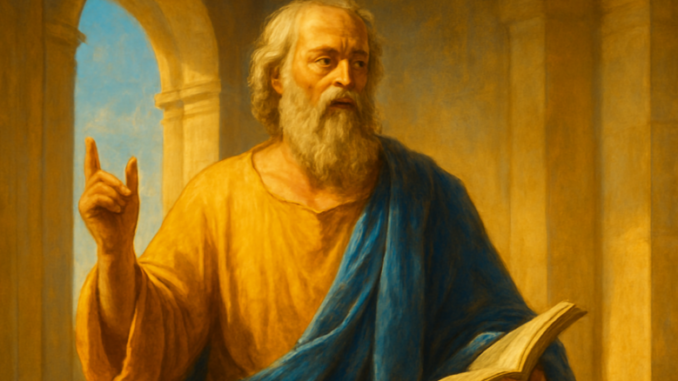
Picture yourself sitting in a lodge, surrounded by brethren from every conceivable background — different professions, beliefs, and life experiences. What holds this community together? Plato asked himself the very same question more than 2,400 years ago when he wrestled with the ideal organization of society. His final and longest dialogue, The Laws, offers surprisingly practical insights that speak directly to lodge life and to every Mason’s personal quest for connection and truth.
Why Structure Makes Freedom Possible
In The Laws, Plato describes a conversation among three elderly men tasked with designing a new colony from scratch. Unlike his more famous work The Republic, this dialogue is not a utopian blueprint. It is a pragmatic exploration of workable agreements among imperfect human beings. Plato acknowledges that people are flawed, and that good laws help them become their better selves. This is exactly what you experience inside a lodge: rituals and rules do not exist to restrict, but to create a space where genuine encounter becomes possible.
Think about your own routine. When you know that every Tuesday evening the lodge meets, you carve out a dedicated place in your life for reflection and brotherhood. Without that structure, conversations about virtue and truth would be drowned out by the noise of everyday life. Plato understood this deeply: freedom without a framework leads to chaos, but a framework without freedom leads to tyranny. The art lies in finding the balance between the two.
Virtue as the Foundation of Connection
A central theme in The Laws is that legislation only works when citizens are virtuous. Plato identifies four cardinal virtues — wisdom, courage, temperance, and justice — and argues that education and community-building are essential to cultivating them. His thinking connects directly to Freemasonry, where the working of the rough ashlar symbolizes the pursuit of moral perfection.
A strong community is never built by enforcing rules alone. It is built by shaping individuals who choose to do good out of inner conviction.
In practice, this means more than simply showing up at lodge meetings. It means actively working on your own character. Ask yourself regularly: “Did I act from wisdom today, or from laziness? Was I just in my dealings with others?” This kind of self-reflection is not an abstract exercise. It is a concrete habit you can practice every single day.
Three Practical Lessons from The Laws
Plato’s dialogue offers tangible principles you can apply immediately. Here are three lessons that resonate powerfully with the Masonic journey:
1. Listen before you judge. Plato emphasizes that good legislation arises from dialogue among equals. In the lodge, this means giving every brother the space to express his thoughts — especially when those thoughts differ from your own. True fraternity requires the discipline of listening.
2. Seek the golden mean. For Plato, temperance is not weakness — it is strength. Apply this by refusing to turn discussions into battles for being right. Instead, strive for shared understanding. The goal is not to win an argument but to arrive together at deeper insight.
3. Connect personal growth to the common good. Plato insists that individual virtue only gains real value when it contributes to the whole. Ask yourself how your own development strengthens the lodge and your wider community. Growth that stays purely private remains incomplete.
The Search for Truth in Community
In The Laws, Plato makes clear that true knowledge does not arise in isolation — it emerges through conversation. The three interlocutors in the dialogue — an Athenian, a Spartan, and a Cretan — represent different traditions and life experiences. It is precisely their diversity that leads them to deeper insights. You will recognize this principle in the lodge, where men of widely varying religious, cultural, and professional backgrounds come together on the level.
The practical application is simple but powerful: actively seek out conversations with brethren who think differently than you do. Not to convince them, but to broaden your own perspective. Plato taught that truth is not a possession anyone can claim. It is a horizon you move toward together.
From the Lodge to Daily Life
It would be a shame to confine the wisdom of The Laws to the lodge floor. Plato intended his ideas for all of society. So how do you put them into practice? Start small. Choose one moment this week to consciously listen to someone you disagree with. Ask follow-up questions. Show genuine curiosity. Resist the urge to respond immediately.
Another concrete step: at the end of each day, reflect on your actions. Not as an act of self-punishment, but as a loving inspection of the work you have done. What went well? Where can you grow tomorrow? This habit — closely related to the evening review that many Freemasons already practice — transforms Plato’s abstract ideals into something tangible and achievable.
Connection Begins with Yourself
Plato reminds us that a just society begins with just individuals. In Freemasonry, we speak of the rough ashlar that must be worked into a perfect cube. This work is not a solitary task. It takes place within the context of brotherhood. You need others to see your blind spots, to inspire you, and to hold you accountable.
The beauty of both Plato’s philosophy and Freemasonry lies in the recognition that growth is a lifelong process. There is no final destination — only a continuing journey toward more light, more knowledge, and deeper connection. The Laws invites you not to postpone this journey, but to begin it today.
Plato’s The Laws is far from a dusty philosophical treatise. It is an invitation to action. The dialogue teaches us that strong communities arise when individuals consciously work on their character, remain open to perspectives unlike their own, and embrace structure as a tool for freedom rather than a constraint upon it. These are precisely the values that Freemasons cultivate in their lodges every time they meet. The question is not whether these insights are still relevant — they clearly are. The real question is whether you are willing to apply them today, in your own life and in your own community.
Copyright text & image: devrijmetselaar.nl
Texts are based on the ideas and content of the author of devrijmetselaar.nl, reviewed, corrected, and supplemented with the assistance of OpenAI. Images are created based on the ideas of the author of devrijmetselaar.nl using OpenAI/DALL-E.



Be the first to comment