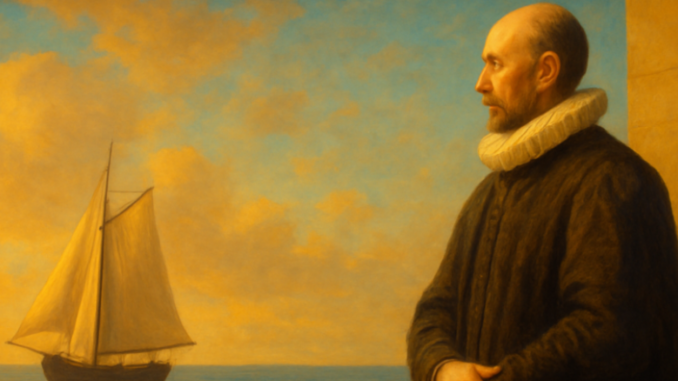
In 1580, Michel de Montaigne penned a brief but penetrating essay on the dangers of imposing one’s will too hastily. His reflections in ‘That Our Will Should Not Be Too Quickly Enforced’ read like an echo of the wisdom Freemasons have practiced in their lodges for centuries. What does a sixteenth-century French philosopher have to teach us about the art of restraint — and why does his message resonate so deeply with the Masonic pursuit of inner growth and brotherhood?
The Historical Context of Montaigne’s Warning
Michel de Montaigne lived in an age of religious warfare and political turmoil. France was being torn apart by conflicts between Catholics and Huguenots, with both sides attempting to force their will through violence. From his tower study in the Dordogne, Montaigne watched how this unbridled assertion of power brought nothing but destruction. His essay did not spring from abstract philosophy — it grew from the concrete observation of human failure.
As mayor of Bordeaux, Montaigne was constantly navigating between opposing interests. He learned that the art of governance did not lie in stubbornly pushing one’s own convictions, but in creating space for dialogue. This practical wisdom formed the core of his essay: whoever forces their will too quickly not only loses the trust of others but also loses touch with themselves.
The Rough Ashlar and the Impatient Heart
In Freemasonry, the rough ashlar is one of the most enduring symbols — an image of the unworked human being who must labour upon themselves. This labour demands time, patience, and continuous self-reflection. Montaigne’s caution against hasty willpower fits seamlessly into this framework. Anyone who tries to shape the stone with crude, heavy blows risks cracks and fractures. The true sculptor understands the value of waiting, observing, and listening to the material.
True connection does not arise from overcoming the will of another, but from creating space in which both may grow.
The parallel between Montaigne’s philosophy and Masonic symbolism is no coincidence. Both traditions draw from the same humanistic wellspring: the understanding that human perfection is a process, not a destination. The Freemason who meets his brethren in the lodge practises exactly what Montaigne describes. He learns to temper his own convictions, to listen before he speaks, and to align his will with the greater whole.
Brotherhood as an Exercise in Restraint
In this light, the concept of brotherhood takes on a deeper meaning. Brotherhood is not simply the sharing of a space or a ritual. It is the daily practice of suspending judgment, acknowledging that the other person walks their own path, and accepting that connection sometimes requires silence. Montaigne described how, in his friendship with Étienne de La Boétie, he learned that true closeness arises from not trying to control everything.
In the Masonic lodge, this principle is practised ritually. The Entered Apprentice learns to remain silent — not out of submission, but as training in receptivity. The Fellow Craft discovers that growing knowledge does not grant the right to dominate others. The Master Mason understands that leadership consists of facilitating another’s development, not imposing one’s own insights. Each of these degrees reflects Montaigne’s lesson: haste destroys what patience builds.
From the Sixteenth Century to Today
What can we — living in an era of social media and instant gratification — learn from this historical wisdom? The temptation to react immediately, to prove ourselves right on the spot, and to amplify our own opinions is greater than ever. Montaigne’s warning sounds like an antidote. He reminds us that human connection flourishes in slowing down, not in speeding up.
Self-reflection requires silence, not reaction. Virtue grows through practice, not persuasion. Brotherhood emerges by giving space, not by claiming it. Truth unfolds gradually to those who seek with patience.
Freemasonry offers a practical framework for exercising these insights. The lodge is a laboratory for patience — a space where the normal urge to dominate is consciously set aside. Here we recognise Montaigne’s ideal: not the absence of will, but the wisdom to temper that will in service of something greater.
The Square as a Measure of the Will
The Masonic symbol of the square can be read as an instrument for measuring one’s own will. Just as the square ensures the right angle, the wise person guards the boundaries of their own impulses. Montaigne would have appreciated this image. Throughout his essays, he constantly searched for tools to limit himself — to correct his natural tendency toward willfulness.
This self-limitation is not weakness; it is strength. It is the ability to recognise that one’s own truth is merely one perspective among many. In the lodge, men of different backgrounds, beliefs, and ages come together. What unites them is not uniformity but a shared pursuit of light. That pursuit demands a willingness to subordinate one’s personal will to the collective search for understanding.
Michel de Montaigne wrote about the art of restraint more than four centuries ago, yet his words remain strikingly relevant. For Freemasons, his essay provides a philosophical foundation for what they ritually practise in the lodge: the discipline to temper the will, the courage to choose connection over conquest, and the patience to wait until true wisdom reveals itself. In a world that clamours for speed, this ancient wisdom offers a path toward deeper, more meaningful human connection.
Copyright text & image: devrijmetselaar.nl
Texts are based on the ideas and content of the author of devrijmetselaar.nl, reviewed, corrected, and supplemented with the assistance of OpenAI. Images are created based on the ideas of the author of devrijmetselaar.nl using OpenAI/DALL-E.

Be the first to comment