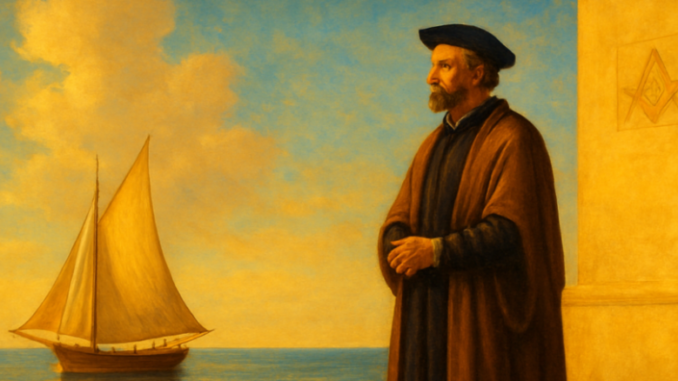
A tear can express joy. A smile can conceal sorrow. Michel de Montaigne understood this paradox of the human soul when he observed that we do not laugh and cry about the same thing. Hidden within this sixteenth-century essay lies a timeless truth that resonates deeply with Masonic thought: genuine connection between people requires us to look beyond the surface of expressions and gestures, into one another’s inner landscape.
The Surface Deceives
Montaigne opens his essay with a seemingly simple observation: the same event can evoke opposite emotions in different people. More than that, within the same person, laughter and tears can lie remarkably close together — sometimes even occurring simultaneously. What does this mean for how we understand one another? Montaigne suggests that we judge far too quickly based on what we see. The tear on someone’s cheek does not tell the whole story. The smile on someone’s lips may well be a mask.
This insight touches on a fundamental Masonic principle: the distinction between the exoteric and the esoteric, between the outer form and the inner truth. In the lodge, we learn that symbols carry multiple layers of meaning. A square is not merely a tool. A level is more than an instrument for measuring flatness. In the same way, human emotions are layered and complex. Montaigne invites us to look deeper, past the first impression, past the obvious — a practice every Freemason recognizes from his own journey.
The Mirror of Self-Reflection
Before we can truly understand another person, we must first know ourselves. Montaigne was a master of self-reflection. His entire project of writing essays was an attempt to fathom himself — contradictions, inconsistencies, and all. He felt no shame about his changeability. On the contrary, he saw it as essentially human.
Freemasonry shares a similar tradition of introspection. The rough ashlar that must be shaped into a perfect cube is a symbol of the self in need of refinement. That work begins with honest self-examination. Why am I laughing right now? Why am I weeping? Are my emotions truly a response to what is happening, or do they reflect something that has been living inside me far longer? Montaigne would greet these questions with wholehearted approval.
Brotherhood Beyond the Mask
In the Masonic lodge, people come together who might never cross paths in everyday life. Different backgrounds, different beliefs, different ways of experiencing the world. And yet brotherhood emerges. How is that possible? Montaigne’s essay offers a clue: genuine connection arises when we acknowledge that behind every outward expression lies a complex inner life.
True brotherhood does not require identical emotions. It requires the willingness to recognize and respect each other’s inner complexity. The brother who laughs at a story that moves me to tears is no less my brother. On the contrary — his different reaction reminds me that reality is multifaceted. His perspective enriches mine. This is the heart of what Montaigne teaches about human diversity: it is not an obstacle to connection, but the very condition that makes it possible.
Ritual as a Shared Language
Where words fall short and emotions diverge, ritual offers common ground. In Freemasonry, rituals are not mere ceremonies. They are a language that speaks to layers of our consciousness that ordinary conversation cannot reach. When brothers perform a ritual together, they share an experience that transcends individual interpretation.
Montaigne wrote during a time when religious division was tearing Europe apart. Catholics and Protestants wept and laughed at the same events, but for entirely different reasons. Montaigne searched for what unites people despite their differences. Freemasonry was born from a similar spirit. Its rituals create a space where a brother can set aside his particular convictions for a time and, together with others, experience something universal.
The Search for Inner Truth
Montaigne does not end his essay with a definitive answer. That is characteristic of his style. He poses questions, explores possibilities, and leaves the reader with a sense of openness. This aligns beautifully with the Masonic understanding that truth is not a possession but a perpetual quest. The Light toward which the initiate strives is not a destination — it is a direction.
The question of why we do not laugh and cry about the same thing opens onto a deeper inquiry: what is the nature of our emotional truth? Is it subjective, relative, ever-changing? Or does something shared, something binding, lie hidden beneath all our diversity? Montaigne leaned toward the former but never ruled out the latter. Freemasonry offers a framework in which both perspectives can coexist.
Emotion as Building Material
The mason builds with stones. The Freemason builds himself and builds brotherhood. In that work, emotions are not obstacles — they are building materials. The tear I shed when a brother shares his story connects me to him. The laughter we share after a meeting cements our bond. Montaigne would understand this completely. For him, emotions were not irrational outbursts to be controlled but windows into the soul.
Self-reflection reveals the many layers of our own emotions. Openness toward others demands that we let go of hasty judgments. Ritual provides a common language beyond words. And the diversity of emotional responses among brothers does not weaken the fraternity — it enriches it profoundly.
Seen in this light, Montaigne’s observation about laughter and tears is not a mere psychological curiosity. It is an invitation to deeper human connection — an invitation that finds its natural home in Freemasonry.
Michel de Montaigne wrote more than four centuries ago, yet his words still speak to anyone willing to listen. The insight that we do not laugh and cry about the same thing is far more than a philosophical reflection on the nature of emotion. It is a call to look beyond appearances, to know ourselves honestly, and to meet our brothers with the humility and openness that genuine connection demands. In the lodge, in the ritual, and in the quiet moments of self-examination, this ancient wisdom continues to illuminate the Masonic path.
Copyright text & image: devrijmetselaar.nl
Texts are based on the ideas and content of the author of devrijmetselaar.nl, reviewed, corrected, and supplemented with the assistance of OpenAI. Images are created based on the ideas of the author of devrijmetselaar.nl using OpenAI/DALL-E.
Frequently Asked Questions
What is Montaigne's paradox about laughter and tears, and why is it relevant to Freemasonry?
Montaigne observed that the same event can evoke opposite emotions in different people, and that laughter and tears can lie remarkably close together. This paradox is relevant to Freemasonry because it teaches the fundamental Masonic principle of looking beyond surface expressions to understand the inner truth of others. Just as Masonic symbols carry multiple layers of meaning, human emotions are complex and layered. Genuine connection requires looking past first impressions into one another's inner landscape.
How does self-reflection connect Montaigne's philosophy to Masonic practice?
Both Montaigne and Freemasonry emphasize the importance of honest self-examination and introspection. Montaigne's essays were an attempt to understand himself with all his contradictions and inconsistencies. Similarly, Freemasonry uses the symbol of the rough ashlar being shaped into a perfect cube to represent the self in need of refinement. This work of self-improvement begins with the kind of honest self-questioning that Montaigne championed, asking why we feel and act as we do.
How does Masonic brotherhood overcome differences between people from different backgrounds?
The article suggests that in the Masonic lodge, people from different backgrounds, beliefs, and ways of experiencing the world come together to form brotherhood. This connection is made possible through the principles discussed in Montaigne's work—by looking beyond surface expressions and understanding the deeper, shared human experience that connects all people. The lodge creates a space where genuine understanding transcends the differences that might keep these individuals apart in everyday life.

Be the first to comment