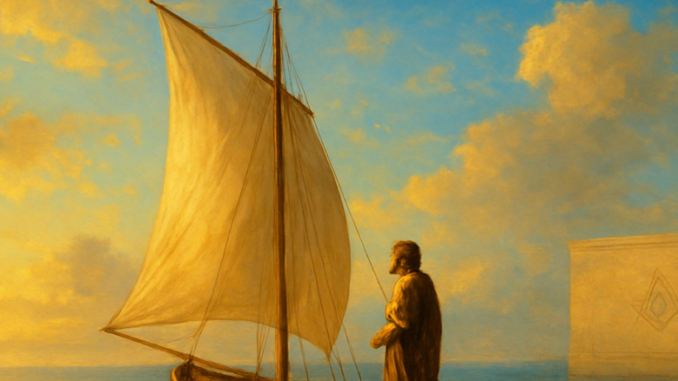
Deep in the night, the emperor picks up his writing tablet. Outside, wind howls past the legion tents along the Danube frontier. Inside, by the flickering light of an oil lamp, Marcus Aurelius bends over a question every human being knows: how do you remain steadfast when fortune turns against you? His answers, recorded in Book VII of the Meditations, still speak to anyone searching for inner peace amid uncertainty — and they carry a particular resonance for those who walk the path of self-improvement through Freemasonry.
The Core Idea of Book VII
The central theme of Book VII revolves around how we deal with change and adversity. Marcus Aurelius argues that external events are, in themselves, neutral. It is our judgment that turns them into disasters or blessings. This foundational Stoic principle receives a deeply personal and practical treatment in this book. The emperor does not write as an abstract philosopher but as a man who contends daily with illness, war, and political intrigue.
What sets Book VII apart from the other books of the Meditations is its emphasis on the transience of all things. Marcus Aurelius reminds himself repeatedly that fame is fleeting, that bodies decay, and that even the mightiest empires will crumble to dust. Yet this is not pessimism. It is a call to liberation: whoever truly accepts the impermanence of all things is no longer paralyzed by the fear of loss.
Striking Metaphors from the Text
Throughout Book VII, Marcus Aurelius employs vivid imagery to reinforce his insights. He compares human life to a droplet in an infinite river. We flow past, just as every droplet before us has done. The river remains, but each individual drop vanishes into the whole. This image invites humility: your worries, however real they may feel, are merely ripples in a far greater current.
Another recurring image is that of the actor on stage. Life gives you a role, the emperor writes, and it is not for you to decide how long that role lasts or which scenes you play. What is within your power is to perform that role with dignity, regardless of the circumstances. Whether you play three acts or five, what matters is that you speak your lines with conviction for as long as you stand upon the stage.
For Freemasons, this metaphor carries a familiar weight. The Craft teaches that we are all working on the rough ashlar of our character — not with any guarantee of how much time we have, but with the solemn responsibility to make each stroke of the chisel count.
It is not what happens to you that determines your fate, but how you respond to it that shapes who you truly are.
Inner Freedom as the Answer to External Chaos
One of the most powerful passages in Book VII concerns the impregnability of the inner citadel. Marcus Aurelius asserts that no one can compel you to be unhappy. Others may confine your body, strip away your possessions, or tarnish your reputation. But your thoughts, your judgments, your inner disposition remain entirely under your own authority — provided you claim that authority.
This idea has resonated through the centuries with thinkers from Epictetus and Seneca to later humanistic philosophers. It forms the heart of what is often called Stoic resilience: not the absence of suffering, but the ability to maintain your inner compass in the midst of suffering. For the emperor himself, this was no armchair philosophy but a daily necessity on the front lines of his embattled legions.
The Masonic tradition echoes this principle in its own way. The inner chamber of the heart, the sanctum of conscience that no external force can breach — this is a concept well understood by any Brother who has reflected on the deeper symbolism of the Lodge. True freedom is not freedom from hardship but freedom within it.
The Impermanence of Fame and Power
Particularly striking is the passage in which Marcus Aurelius lists the names of emperors, generals, and philosophers who lived before him. Where are they now? he asks rhetorically. Their glory is forgotten; their names have become smoke. This applies equally to himself, he realizes. His own name will one day be nothing more than an echo — a footnote in a historical record that will itself eventually perish.
This meditation on impermanence is not an invitation to nihilism. Quite the opposite. Precisely because everything passes, the present moment receives its full weight. The question is not how to achieve immortality, but how to live this one life, this single day, with integrity and attention. Every action becomes a choice: do you contribute to the good, or do you allow yourself to be swept along by trivial concerns?
Freemasons will recognize here the lesson of memento mori woven into the third degree. The awareness of mortality is not meant to breed despair. It is the key that unlocks a more purposeful and examined life.
Timeless Lessons for the Modern Reader
Although Book VII was written nearly two millennia ago, it speaks directly to contemporary readers. The struggles Marcus Aurelius describes are timeless. Who does not know the anxiety of uncertain outcomes? Who has not discovered that fame and recognition can turn out to be empty promises? The Stoic emperor’s answers offer no magic solution, but they provide a perspective that gives both comfort and direction.
What makes the Meditations so extraordinary is that they were never intended for publication. These are the private notes of a man trying to improve himself. That sincerity makes the book both vulnerable and powerful at the same time. You are reading over the shoulder of someone who, just like you, is searching for answers — fully aware that absolute certainty does not exist.
For those on the Masonic journey, this raw honesty is deeply relatable. The work of self-knowledge is never finished. The Lodge provides a framework, but the real labor takes place in the silence of one’s own reflection — exactly as Marcus Aurelius practiced it by lamplight on the Danube frontier.
Book VII of the Meditations teaches us that fortune is unpredictable, but our response to it lies entirely within our own reach. Fame fades, bodies decay, empires fall. What endures is the choice to live each moment with dignity and attention. Marcus Aurelius speaks not as an untouchable sage but as a fellow human being who knows the same storms we do. His words invite us toward inner freedom — not despite the fickleness of fate, but precisely because we have come to understand it. The wind may rage outside; circumstances may shift without warning. But within, in the stillness of your own mind, an unshakable calm awaits. That is the promise and the challenge this book holds before us — and it is a challenge every Freemason is well-equipped to accept.
Copyright text & image: devrijmetselaar.nl
Texts are based on the ideas and content of the author of devrijmetselaar.nl, reviewed, corrected, and supplemented with the assistance of OpenAI. Images are created based on the ideas of the author of devrijmetselaar.nl using OpenAI/DALL-E.


Be the first to comment