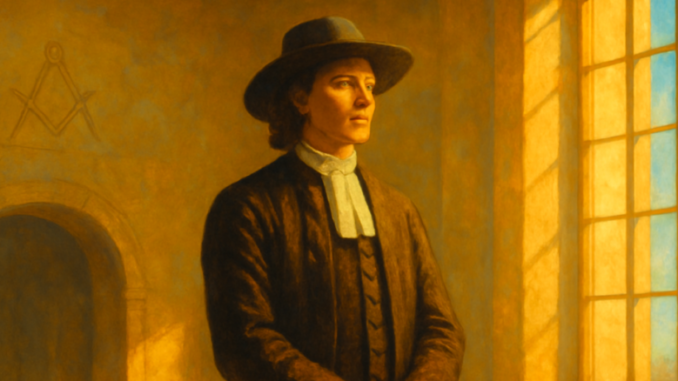
Imagine sitting in a bare room with no priest, no liturgy, no outward display of any kind. You wait in silence until someone is moved to speak — or no one speaks at all, and the silence itself becomes the message. This experience, which has transformed millions of lives across the centuries, began in seventeenth-century England with a shoemaker’s apprentice who refused to remove his hat for any earthly authority. The Society of Friends, known internationally as the Quakers, offers a surprisingly practical approach to spirituality that resonates deeply with Freemasons.
A Revolutionary Beginning in Turbulent Times
George Fox, born in 1624 in Leicestershire, grew up in an England torn apart by religious disputes and civil war. As a young man, he wandered for years in search of spiritual answers, but no preacher or theologian could satisfy his deepest questions. In 1647, he experienced what he would later describe as a moment of revelation: there existed an inner light in every human being that granted direct access to divine truth — without the mediation of priests or sacraments.
This insight was explosive in an era when religious authority was literally a matter of life and death. Fox began to preach that every person, regardless of birth, gender, or education, could experience this inner light. He gathered like-minded seekers around him, including Margaret Fell, who would later become his wife. Her estate, Swarthmoor Hall, became the first organizational center of the movement.
The Name and Its Meaning
The nickname “Quakers” — literally meaning “tremblers” — was originally intended as a term of mockery. According to some sources, Fox told Judge Gervase Bennet during a trial in 1650 that the judge should “tremble at the word of the Lord.” The followers themselves, however, called their community the Society of Friends, a reference to the biblical verse in which Jesus calls his followers friends rather than servants. This emphasis on equality and friendship became a defining characteristic of the movement.
The inner light is not an abstract concept but a practical guide: it calls for silence, deep listening, and the courage to act on what you truly know to be right.
Persecution and Steadfastness
The first decades of the movement were marked by intense persecution. Thousands of adherents, including Fox himself, spent years in prison. Their refusal to swear oaths, to remove their hats before authorities, or to pay tithes to the established church made them permanent targets. Yet the movement continued to grow — precisely because of this steadfastness.
What stands out in the historical records is the practical organizational structure the Quakers developed. Monthly, quarterly, and yearly meetings formed a network that provided mutual support, mediation during conflicts, and even financial assistance to imprisoned brothers and sisters. This structure, built on consensus rather than hierarchy, proved remarkably resilient — a principle that echoes through other fraternal organizations, including Freemasonry.
William Penn and the Holy Experiment
One of the most influential early Quakers was William Penn, the son of an admiral and himself a well-educated gentleman. In 1681, Penn received from King Charles II a vast tract of land in North America as settlement of a debt owed to his late father. He named it Pennsylvania and launched what he called his “Holy Experiment” — a colony founded on religious tolerance and peaceful coexistence with the indigenous population.
Penn drafted a constitution that guaranteed religious freedom for all monotheists, a radical idea at the time. His treaties with the Lenape people were characterized by fair negotiation and mutual respect. Philadelphia — the “City of Brotherly Love” — grew into a thriving center where people of all faiths could live together in peace. The parallels with Masonic ideals of tolerance and universal brotherhood are hard to miss.
Spiritual Practice and the Inner Light
The heart of Quaker spirituality is wonderfully simple and yet profoundly challenging. Their meetings for worship consist of shared silence. Participants sit in a circle or square — no pulpit, no altar — and wait for what they call “led ministry.” When someone feels called to speak, that person rises and shares what has been given to them. Sometimes an entire meeting passes in complete silence.
This practice requires discipline and surrender. You learn to distinguish between your own thoughts and impulses and that which truly arises from a deeper source. For Freemasons, this is deeply recognizable: in the lodge, too, we learn to set aside the ego and listen for wisdom that transcends us. The difference is that the Quakers pursue this without any ceremonial framework — no ritual, no regalia, no prescribed words. The silence itself is both the vessel and the message.
Practical Lessons for Spiritual Growth
What can you take away from this tradition and apply in your own life? First, there is the extraordinary value of silence. Try sitting for ten minutes a day in complete stillness — no agenda, no meditation app, just waiting. This is more uncomfortable than it sounds, and that discomfort is precisely what makes it valuable.
Here are a few practical steps inspired by the Quaker tradition: Begin with five minutes of daily silence and build up gradually. Ask yourself honestly: what do I truly know, beyond opinions and assumptions? Practice listening to others without immediately formulating a response. And examine where your actions fail to align with your deepest convictions.
Second, the early Friends teach us that spirituality and ethical action are inseparable. They refused to lie, even in small matters. They treated women as spiritual equals centuries before this was widely accepted. Their opposition to slavery began as early as the seventeenth century — long before it became a mainstream cause.
A Mirror for Freemasons
For Freemasons, the history of the Society of Friends holds up a revealing mirror. Both traditions emerged during an era of religious division and sought a more universal foundation for brotherhood and ethics. Both emphasize personal transformation as the starting point for improving the world. Both value the individual’s direct encounter with truth over blind obedience to external authority.
Where Freemasonry uses ritual, symbol, and degree work to guide the initiate inward, the Quakers strip everything away and trust silence to do the same work. These are different paths toward a remarkably similar destination: the understanding that genuine spiritual growth demands both inner reflection and outward integrity. Neither tradition treats belief as a spectator sport — both insist that what you know must shape how you live.
The Quakers remind us that the most powerful spiritual tools are often the simplest. Silence, honesty, equality, and the courage to act on conviction — these are not relics of seventeenth-century radicalism but living principles that speak directly to the Masonic journey. Whether you sit in the quietude of a Quaker meeting or stand in the structured beauty of a Masonic lodge, the essential invitation is the same: look inward, listen deeply, and let what you find there transform not only yourself but the world around you.
Copyright text & image: devrijmetselaar.nl
Texts are based on the ideas and content of the author of devrijmetselaar.nl, reviewed, corrected, and supplemented with the assistance of OpenAI. Images are created based on the ideas of the author of devrijmetselaar.nl using OpenAI/DALL-E.



Be the first to comment