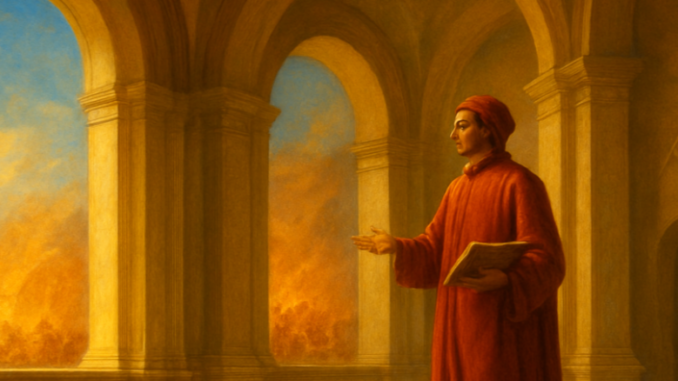
You’ve probably been there: a colleague, friend, or family member tells you that powerful secret societies are pulling the strings behind the scenes, shaping the course of world events. They might reference a book or a movie. Chances are, Dan Brown’s Inferno comes up. In this novel, Brown paints a world where a shadowy organization grapples with the fear of overpopulation — and is willing to take extreme measures. But what does the book actually claim? And how can you, as a Freemason, navigate these conversations when they inevitably arise?
What Inferno Claims About Secret Societies
In Inferno, Dan Brown tells the story of a brilliant scientist who is consumed by the fear of overpopulation. This scientist partners with a clandestine organization that specializes in carrying out complex operations invisibly, far beyond the reach of governments and international institutions. The novel suggests that such organizations thrive because powerful individuals are willing to pay handsomely for discretion and outcomes that would be impossible through legitimate channels.
The scientist in the story is convinced that the global population is hurtling toward a catastrophic tipping point and that only radical intervention can save humanity. The secret society facilitates his plan without asking questions about the moral implications. Brown draws a direct line between the fear of overpopulation and the willingness to cross ethical boundaries. The book creates the impression that secret organizations are the ideal instrument for those who believe the end justifies the means.
In the public reception of the novel, this portrayal was widely discussed. Critics noted that Brown deliberately plays on the distrust many readers feel toward entities that operate outside democratic oversight. Whether intentional or not, these narratives shape how people think about any organization that values privacy or conducts its affairs behind closed doors.
The Fear of Overpopulation as a Driving Force
The central premise of Inferno is that the Earth is approaching a tipping point where population growth will lead to famine, pandemics, and societal collapse. Brown weaves in ideas that trace back to the eighteenth-century economist Thomas Malthus, who warned that population growth would outpace food production. In the novel, this anxiety is taken to its extreme: the antagonist doesn’t see himself as a villain, but as humanity’s savior.
That’s precisely what makes the novel so unsettling. The reader is forced to confront an uncomfortable question: at what point does genuine concern become a justification for crossing moral boundaries? It’s a question that resonates far beyond the pages of fiction, touching on real debates about climate change, resource scarcity, and the ethics of intervention.
Why This Matters for Freemasons
As a Freemason, you’re regularly confronted with prejudices about secret societies. People wonder whether the lodge is a place where invisible powers pull the strings. Inferno feeds that image, even though the book doesn’t specifically address Freemasonry. But that’s exactly why it’s valuable to understand what Dan Brown is claiming: his stories have an enormous influence on the public perception of any organization characterized by private meetings and rituals.
An earlier Dan Brown novel — The Lost Symbol — which dealt directly with Freemasonry, already triggered a flood of questions at lodges around the world. Inferno does something similar, but on a broader scale: the suspicion extends to every society that doesn’t operate with full transparency.
Here’s the important distinction: a secret society in a novel is fiction, but the ethical questions it raises are not. Freemasonry answers those questions with openness about its core principles — brotherhood, tolerance, and personal growth. Understanding the difference between fiction and reality is key to having meaningful conversations about the Craft.
Practical Steps: How to Handle These Conversations
Knowing what Inferno claims is one thing. Applying that knowledge in everyday life is another. Here are concrete actions you can take as a Freemason when confronted with questions or prejudices fueled by books like Inferno.
Listen first. When someone asks whether Freemasonry is a secret society operating behind the scenes, resist the urge to be defensive. Ask what they mean, specifically, and where they got that impression. Often it’s a book, a documentary, or a conversation with someone else. Listening shows respect and opens the door to genuine dialogue.
Clarify the distinction. Explain the difference between a “secret society” and a “society with private customs.” Freemasonry publishes its constitutions, its principles, and in many jurisdictions even its membership lists. What remains private are the rituals through which brothers work together on personal development. That is fundamentally different from the organization in Inferno, which deliberately stays invisible to carry out ethically dubious operations.
Point to the historical tradition. Freemasonry has a tradition stretching back to the seventeenth century, with the publication of James Anderson’s Constitutions in 1723. That text is publicly available and readable by anyone. Compare that to the anonymous, untraceable organization in Dan Brown’s novel — the contrast speaks for itself.
Extend an invitation. The most powerful way to counter misconceptions is to let people experience Freemasonry for themselves. Many lodges organize open evenings or public lectures. Invite your conversation partner to attend one. Personal experience is worth more than a thousand arguments.
The Ethical Core: Responsibility Over Fear
What Inferno ultimately exposes is not so much a conspiracy, but a moral dilemma. The fear of overpopulation is real. How you respond to that fear goes to the very heart of ethical behavior. Aristotle argued that virtue lies in the mean between two extremes. The antagonist in Dan Brown’s novel chooses an extreme and uses a secret society as his instrument.
The Freemason chooses a different path: personal responsibility, dialogue, and the pursuit of improving both oneself and society — step by step. This approach aligns with the philosophy of Voltaire, who championed tolerance and reason over fear and fanaticism. It is a quieter path, perhaps less dramatic than the pages of a thriller, but far more enduring in its impact.
Dan Brown’s Inferno is a gripping piece of fiction, but the questions it raises about secret societies, ethics, and the limits of intervention are anything but fictional. As Freemasons, we have both the opportunity and the responsibility to engage with these questions openly — not by hiding from misconceptions, but by demonstrating through our principles and our actions what a fraternal society truly stands for. Brotherhood, tolerance, and the steady pursuit of personal growth will always be a more compelling answer than any conspiracy theory.
Copyright text & image: devrijmetselaar.nl
Texts are based on the ideas and content of the author of devrijmetselaar.nl, reviewed, corrected, and supplemented with the assistance of OpenAI. Images are created based on the ideas of the author of devrijmetselaar.nl using OpenAI/DALL-E.


Be the first to comment