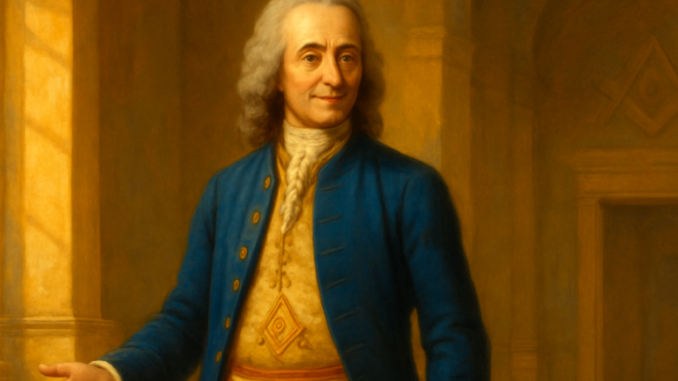
Can a man who questions every authority willingly submit to a ritual initiation? This paradox takes center stage when we consider François-Marie Arouet — better known as Voltaire — and his entry into Freemasonry in 1778. The philosopher who challenged kings and exposed religious dogma knelt down in the final months of his life to become an Entered Apprentice. What drove him to take this step, and what values did he share with the Craft?
Initiation at the Lodge of the Nine Muses
On April 7, 1778, barely two months before his death, Voltaire was initiated into the Parisian lodge Les Neuf Sœurs (The Nine Muses). He was 83 years old, physically weakened by illness, yet mentally as sharp as ever. The lodge counted among its members some of the most prominent thinkers, artists, and scientists of the age. Benjamin Franklin, the American statesman and inventor, was present at the ceremony and would later inherit Voltaire’s Masonic apron. It is a striking image: two towering icons of the Enlightenment, united in a ritual space.
Why did Voltaire wait until so late in life to make this decision? Was it sentiment, curiosity, or genuine conviction? Perhaps all three. Freemasonry offered him a community that aligned with his ideals — a space where religious background was secondary to moral integrity, where reason and brotherhood took precedence. For a man who had spent decades fighting intolerance, it must have felt like coming home.
Tolerance as the Foundation
Voltaire’s most famous principle — often summarized as a defense of free expression — mirrors a core tenet of Freemasonry. Within the lodge, Catholics, Protestants, Jews, and freethinkers met as equals. Voltaire had championed this ideal of tolerance decades earlier in his Treatise on Tolerance, written in response to the unjust execution of Jean Calas. Freemasonry institutionalized precisely the kind of religious and intellectual tolerance that he so often found lacking in the outside world.
Voltaire did not find a new faith in Freemasonry. Instead, he found a practical embodiment of the tolerance he had preached his entire life.
Yet a tension remains. Voltaire was never a man of blind loyalty to any institution. His joining the brotherhood was not a surrender to authority but rather an acknowledgment that certain values flourish better in community than in isolation. The philosopher who writes in solitude can change the world; the brother who shares in ritual embodies that change.
Reason as the Guiding Principle
Voltaire’s philosophy was steeped in rational thought. In works such as the Philosophical Dictionary and Candide, he attacked superstition, religious fanaticism, and irrational traditions. How, then, did he reconcile this with Masonic rituals — their symbolic actions and esoteric references?
The answer lies in the distinction between form and content. Masonic rituals are not magical acts to be taken literally. They are pedagogical instruments — a language of images and gestures that conveys moral truths. The rough ashlar shaped into a perfect cube symbolizes the human pursuit of self-improvement. This kind of symbolism appealed to Voltaire precisely because it imposed no dogma but invited reflection. The rituals were not demands for belief; they were invitations to think.
Brotherhood Beyond Borders
A recurring theme in Voltaire’s writing is his criticism of nationalism and war. In his Letters on the English, he praised English society for its openness to different faiths and backgrounds. Freemasonry, with its international character and emphasis on universal brotherhood, aligned seamlessly with this cosmopolitan vision.
The presence of Benjamin Franklin at Voltaire’s initiation underscores this point beautifully. Here stood two men from different continents, with different backgrounds, united by shared values. The lodge functioned as a microcosm of the enlightened society both men aspired to build — a world where origin and creed mattered less than character and reason.
A Counterpoint: Was It Too Late?
Critics might argue that Voltaire’s initiation was little more than a symbolic gesture at the end of a long life. What significance can two months of membership carry? Yet this criticism overlooks the logic of Voltaire’s choice. The philosopher had never before committed himself to any organized movement. That he did so at the age of 83 speaks to genuine conviction rather than convenience. He had nothing to gain in terms of social status or influence — his fame was already assured. The initiation was a personal affirmation of values he had always championed.
Moreover, Voltaire’s legacy continued to inspire Freemasonry long after his death. His ideas on tolerance, reason, and brotherhood became central themes in Masonic discourse throughout the late eighteenth and nineteenth centuries. He may have been a member for only a short time, but his spirit resided in the lodges far longer than many a regular attendee.
The Philosopher as Builder
Voltaire’s relationship with Freemasonry reveals something essential about both. The Craft was not a sect demanding blind obedience but a workshop for moral growth. The philosopher was not a recluse who rejected the world but a builder who sought collaboration. In their meeting, the Enlightenment and Freemasonry found common ground: the conviction that through reason and brotherhood, humanity can build a better world.
The Masonic lodge offered Voltaire something he could not create alone — a living community dedicated to the very principles he spent his life articulating. And Freemasonry, in turn, gained an intellectual champion whose writings gave philosophical depth to its moral aspirations. It was a partnership, brief in time but profound in consequence.
What remains is a question Voltaire himself might have appreciated: if tolerance, reason, and brotherhood form the pillars of both his philosophy and Freemasonry, why do these values remain so difficult to realize in the wider world? The lodge offers a practice space — a laboratory for enlightened interaction. But the true test lies beyond its walls, in the everyday encounters where these principles are most needed and most easily forgotten. Voltaire showed us that committing to these ideals is never too late — and never finished.
Copyright text & image: devrijmetselaar.nl
Texts are based on the ideas and content of the author of devrijmetselaar.nl, reviewed, corrected, and supplemented with the assistance of OpenAI. Images are created based on the ideas of the author of devrijmetselaar.nl using OpenAI/DALL-E.

Be the first to comment