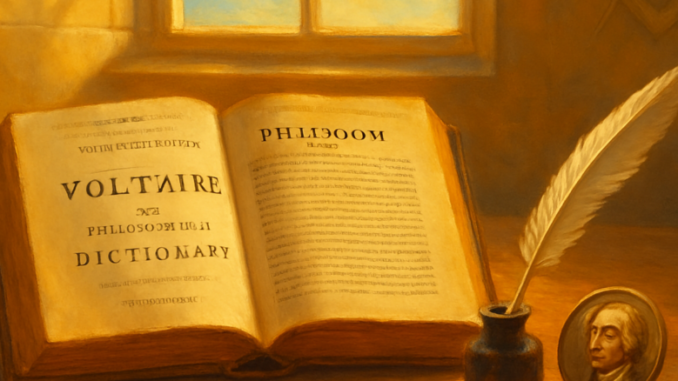
In 1764, François-Marie Arouet — better known as Voltaire — published his Philosophical Dictionary. The entry on freedom quickly became one of the most debated passages in the entire work. But which thinkers and intellectual currents laid the groundwork for Voltaire’s ideas? A journey through the philosophical sources of the Enlightenment reveals surprising connections to the values that Freemasonry continues to cherish to this day.
The Legacy of John Locke
No philosopher exerted a greater influence on Voltaire’s concept of freedom than John Locke. During his exile in England from 1726 to 1729, Voltaire immersed himself in Locke’s Essay Concerning Human Understanding. Locke’s central thesis — that the human mind is a blank slate at birth — struck Voltaire profoundly. If our ideas are not innate but arise from experience, then our education and environment shape who we become. This insight carried revolutionary implications for the question of freedom.
Locke drew a careful distinction between freedom of action and freedom of will. We are free when we can do what we want, but the question of whether we are free to want what we want is fundamentally different. Voltaire wrestled with this paradox and adopted Locke’s nuance. In the Philosophical Dictionary, he argued that absolute free will is an illusion, but that practical freedom within social boundaries genuinely exists — and must be protected.
Stoic Foundations
Running deeper than Locke’s direct influence were the Stoic roots of Voltaire’s thinking. Marcus Aurelius, Epictetus, and Seneca were not dusty relics for the eighteenth-century intellectual — they were living conversation partners. Voltaire maintained an extensive collection of classical texts and regularly quoted from the Meditations of Marcus Aurelius. The Stoic conviction that inner freedom is attainable regardless of external circumstances echoed throughout his essays.
Seneca’s Letters to Lucilius offered Voltaire a model for philosophical writing that remained accessible without sacrificing depth. The Stoic emphasis on self-discipline, rational thought, and the distinction between what we can and cannot control provided an ethical compass that Voltaire deftly combined with Enlightenment ideals of social freedom.
Freedom is not the absence of constraints, but the ability to act consciously and reasonably within them.
Pierre Bayle and the Power of Doubt
An often underestimated influence on Voltaire was Pierre Bayle, whose Dictionnaire historique et critique of 1697 served as a direct model for the Philosophical Dictionary. Bayle, a forerunner of the Enlightenment, advocated for religious tolerance and intellectual freedom grounded in systematic doubt. His method of dissecting dogmas through critical questioning was something Voltaire adopted wholeheartedly.
Bayle’s skeptical tradition connected with Pyrrhonism, the ancient Greek philosophy that questioned all certain knowledge. Michel de Montaigne had revived this current in the sixteenth century with his Essays, in which he explored the limits of human understanding. Voltaire knew Montaigne’s work well and valued his personal, searching style. The combination of Bayle’s critical method and Montaigne’s humanistic doubt gave Voltaire the tools to undermine religious absolutism without falling into nihilism.
Spinoza’s Controversial Legacy
Voltaire’s relationship with Baruch de Spinoza was more complex. In his Ethics, the Dutch philosopher had outlined a strictly deterministic worldview in which God and nature were one and the same. Spinoza’s denial of free will was deeply controversial, and Voltaire publicly distanced himself from Spinozism to avoid accusations of atheism. Yet he quietly absorbed key elements: the emphasis on natural laws, the critique of superstition, and the vision that reason constitutes the highest authority.
In his dictionary entry on freedom, Voltaire navigated carefully between determinism and voluntarism. He acknowledged that our choices are influenced by factors beyond our control, yet refused to draw the conclusion that moral responsibility is a fiction. This tension — one he never fully resolved — reflects the broader philosophical struggle of his era.
Freedom as a Masonic Ideal
The philosophical traditions from which Voltaire drew resonate remarkably with the core values of Freemasonry. The Stoic emphasis on self-improvement and rational self-reflection is mirrored in the Masonic pursuit of personal refinement. Locke’s defense of freedom of conscience and tolerance forms the foundation for the Masonic conviction that people of different faiths can come together in brotherhood.
While it remains uncertain whether Voltaire himself was ever formally initiated, he maintained connections with prominent Freemasons and shared their intellectual milieu. The lodge as a space for free inquiry and respectful debate embodied precisely the values Voltaire championed in his Philosophical Dictionary. For him, freedom was not an abstract concept but a practical ideal to be exercised in community.
A Synthesis of Traditions
Voltaire’s essay on freedom was not an original philosophical construction but a brilliant synthesis. He combined Locke’s empiricism with Stoic ethics, added Bayle’s critical method, and grappled with Spinoza’s deterministic challenges. The result was a text that did not so much offer the reader answers as teach them to ask the right questions.
This eclectic approach is what makes Voltaire’s work enduringly relevant. Freedom remains a concept that must be thought through anew in every age, in dialogue with both old and new voices. Freemasonry, with its tradition of symbolic thinking and fraternal conversation, continues to offer a fertile context for such reflections.
Voltaire’s philosophical legacy lives on wherever people come together to search freely for truth, wisdom, and understanding. His synthesis of Enlightenment thought — shaped by Locke, the Stoics, Bayle, and even the shadow of Spinoza — remains a powerful reminder that freedom is not a destination but an ongoing practice. For Freemasons and freethinkers alike, his work invites us to keep questioning, keep refining, and keep building — one carefully placed stone at a time.
Copyright text & image: devrijmetselaar.nl
Texts are based on the ideas and content of the author of devrijmetselaar.nl, reviewed, corrected, and supplemented with the assistance of OpenAI. Images are created based on the ideas of the author of devrijmetselaar.nl using OpenAI/DALL-E.
Frequently Asked Questions
What was John Locke's main influence on Voltaire's concept of freedom?
John Locke profoundly influenced Voltaire's ideas on freedom through his Essay Concerning Human Understanding, particularly the concept that the human mind is a blank slate shaped by experience and environment. Voltaire adopted Locke's nuanced distinction between freedom of action and freedom of will, concluding that while absolute free will is an illusion, practical freedom within social boundaries genuinely exists and must be protected.
How did Stoic philosophy contribute to Voltaire's thinking on freedom?
Stoic philosophers like Marcus Aurelius, Epictetus, and Seneca provided foundational influences on Voltaire's concept of freedom. The Stoics taught that inner freedom is attainable regardless of external circumstances, and their emphasis on self-discipline, rational thought, and distinguishing between what we can and cannot control provided an ethical framework that Voltaire combined with Enlightenment ideals of social freedom.
When did Voltaire publish his most influential work on freedom, and what was it?
Voltaire published his Philosophical Dictionary in 1764, which contained an entry on freedom that quickly became one of the most debated passages in the entire work. This entry synthesized his philosophical influences and presented his nuanced views on freedom that connected to values cherished by Freemasonry.

Be the first to comment