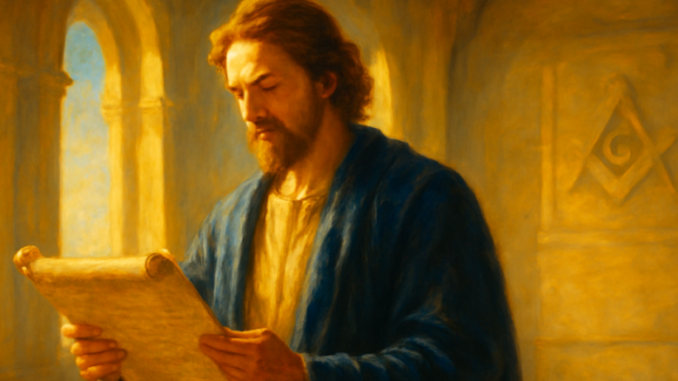
Imagine a brilliant futurologist about to reveal to the entire world where we come from and where we are headed. Two questions that have captivated humanity for millennia, answered by a single computer simulation. That is the premise at the heart of Dan Brown’s Origin. But how scientifically plausible is this fictional breakthrough? And what does the answer tell us about the eternal quest for truth — a quest that also lies at the very core of Freemasonry?
The Two Big Questions in Origin
In Origin, published in 2017, Dan Brown introduces Edmond Kirsch: a tech genius who claims to have answered two fundamental questions using a quantum supercomputer. The first concerns the origin of life on Earth. The second addresses the future of the human species. Brown weaves these questions through a thriller rich with art-historical references and architectural splendor, but the scientific foundation behind them deserves a closer look.
Perhaps you recognize those two questions. They touch on something you may have felt yourself — that deep longing to understand where you come from and what your purpose might be. In Freemasonry, this longing is never answered with dogma but with an invitation to personal inquiry. The rough ashlar you work on is ultimately yourself, and the direction in which you shape it depends on the questions you dare to ask.
What Holds Up: The Origin of Life
The fictional discovery in Origin leans heavily on the work of real scientists. The theory that life arose spontaneously from chemical processes — known as abiogenesis — is not Dan Brown’s invention. As early as 1952, Stanley Miller and Harold Urey conducted their famous experiment, demonstrating that amino acids, the building blocks of life, can form from simple chemical compounds when exposed to energy. This experiment has since been replicated and refined countless times.
What Brown adds is the idea that a computer simulation could fully replicate and predict the complete transition from inert matter to living cells. Here we enter the territory of exaggeration. While researchers do indeed use computer simulations to model chemical evolution, as of 2026 no simulation has successfully reproduced the full pathway from simple molecules to a living cell. The gap between amino acids and a self-replicating organism — often referred to as the protocell problem — remains one of the biggest open questions in biology.
Fact: Amino acids and organic molecules can arise spontaneously under the right conditions.
Exaggeration: A computer simulation that fully reproduces the origin of life does not exist.
Fiction: That a single experiment could render all religious explanations for life’s origin obsolete.
What Holds Up: The Future of Humanity
The second part of the discovery in Origin tackles the question of where humanity is headed. Brown has Kirsch claim that technology and biology will merge into an entirely new form of life. This idea is not pulled from thin air. The mathematician and author Vernor Vinge introduced the concept of the technological singularity in 1993 — the point at which artificial intelligence surpasses human intelligence. And Charles Darwin, with his theory of evolution in 1859, already laid the groundwork for the idea that species are in a constant state of flux and that humanity is not the final chapter.
Yet the way Origin presents this — as an inevitable, predictable outcome calculated by a computer — goes considerably further than what current science can support. Evolution is not a linear process you can extrapolate like a mathematical formula. Chance, catastrophes, and unpredictable mutations play an enormous role. The suggestion that a quantum computer could predict the entire future of the human species belongs firmly in the realm of speculative fiction.
The Quantum Computer: Fact or Fantasy?
In Origin, Dan Brown places a quantum supercomputer in the catacombs beneath a church — a wonderfully dramatic image. In reality, quantum computers do exist, but their capabilities are far more limited than the novel suggests. Quantum computers excel at specific tasks such as factoring large numbers or simulating molecular interactions. However, an all-encompassing simulation of the origin and future of life falls far beyond what current or near-future quantum computers can achieve. The computational power required would surpass anything today’s technology can offer.
The big questions about origin and destiny are scientifically legitimate, but no computer can reduce the mystery of existence to a neat, conclusive algorithm.
Science and Religion: A False Dichotomy
One of Dan Brown’s most striking choices in Origin is the suggestion that a scientific discovery could fundamentally undermine religious belief. It makes for a dramatically effective storyline, but from a historical perspective, it is a simplification. Isaac Newton, a deeply devout man and quite possibly a Freemason, saw no contradiction between his groundbreaking physics and his faith in a Creator. Galileo Galilei, who was condemned by the Church for his heliocentric model, regarded his discoveries as a way to better understand God’s creation — not to deny it.
Within Freemasonry, this apparent contradiction has been transcended for centuries. The lodge is a place where people of widely differing convictions come together — not to refute each other’s views, but to search together for deeper truth. The concept of the Great Architect of the Universe is deliberately not a theological definition but an open principle that leaves room for personal interpretation. Voltaire, himself a Freemason, emphasized the importance of tolerance and the coexistence of reason and faith — a philosophy that remains as relevant today as it was in the Enlightenment.
Freemasonry and the Quest for Truth
What makes Origin so fascinating from a Masonic perspective is not the answer Kirsch provides, but the questions he dares to ask. Freemasonry has never been about offering definitive answers. It is about cultivating the courage to keep asking, to keep searching, and to accept that some mysteries may never be fully resolved. The working tools of the Craft — the square, the compasses, the level — are symbols that invite reflection, not instruments that deliver certainty.
Dan Brown’s novel, for all its dramatic license, touches on something profound: the human need to find meaning. Whether that meaning is found in science, in faith, or in the quiet contemplation of a lodge room, the search itself is what elevates us. The rough stone is never finished, and the cathedral of understanding is always under construction.
Dan Brown’s Origin is a compelling piece of fiction that dresses real scientific questions in thriller-paced storytelling. The ideas about abiogenesis and the technological singularity are rooted in genuine research, but the novel stretches their conclusions far beyond what current science can support. The quantum computer remains more magic than machine in Brown’s telling. Yet perhaps the most valuable takeaway is one that Freemasons have understood for centuries: the power of these questions lies not in their answers, but in the seeking itself. Where we come from and where we are going are questions worth asking — not because we expect a final answer, but because the journey of inquiry is what shapes us.
Copyright text & image: devrijmetselaar.nl
Texts are based on the ideas and content of the author of devrijmetselaar.nl, reviewed, corrected, and supplemented with the assistance of OpenAI. Images are created based on the ideas of the author of devrijmetselaar.nl using OpenAI/DALL-E.
Frequently Asked Questions
What is the scientific basis for the origin of life discovery in Dan Brown's Origin?
The fictional discovery in Origin is based on the real scientific theory of abiogenesis — the idea that life arose spontaneously from chemical processes. This builds on actual experiments like the 1952 Miller-Urey experiment, which demonstrated that amino acids (building blocks of life) can form from simple chemical compounds when exposed to energy. However, Brown's premise that a quantum supercomputer could fully simulate the complete transition from inert matter to living cells is an exaggeration, as scientists have not yet successfully reproduced the full pathway from simple molecules to a self-replicating organism.
Is it scientifically plausible for a computer simulation to answer questions about human origins and the future?
While researchers do use computer simulations to model chemical evolution and other biological processes, current technology cannot fully replicate the complete pathway from simple molecules to a living cell. The protocell problem — understanding how self-replicating organisms first emerged — remains one of the biggest open questions in biology as of 2026. Therefore, Brown's premise of a single computer simulation answering both the origin of life and humanity's future is scientifically implausible given our current knowledge and technological capabilities.
How does Freemasonry relate to the themes of seeking truth in Origin?
In Freemasonry, the eternal quest for truth — a central theme in Origin — is pursued through personal inquiry rather than dogma. Like Edmond Kirsch's search for answers about human origins and destiny, Freemasonry invites members to ask deep questions about themselves and their purpose. The concept of the rough ashlar (a stone that a Mason shapes) represents the self, and its direction depends on the questions one dares to ask. This philosophical approach mirrors the fundamental human longing to understand where we come from and what our purpose might be.



Be the first to comment