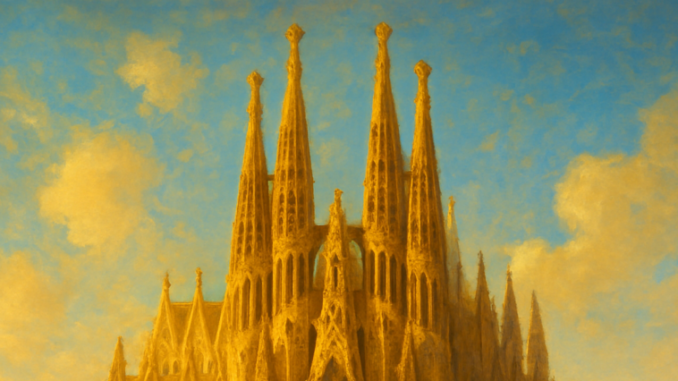
When Antoni Gaudí took over the construction of what would become the Sagrada Família in 1883, he could never have imagined that his life’s work would one day serve as the backdrop for an international thriller. In Origin, Dan Brown transforms this monumental basilica into a spectacular stage for intrigue involving secret societies and hidden truths. But how much of what Brown suggests about the building’s symbolism and its supposed connections to Freemasonry is grounded in historical fact? A journey through the real history of the Sagrada Família reveals a far more nuanced story than fiction would have us believe.
The Birth of a Myth
The Sagrada Família was originally initiated by the Associació Espiritual de Devots de Sant Josep, a Catholic brotherhood founded in 1866. Josep Maria Bocabella, a bookseller and the driving force behind the project, was inspired by a pilgrimage to Rome and Loreto. From its very inception, this building was an explicitly Roman Catholic endeavor, dedicated to the Holy Family. When Dan Brown weaves suggestions of hidden symbolism and mysterious connections into Origin, he effectively sidesteps the deeply religious origins of the structure.
Gaudí himself was a devout Catholic who dedicated the final years of his life entirely to the church. He even slept in his workshop on the construction site and lived as a virtual hermit. His cause for beatification was opened by the Roman Catholic Church in 2003. This biographical reality stands in stark contrast to the insinuations that fictional works sometimes make about architects harboring double agendas or secret society affiliations.
Gaudí and Freemasonry: What Do the Sources Actually Say?
A persistent myth suggests that Gaudí had connections to Masonic lodges. However, historical research has produced no evidence whatsoever to support this claim. While Freemasons were certainly present in the Catalonia of Gaudí’s time, the architect moved in decidedly Catholic circles. His mentor, Bishop Josep Torras i Bages, was a prominent opponent of Freemasonry and the modernist currents he viewed as threats to the Catholic faith.
The symbolism found throughout the Sagrada Família is deeply Catholic in nature and reflects Gaudí’s personal devotion — not a hidden Masonic tradition. The confusion likely arises because Gaudí’s work contains geometric forms that also appear in Masonic symbolism: spirals, cubes, and triangles. But these shapes are universal in architecture. In Gaudí’s case, they originate from his intensive study of nature. He called nature his greatest teacher and saw God’s hand in every natural structure. The hyperbolic paraboloid forms that characterize the church were inspired by tree branches and skeletal structures, not esoteric societies.
What Dan Brown Does — And Why It Works
Dan Brown is a master at interweaving real locations with fictional intrigue. Just as he previously used Notre-Dame and the Louvre in his novel about an alleged bloodline, he deploys the Sagrada Família in Origin as a theatrical set piece. The power of this technique lies in recognition: readers who have visited Barcelona feel an immediate connection to the story. At the same time, this method creates a problem when readers lose sight of the boundary between fact and fiction.
In Origin, the basilica plays a role in a plot revolving around artificial intelligence and the origin of life. Brown draws connections between ancient mystery schools and modern technology. While this makes for fascinating fictional material, it reinforces existing misconceptions about the actual history of both the Sagrada Família and Freemasonry. For anyone genuinely interested in either subject, it is worth looking beyond the novel’s claims.
What Masonic Symbolism Actually Means
To understand why the suggestions in Origin are misleading, it helps to examine what Masonic symbolism actually entails. The classic symbols of the square and compasses refer to moral principles: measuring one’s conduct, building one’s character. This symbolism has its origins in the medieval guilds of stonemasons who, through their craftsmanship, built the great cathedrals of Europe.
The compasses symbolize the ability to set boundaries on one’s passions and desires. The square represents honesty and fairness in one’s dealings. The rough ashlar represents the individual in an unrefined state, while the perfect ashlar embodies the ideal of self-improvement. This symbolism is fundamentally about ethical development, not about secret messages hidden in buildings.
Freemasons build metaphorically on their inner temple — a concept that traces back to Solomon’s Temple and the legends surrounding the master builder Hiram Abiff. It is this symbolic tradition that is sometimes confused with architectural secrets, when in reality it concerns personal growth and moral refinement.
A Lesson from the Past for Today
The impulse to search for hidden meanings in architecture is as old as building itself. As far back as the Renaissance, authors wrote about concealed knowledge embedded in cathedrals. But the real lesson we can draw from buildings like the Sagrada Família is more modest — and perhaps more valuable for it. Gaudí worked for decades on a project he knew he would never see completed. He planted seeds whose fruits others would harvest.
This long-term thinking resonates deeply with Masonic values: the understanding that we build for future generations, that our work is part of a greater whole. The true parallel between the Sagrada Família and Freemasonry lies not in hidden symbols carved into stone, but in this shared conviction that patient, devoted building — whether literal or figurative — is the true path to meaning.
Dan Brown’s Origin makes for thrilling reading, but anyone who truly wants to understand the Sagrada Família would do well to consult the historical sources. The basilica is a monument to Catholic devotion, not to esoteric societies. And Freemasonry, with its rich tradition of moral symbolism, deserves to be understood on its own terms rather than through the lens of fictional conspiracy. The most profound connection between Gaudí’s masterpiece and the Craft is not a hidden code — it is the shared belief that the greatest structures, whether of stone or of character, are built with patience, purpose, and an unwavering commitment to something larger than oneself.
Copyright text & image: devrijmetselaar.nl
Texts are based on the ideas and content of the author of devrijmetselaar.nl, reviewed, corrected, and supplemented with the assistance of OpenAI. Images are created based on the ideas of the author of devrijmetselaar.nl using OpenAI/DALL-E.
Frequently Asked Questions
Did Antoni Gaudí have connections to Freemasonry?
No. Historical research has produced no evidence to support claims that Gaudí had connections to Masonic lodges. Gaudí moved in decidedly Catholic circles and was mentored by Bishop Josep Torras i Bages, who was actually a prominent opponent of Freemasonry. Gaudí was a devout Catholic who dedicated his final years entirely to the church.
What were the true origins of the Sagrada Família project?
The Sagrada Família was initiated by the Associació Espiritual de Devots de Sant Josep, a Catholic brotherhood founded in 1866. Josep Maria Bocabella, a bookseller, led the project after being inspired by a pilgrimage to Rome and Loreto. From its inception, it was an explicitly Roman Catholic endeavor dedicated to the Holy Family.
Why do people think the Sagrada Família contains Masonic symbolism?
The confusion likely arises because Gaudí's architectural work contains geometric forms like spirals, cubes, and triangles that also appear in Masonic symbolism. However, these shapes are universal in architecture. In Gaudí's case, the symbolism found throughout the Sagrada Família is deeply Catholic in nature and reflects his personal devotion, not hidden Masonic traditions.

Be the first to comment