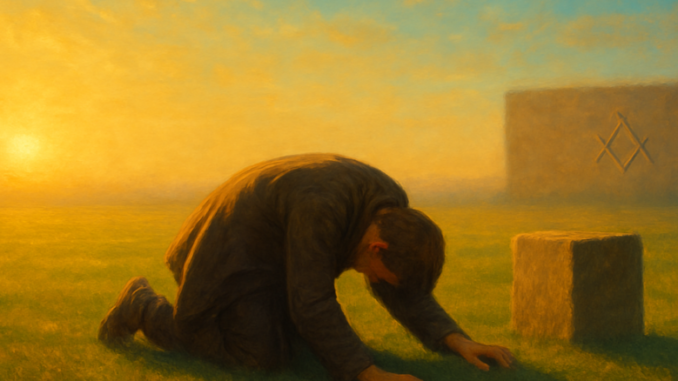
On October 23, 2026, news breaks that Vincent Kompany, head coach of Bayern Munich, has collapsed during a training session and been rushed to hospital. In a world that glorifies strength and conceals weakness, such a moment confronts us with an uncomfortable truth: even the strongest among us are mortal. This realization is hardly new. Centuries ago, philosophers and master builders understood that the very acknowledgment of our vulnerability holds the key to genuine strength.
The Fallen Hero Throughout History
History is filled with leaders who were struck down by their own bodies at the height of their power. Julius Caesar suffered from epilepsy. Alexander the Great died young, likely weakened by exhaustion and fever. Frederick the Great of Prussia battled chronic ailments he carefully hid from his subjects. These men, regarded by their contemporaries as near-divine figures, all shared the same human fragility.
In the eighteenth century, when modern Freemasonry took shape in the lodges of London and Paris, this awareness of mortality was not a footnote — it was a central theme. The founders of the organized Brotherhood, including James Anderson and John Theophilus Desaguliers, designed rituals that remind Brethren of the transience of earthly existence. Not to foster gloom, but to sharpen priorities.
The Moment of Collapse as a Turning Point
When a public figure collapses, a remarkable social ritual unfolds. First comes shock, then speculation, followed by expressions of support, and finally reflection. This pattern is no accident. It reflects a deeply rooted human need to find meaning in vulnerability. The Roman philosopher Seneca wrote about this in his letters to Lucilius: it is not the fall that defines a person, but how he relates to his own mortality.
In Freemasonry, this idea is translated into the concept of the rough ashlar. Every Brother begins as an unworked block of stone, full of imperfections and cracks. The goal is not to hide these flaws but to acknowledge them as the very material that must be worked upon. A coach who collapses on the training ground reminds us that even the most polished stone remains stone — subject to the laws of wear and decay.
Leadership and the Courage to Be Weak
The ancient Greek philosophers distinguished between different forms of courage. Aristotle described in his Nicomachean Ethics how true bravery is not the absence of fear but the ability to act rightly in spite of it. This principle applies equally to vulnerability. The courage to show weakness, to ask for help, to allow yourself not to be strong for a moment — this often requires more character than maintaining an illusion of invincibility.
True strength reveals itself not in avoiding the fall, but in recognizing that falling is human.
Johann Wolfgang von Goethe, himself a Freemason and one of the greatest thinkers of the German Enlightenment, wrote extensively about the relationship between strength and vulnerability. Throughout his work, a recurring theme emerges: growth is only possible through confrontation with one’s own limitations. The hero who never fails learns nothing. The leader who does not know his own weakness cannot truly serve his Brethren.
From the Training Ground to the Lodge
The parallel between a football training session and a lodge meeting may be less far-fetched than it first appears. Both are enclosed spaces where individuals come together to work toward a shared purpose. Both have rituals, hierarchies, and moments of individual testing. And in both settings, an unexpected moment of vulnerability can transform the entire group dynamic.
When a Worshipful Master in the lodge or a coach on the field shows human weakness, something remarkable often happens. The group closes ranks. Egos shrink. The realization that everyone shares the same fragile humanity creates a bond that success stories rarely achieve. The eighteenth-century Freemasons understood this intuitively, which is why they wove moments of reflection on mortality into their rituals.
The Lesson for Today
What can we, in October 2026, learn from a coach who collapses and from ancient wisdom traditions that embraced vulnerability? Perhaps, first and foremost, that our modern cult of relentless performance and visible strength has a shadow side we too often ignore. The pressure to always appear strong, to show no weakness, to push on until you physically cannot — this takes a toll that sometimes becomes literally visible on a training ground in Munich.
Freemasonry offers no magic solution to this, but it does provide a counterbalance. Within the privacy of the lodge, Brethren are allowed to remove their masks. Not to complain or wallow in self-pity, but to be honest about the cracks in their own rough ashlar. This is not weakness but wisdom, not failure but growth. Marcus Aurelius, the philosopher-emperor whose Meditations are still widely read today, wrote that the person who knows his own limitations is freer than the tyrant who believes himself invincible.
Consider these principles as guideposts: recognize vulnerability as an essential part of the human condition. Seek spaces where authenticity is valued above performance. Learn from historical wisdom traditions about mortality. And see moments of collapse not as catastrophe, but as an invitation to deeper reflection.
The news about a coach collapsing will vanish from the headlines within days. But the question it raises lingers far longer: do we dare to acknowledge our own vulnerability before our bodies force us to?
History teaches us that the greatest leaders were not those who never fell, but those who found the courage to be human in their falling. From Seneca to Goethe, from the medieval building guilds to today’s Masonic lodges, the same wisdom echoes across the centuries: the recognition of our own vulnerability is not the end of strength — it is where true strength begins.
Copyright text & image: devrijmetselaar.nl
Texts are based on the ideas and content of the author of devrijmetselaar.nl, reviewed, corrected, and supplemented with the assistance of OpenAI. Images are created based on the ideas of the author of devrijmetselaar.nl using OpenAI/DALL-E.
Frequently Asked Questions
What is the connection between Freemasonry and vulnerability?
In eighteenth-century Freemasonry, vulnerability and mortality were central themes, not peripheral ones. Founders like James Anderson and John Theophilus Desaguliers designed rituals to remind Brethren of the transience of earthly existence. This awareness was intended not to foster despair, but to sharpen priorities and encourage personal growth. The concept of the rough ashlar exemplifies this—every Brother begins as an unworked block of stone full of imperfections, and the goal is to acknowledge these flaws as material for self-improvement rather than hide them.
How does the concept of the 'rough ashlar' relate to leadership?
The rough ashlar is a Masonic symbol representing that every person begins as an imperfect stone. Rather than concealing flaws, Freemasonry teaches that imperfections should be acknowledged as the very material upon which one must work. Applied to leadership, this means that even the most accomplished leaders—like a polished stone—remain subject to human limitations, wear, and decay. A leader's collapse, therefore, is not a failure but a reminder of this universal truth and an opportunity for genuine strength through honest acknowledgment of vulnerability.
Why is vulnerability considered a form of strength according to this article?
The article argues that true strength lies not in the absence of weakness but in how one relates to mortality and fragility. Drawing on Aristotle's concept of courage from the Nicomachean Ethics, genuine bravery is not fearlessness but the ability to act rightly despite fear and limitations. History's greatest leaders—Julius Caesar, Alexander the Great, and Frederick the Great—all experienced vulnerability and mortality. By acknowledging our human fragility rather than concealing it, we develop the authentic courage and prioritization that defines real leadership.


Be the first to comment