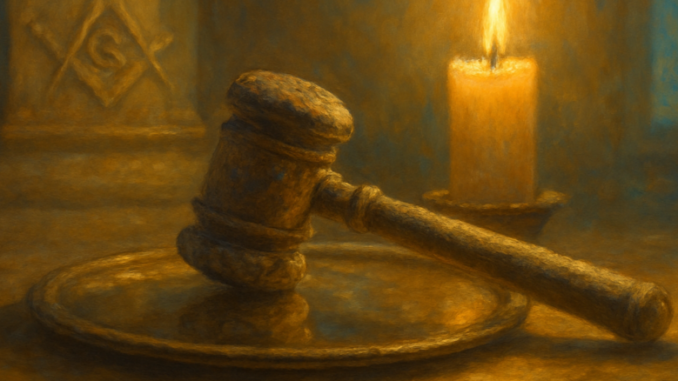
When the law itself turns out to be unlawful, where do we find a true standard of justice? Recent news about search warrants declared illegal in connection with a former member of the British royal family raises a timeless question that reaches far beyond legal procedure. It touches on something Freemasons have contemplated for centuries: the tension between external authority and inner conscience, between human legislation and a deeper, spiritual form of justice.
The Paradox of Unlawful Law
Here we encounter a philosophical paradox that has fascinated thinkers throughout the ages. A search warrant is the quintessential instrument of lawful power. It represents the state’s authority to enter the private sphere of the individual. When such a warrant is declared unlawful, a remarkable spectacle unfolds: the law turns against its own enforcers.
Marcus Aurelius wrote in his Meditations that we must distinguish between what lies within our power and what lies beyond it. The Stoic philosopher might observe that external circumstances — whether lawful or unlawful — matter less than our inner disposition toward those circumstances. Yet this raises a deeper question: if even the law can fail, where do we find a reliable compass?
The Inner Tribunal of the Freemason
Within Freemasonry there exists an ancient concept that speaks directly to this dilemma: every person carries an inner tribunal. This is not a court of statutes and legal articles, but a tribunal of conscience. Every Freemason is encouraged to measure his actions against an inner judge who passes stricter verdicts than any human court ever could.
True justice does not begin with the law book, but with the quiet verdict a person passes upon himself when no one is watching.
This inner tribunal forms the core of what we might call spiritual justice. It is not about punishment or reward, but about whether our actions align with a standard higher than that of human convention. Plato would recognize this as an echo of his world of Forms: somewhere there exists a perfect Form of Justice, of which all human laws are merely imperfect reflections.
The Imperfection of Human Institutions
What the case of unlawful search warrants inadvertently teaches us is the fundamental imperfection of all human institutions. This is not a cynical observation but a spiritual truth that recurs across many wisdom traditions. Freemasonry acknowledges this through the symbol of the rough ashlar: the human being is unfinished, society is unfinished, the law is unfinished.
Spinoza argued that human beings are part of a greater order they cannot fully comprehend. From that perspective, every law is an attempt to capture something inherently too vast for human frameworks. The error of the judges who issued those warrants is not merely a legal misstep — it is a reminder of our human limitations.
Power, Privilege, and Spiritual Equality
There is another dimension to this case that deserves attention. It involves a former member of a royal house — someone born into a position of extraordinary privilege. The question naturally arises: does the law apply equally to everyone, or do different standards exist for different people?
In the lodge, all outward distinctions dissolve. Freemasonry has long upheld the principle that all brethren are equal, regardless of their social standing. A prince and a carpenter meet as equals on the mosaic pavement. This is not naive egalitarianism — it is a spiritual discipline. When a person sheds external titles, he draws closer to his true self.
The Question That Lingers
Aristotle distinguished between justice according to the letter of the law and justice according to its spirit. He called the latter epikeia — a kind of higher insight that corrects where the law falls short. Perhaps that is where this case ultimately leads us: not toward a verdict of guilt or innocence, but toward the recognition that human justice will always remain an approximation.
The Freemason cultivates an attitude of humility before great questions. He knows he holds no definitive answers about good and evil, about right and wrong. What he does possess is the willingness to ask those questions again and again, in the understanding that the act of questioning itself is a spiritual exercise.
Voltaire might have sarcastically remarked that laws often reveal more about the lawmaker than about the reality they seek to regulate. In his critique of arbitrary authority, we recognize a kindred spirit — someone who urged people to think for themselves, to refuse blind trust in external figures of power.
Several key insights emerge from this reflection:
- Inner justice serves as a compass when external laws fail.
- The recognition of human imperfection is itself a spiritual truth.
- Equality is a discipline, not a given.
- Conscience is the highest court.
The story of unlawful search warrants may soon fade from the headlines, but the question it raises endures. What is the source of true justice? The Freemason would answer: look within. Not because the answer is easily found there, but because the search itself shapes us. Perhaps that is the deepest spiritual lesson we can distill from this episode: every failure of the external system is an invitation to refine our internal one. And that refinement is never finished.
Copyright text & image: devrijmetselaar.nl
Texts are based on the ideas and content of the author of devrijmetselaar.nl, reviewed, corrected, and supplemented with the assistance of OpenAI. Images are created based on the ideas of the author of devrijmetselaar.nl using OpenAI/DALL-E.


Be the first to comment