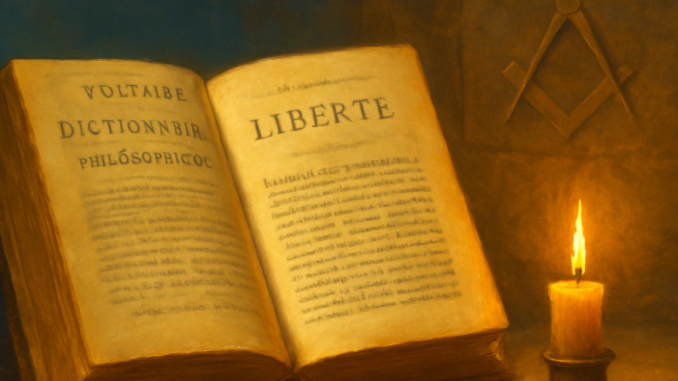
What does freedom truly mean? And why would an eighteenth-century philosopher still have something meaningful to say to modern-day Freemasons? In his Philosophical Dictionary, Voltaire wrestled with precisely this question. Let us sit down with his ideas and explore where they intersect with the values that brothers and sisters have cherished for centuries.
What Did Voltaire Actually Mean by Freedom?
This is perhaps the first question we need to ask. In his entry on freedom in the Philosophical Dictionary, Voltaire examined a fundamental problem: are we truly free to will what we will? Or are our choices determined by forces beyond our control? Voltaire refused to settle for easy answers. He acknowledged that our will is shaped by upbringing, circumstances, and even our physical condition. Yet he also refused to reduce human beings to helpless creatures devoid of agency.
For Voltaire, the essence of freedom did not lie in the absence of influences, but in engaging with those influences consciously. The free person is one who examines their impulses, recognizes their prejudices, and then deliberately chooses how to act. This is not a passive state but an active endeavor — a daily labor upon oneself.
How Does This Relate to Self-Reflection in Freemasonry?
This is where Voltaire’s thinking directly touches one of Freemasonry’s core values. The Craft asks its members to continually look inward. What drives me? Which rough stone within me still needs to be shaped? This is not an idle question — it forms the very foundation of the initiatic process. Like Voltaire, Freemasonry proceeds from the conviction that true freedom begins with self-knowledge.
Freedom is not the absence of chains, but the ability to recognize your own inner chains and consciously choose how to deal with them.
The working tools that Freemasons use as symbols — the square and compasses, the gavel and chisel — point precisely to this process. They invite us to shape our own character with intention and care. Voltaire would likely have recognized this as the philosophical practice par excellence: examining life in order to live it more wisely.
Is Freedom Purely an Individual Matter?
No — and this is where the conversation becomes especially compelling. Voltaire emphasized that freedom can never be separated from community. A person who lives only for themselves misses the full dimension of being free. Freedom gains its deepest meaning in relation to others, in the space we grant one another to grow and to become who we are capable of being.
Freemasonry translates this principle into the concept of brotherhood. The lodge is not a random collection of individuals who happen to share the same room. It is a community in which members support one another in their personal development. The bond between brothers and sisters creates a safe space where free thought becomes possible. Paradoxically, we often discover the greatest freedom within the structure of meaningful relationships.
The Pursuit of Truth as a Path to Freedom
Voltaire was a tireless opponent of prejudice and superstition. He believed that only through critical thinking and the pursuit of truth could a person become genuinely free. Ignorance, he argued, is a form of slavery — a submission to opinions we have never bothered to examine.
In Freemasonry, we find this reflected in the central metaphor of light and darkness. The candidate symbolically steps out of darkness and receives light, representing knowledge, insight, and awareness. This is not a one-time event but a lifelong journey. Every degree, every ritual, every discussion in the lodge invites further illumination.
Consider these four dimensions where Voltaire’s philosophy and Masonic practice converge:
Freedom through self-knowledge: “Know thyself” — the ancient Delphic command that permeates both traditions. Freedom through connection: growth happens in community, not in isolation. Freedom through truth: combat prejudice and seek the light. Freedom through virtue: act consciously and with moral responsibility.
What Can We Take from This Today?
Voltaire wrote in an age of censorship and religious intolerance. His words about freedom were an act of defiance. Today we face different challenges, but the core message remains strikingly relevant. We are inundated with information, opinions, and images. The question of what we truly think and want has become harder to answer than ever before.
Freemasonry offers a rare space for this kind of inquiry. In the stillness of the temple, in the rhythm of the ritual, in conversation with brothers and sisters, there arises an opportunity to step away from the noise. Not to escape the world, but to see more clearly where we stand and where we wish to grow.
The Inner Workshop
Voltaire’s philosophy and Masonic practice meet in what we might call the inner workshop. This is the place where thoughts are tested, where virtue is practiced, where the rough stone slowly takes shape. It is not a place of passive contemplation but of active building. Freedom here is not the final destination — it is the very tool with which we work on ourselves and on a better community.
Voltaire invites us to see freedom not as something we can take for granted, but as a continuing commitment. Freemasonry offers a path to give that commitment form and substance — through self-reflection, through brotherhood, through the eternal search for more light.
Perhaps this is the most beautiful connection between these two traditions: both refuse to be finished with the great questions of life. Both invite us to keep searching together — not for final answers, but for deeper understanding. In a world that constantly pushes us toward certainty and quick conclusions, that shared refusal may be the most radical act of freedom there is.
Copyright text & image: devrijmetselaar.nl
Texts are based on the ideas and content of the author of devrijmetselaar.nl, reviewed, corrected, and supplemented with the assistance of OpenAI. Images are created based on the ideas of the author of devrijmetselaar.nl using OpenAI/DALL-E.
Frequently Asked Questions
What did Voltaire believe true freedom means?
Voltaire believed that true freedom does not mean the absence of influences or external forces. Instead, he argued that freedom is an active endeavor where a person consciously examines their impulses, recognizes their prejudices, and deliberately chooses how to act. For Voltaire, the free person engages with influences consciously rather than being passively shaped by them, making freedom a daily labor upon oneself.
How does Voltaire's concept of freedom relate to Freemasonry?
Voltaire's emphasis on self-examination and conscious choice directly aligns with Freemasonry's core value of self-reflection. Both Voltaire's philosophy and Freemasonry's initiatic process are founded on the conviction that true freedom begins with self-knowledge. The Craft's symbolic working tools—such as the square, compasses, gavel, and chisel—represent the intentional shaping of one's character, which Voltaire would have recognized as philosophical practice at its finest.
Is freedom, according to Voltaire, purely an individual matter?
No. Voltaire emphasized that freedom cannot be separated from community and cannot exist purely on an individual level. He argued that a person who lives only for themselves misses the full dimension of being free. Freedom gains its deepest meaning in relation to others and in the space we grant one another to grow, making it fundamentally a social and communal value.

Be the first to comment