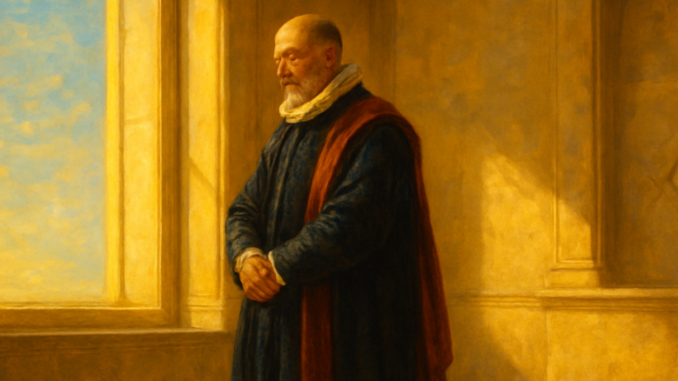
In 1571, Michel de Montaigne retired to the tower library of his château in the Dordogne. He was thirty-eight years old, had completed a career as a magistrate, and resolved to devote the rest of his life to reading, thinking, and writing. That decision gave rise to one of his most penetrating essays: On Solitude. In this thirty-eighth essay from the first book of the Essays, Montaigne examines what it truly means to withdraw from the world — and why most people who attempt it fail miserably.
The Historical Context: Why Montaigne Withdrew
Sixteenth-century France was a nation in turmoil. The Wars of Religion between Catholics and Huguenots were tearing apart the social fabric. As a councillor at the Parliament of Bordeaux, Montaigne had witnessed firsthand how political and religious conflict poisoned public life. The loss of his dear friend Étienne de La Boétie in 1563 had also affected him profoundly. When he arrived at his estate, he had a Latin inscription placed on the wall of his study: he declared himself weary of the slavery of the court and public duties, and from that point forward dedicated himself to rest and freedom.
It was from this deeply personal experience that Montaigne wrote his essay On Solitude. But contrary to what one might expect, it is not a hymn to the hermit’s life. The essay is, rather, a sharp analysis of what goes wrong when people assume that physical seclusion will automatically bring them peace.
The Core Idea: Solitude Is an Inner Attitude
Montaigne’s central argument is deceptively simple yet profoundly deep: true solitude is not a matter of physical isolation but of inner freedom. You can retreat to the countryside, rent a cabin in the mountains, or lock yourself in a monastery cell — but if you carry your worries, ambitions, and attachments with you, you are just as unfree as before. Montaigne writes that we must furnish a “back room” in our minds, a space that is entirely our own, free from the influence of others.
True solitude, in Montaigne’s view, is not an escape from the world but the ability to preserve within oneself a space that no one else can enter or disturb.
This idea Montaigne draws partly from Seneca, whom he quotes extensively in the essay, and from the Stoic tradition more broadly. But where Seneca tended toward strict self-discipline, Montaigne is gentler and more pragmatic. He acknowledges that most people are unable to relinquish all worldly attachments overnight. The point, he argues, is to gradually learn not to make your happiness dependent on external circumstances.
For those familiar with Masonic philosophy, this resonates deeply. The idea of cultivating an interior temple — a sacred space within — mirrors the Masonic principle that the most important building project is the work upon the self. The rough ashlar is not shaped by changing one’s location but by persistent inner labour.
Classical Examples Montaigne Employs
As is characteristic of the Essays, Montaigne draws liberally from classical antiquity. He references Pliny the Elder, who withdrew to study but did so with a ferocious work ethic, and Cicero, whose exile was more of a tortured struggle than a serene retreat. Montaigne observes sharply that Cicero’s solitude failed precisely because he never stopped longing for his lost political position. The lesson is clear: whoever retreats from the world out of frustration will inevitably carry that frustration along.
Against this, Montaigne places the example of Diogenes of Sinope, the Cynic philosopher who lived in a barrel and reduced his possessions to an absolute minimum. Although Montaigne admires such radical simplicity, he does not think it necessary to go that far. He advocates a middle path: enjoy what life offers, but ensure you never become dependent on it. He also mentions King Hiero of Syracuse, who, after relinquishing his throne, discovered that the simplicity of ordinary life gave him more satisfaction than all his royal splendour.
The Difference Between Being Alone and Being Free
One of the most powerful passages in the essay concerns the distinction between being alone and being truly free. Montaigne stresses that many people who withdraw from public life simply trade one set of chains for another. The ambitious politician who settles on his estate soon starts a new project that consumes him just as thoroughly as his former career. The merchant who retires then frets about his garden wall or his harvest. The problem, Montaigne argues, is not the outside world but the restless mind that everywhere seeks a new object of attachment.
Montaigne insists that we must learn to be sufficient unto ourselves. This requires practice and self-knowledge. The famous “back room” is not a physical place but a mental state: the ability to find refuge in your own thoughts at any moment, regardless of circumstance. In a sense, this is a lifelong project that is never fully completed.
Again, the Masonic parallel is striking. The journey through the degrees teaches us precisely this: that self-knowledge is not a destination but a continuous process of reflection, examination, and growth. The Lodge room itself can be understood as an outward expression of that inner back room Montaigne describes — a sanctified space set apart from the noise of the profane world, dedicated to contemplation and improvement.
A Mirror for the Modern Reader — and the Modern Freemason
Anyone reading this essay today will immediately recognise its relevance. In an age of constant digital connectivity, where notifications pull us out of concentration every few minutes and social media provide a relentless stream of comparison and validation, Montaigne’s call to cultivate an inner refuge is more urgent than ever. The point is not that we should throw away our phones or flee from society. The point is that we develop the skill to be at peace with ourselves amid all the noise.
Montaigne warns us against the illusion that a change of environment automatically brings a change of mood. Whether you live in a bustling city or in a remote mountain village, if you are internally restless, you will carry that restlessness with you wherever you go. The essay is therefore not a plea for isolation but for self-sufficiency of the mind.
For Freemasons, this teaching holds a particular significance. We gather in Lodge to work on ourselves, but the real test comes when we leave the temple and re-enter daily life. Can we maintain that inner equilibrium, that centred stillness Montaigne describes, when the world presses in on us with its demands and distractions? The ritual tools we are given — the square, the compass, the plumb line — are ultimately instruments of inner architecture. They remind us that the most important structure we will ever build is the one within.
Montaigne’s essay On Solitude is not a call to flee the world but an invitation to master the self. Four and a half centuries later, his insight remains as sharp and necessary as ever: true freedom is not found by changing where you are, but by transforming who you are within. For Freemasons engaged in the lifelong work of self-improvement, Montaigne’s “back room” serves as a powerful reminder that the inner temple must be tended with at least as much care as the outer one. In the end, the most profound solitude is not loneliness — it is the quiet strength of a mind that has learned to be at home with itself.
Copyright text & image: devrijmetselaar.nl
Texts are based on the ideas and content of the author of devrijmetselaar.nl, reviewed, corrected, and supplemented with the assistance of OpenAI. Images are created based on the ideas of the author of devrijmetselaar.nl using OpenAI/DALL-E.
Frequently Asked Questions
Why did Michel de Montaigne retire to his tower library in 1571?
Montaigne retired at age thirty-eight after completing his career as a magistrate at the Parliament of Bordeaux. He was motivated by the turmoil of sixteenth-century France, including the Wars of Religion between Catholics and Huguenots, the poisonous effects of political conflict he witnessed firsthand, and the profound loss of his dear friend Étienne de La Boétie. He resolved to devote the rest of his life to reading, thinking, and writing.
What is Montaigne's main argument in his essay 'On Solitude'?
Montaigne's central argument is that true solitude is not a matter of physical isolation but of inner freedom and attitude. He contends that you can retreat physically from the world, but if you carry your worries, ambitions, and attachments with you, you remain unfree. True solitude requires creating a 'back room' in your mind—a personal space entirely your own that is free from others' influence.
Why does Montaigne believe most people fail at attempting solitude?
Montaigne argues that most people fail at solitude because they assume physical seclusion will automatically bring peace, without addressing their inner state. They mistakenly believe that merely withdrawing from society will free them from their worries and attachments. However, without cultivating inner freedom and detachment from worldly concerns, physical isolation alone cannot achieve true solitude.


Be the first to comment