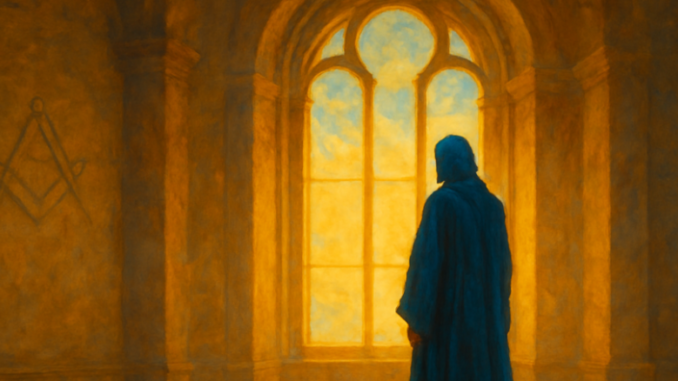
A thought that alters matter. A human mind that exerts measurable influence on physical reality. It sounds like alchemy, like magic — like something that belongs in the cellar of a medieval laboratory. Yet in his thriller The Lost Symbol, Dan Brown presents exactly this idea as a scientific breakthrough, intimately woven into the rituals and secrets of Freemasonry. But what is noetic science, really? And does Brown’s portrayal of the role Freemasons supposedly play in it hold up to scrutiny?
The Candle on the Working Table
Imagine a candle. Not the kind on a birthday cake, but a single flame on a working table in a quiet room. You look at it and see light, warmth, wax slowly melting. A chemist sees a combustion reaction. A poet sees impermanence. And a Freemason? A Freemason sees in that same flame an ancient, multilayered symbol: the light of knowledge dispelling the darkness of ignorance. The same candle, but a world of difference in meaning — depending on the consciousness with which you observe it.
It is precisely this interplay between observer and reality that lies at the foundation of what is sometimes called “noetic science.” The word derives from the Greek nous, meaning mind or consciousness. The central question is as simple as it is radical: can human consciousness influence the material world? In The Lost Symbol, Dan Brown makes this question a central plot element and ties the idea directly to Freemasonry. But it is important to carefully separate fiction from fact.
What Brown Claims vs. What Science Says
In Dan Brown’s novels, Freemasons are frequently portrayed as guardians of ancient, hidden knowledge. In The Lost Symbol, the story suggests that the noetic sciences prove that human thoughts can literally alter the fabric of reality — and that Freemasons have known this for centuries. It is a seductive idea that works beautifully in a thriller, but it deserves some nuance.
The noetic sciences do indeed exist as a field of inquiry. The Institute of Noetic Sciences, founded in the 1970s, conducts experiments exploring the possible influence of consciousness on matter. Some of these experiments — such as research into the effects of meditation or intention on random number generators — have produced intriguing results. However, within the established scientific community, these findings are considered controversial. The results are often difficult to replicate, the effects small, and the methodology regularly questioned. There is no proven, incontrovertible fact to point to.
The Rough Stone and Consciousness
This is where things become truly interesting from a Masonic perspective. Although Freemasonry is not a scientific institution and takes no position on the validity of noetic experiments, there is a deeper kinship with the underlying question. The entire Masonic tradition is built on the principle that inner work leads to outer transformation.
Consider the image of the rough ashlar — one of the most fundamental symbols in Freemasonry. The Entered Apprentice receives an unworked stone and is invited to labor on it: to chip, to shape, to refine. This is not literal stonemasonry. It is an invitation to self-knowledge and moral development. The idea behind it is that when a person transforms his own consciousness — polishes his character, chisels away his prejudices — he thereby changes the world around him as well. Not through supernatural forces, but through more conscious action, more just judgment, and deeper listening.
Freemasonry does not teach that thoughts change matter. It teaches that inner work on character and consciousness can tangibly improve the world through more righteous action.
The Misconception That Brown Reinforces
The greatest misconception that The Lost Symbol encourages is the idea that Freemasonry is a secret scientific society possessing hidden knowledge about the power of human consciousness. This image makes for thrilling fiction, but it is inaccurate. Freemasonry is a fraternity devoted to moral and personal development. Its rituals do contain rich, centuries-old symbolic language, but that language points to ethical and philosophical principles — not to secret scientific insights.
Thinkers who have influenced Freemasonry — such as Isaac Newton, Johann Wolfgang von Goethe, and Voltaire — were indeed interested in the boundaries of human knowledge. Newton spent a considerable portion of his life on alchemy and theology alongside his groundbreaking physics. Goethe explored the limits of human striving in his Faust. But none of them regarded Freemasonry as a laboratory for supernatural experiments. They saw the fraternity as a space for deepening understanding, for asking the great questions, for practicing tolerance, and for seeking truth.
The Flame as Mirror
Let us return to the candle on the working table. If we are honest, a thought does not change the flame. The wax does not melt faster because you stare at it. But your relationship to that flame — to the light, to the darkness surrounding it — that does change. And in that change lies something essential. Because anyone who learns to observe himself, who examines and refines his own consciousness, moves through the world differently. Not because matter changes, but because the observer changes.
This is perhaps the real secret that Dan Brown touches upon in The Lost Symbol without fully articulating it. Freemasonry promises no magical powers. It offers a method: a path of ritual, reflection, and brotherhood that invites each person to live more consciously.
The noetic sciences ask a fascinating question — whether consciousness can shape reality — but the answer remains far from settled. Freemasonry, meanwhile, has never claimed to hold that answer. What it does offer is something arguably more profound: a disciplined practice of self-examination that transforms how a person sees, thinks, and acts in the world. The candle on the table does not change. But the one who watches the flame, truly watches, may never be quite the same again.
Copyright text & image: devrijmetselaar.nl
Texts are based on the ideas and content of the author of devrijmetselaar.nl, reviewed, corrected, and supplemented with the assistance of OpenAI. Images are created based on the ideas of the author of devrijmetselaar.nl using OpenAI/DALL-E.
Frequently Asked Questions
What is noetic science and where does the term come from?
Noetic science is a field of inquiry derived from the Greek word 'nous,' meaning mind or consciousness. It explores the central question of whether human consciousness can influence the material world. The Institute of Noetic Sciences, founded in the 1970s, conducts experiments in this area, such as research into the effects of meditation or intention on random number generators.
Does Dan Brown's portrayal of Freemasonry in The Lost Symbol accurately reflect real Masonic beliefs about noetic science?
No. While Brown's novel suggests that Freemasons are guardians of ancient knowledge about noetic sciences and that human thoughts can alter reality, this is a fictional narrative. While Freemasonry does use symbols like the candle to represent deeper meanings such as knowledge dispelling ignorance, there is no evidence that the organization has centuries-old knowledge of proven noetic scientific principles.
Is noetic science accepted by the mainstream scientific community?
No. Although the Institute of Noetic Sciences has produced some intriguing experimental results, the mainstream scientific community considers these findings controversial. The results are often difficult to replicate, the effects are small, and the methodology is regularly questioned. There is no proven, incontrovertible evidence supporting the core claims of noetic science.

Be the first to comment