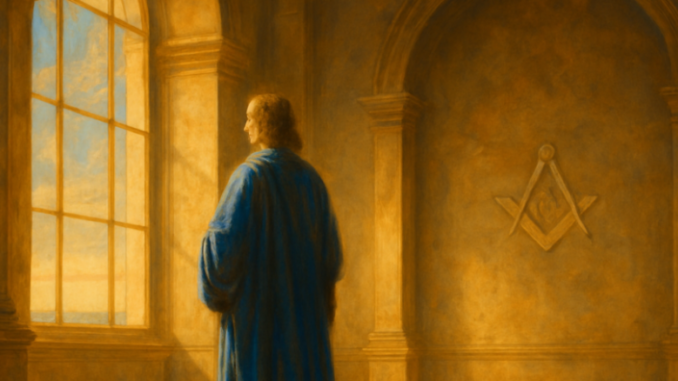
Can the human mind alter physical reality? This question, as old as philosophy itself, takes on a new form in Dan Brown’s The Secret of Secrets. The novel introduces readers to a fascinating yet controversial field: noetic science — a discipline that claims human thoughts and intentions can produce measurable effects on matter. But what does this claim actually amount to, and where does it intersect with the age-old quest for hidden knowledge that lies at the heart of Freemasonry?
The Premise: Consciousness as a Force
In The Secret of Secrets, Dan Brown presents noetic science as a legitimate field of research in which scientists experiment with the measurable influence of human intention on the physical world. According to the novel’s storyline, focused thoughts and collective meditation can actually alter the molecular structure of water, disrupt random number generators, and even accelerate healing processes. The book suggests that these insights have long been suppressed by powerful institutions but are now finally receiving scientific validation.
Brown does not present these ideas in isolation. He connects them to a rich tradition of esoteric wisdom — Hermetic philosophy, the Kabbalistic Tree of Life, and the mystical traditions preserved within Freemasonry. The implication is clear: what ancient initiates knew intuitively, modern science is now confirming with instruments and statistics.
The Paradox of the Measurable Mystery
Here a philosophical tension emerges that is well worth exploring. Noetic science, as The Secret of Secrets presents it, promises to make the intangible tangible. It seeks to subject the mystery of consciousness to laboratory conditions, repeatable experiments, and peer review. But is that not precisely what makes a mystery a mystery — that it resists complete comprehension?
Aristotle already distinguished between different forms of knowing. Episteme, demonstrative knowledge, differed fundamentally from sophia, the wisdom that touches the unspeakable. Plato wrote in his Seventh Letter about insights that cannot be captured in words but arise only through prolonged engagement with the subject itself. The question presents itself: if consciousness can truly influence matter, does the nature of that influence change the moment we place it under a microscope?
The power of a symbol lies not in what it reveals, but in what it conceals while revealing.
The Critical Reception: A Necessary Counterweight
The public debate surrounding The Secret of Secrets has laid bare this very tension. Science journalists and researchers have pointed to the methodological weaknesses of many experiments Brown cites. Effects found in some studies proved irreproducible under stricter conditions. Statistical significance was often marginal, and interpretation speculative.
Yet it would be too easy to dismiss the claim entirely. The history of science is full of ideas that were initially branded as quackery and later became mainstream. Continental drift, bacterial infection, even the finite nature of the universe — each of these insights was once ridiculed by the scientific establishment. The real question is not whether noetic science is true, but what standard of evidence we apply and why.
The Masonic Dimension: Knowledge as Initiation
For Freemasons, this debate resonates in a particularly profound way. The tradition of the Royal Art has always acknowledged that certain truths cannot simply be handed over. They must be experienced, lived through, acquired by means of ritual and reflection. The symbols in the Lodge — from the rough ashlar to the square and compasses — do not function as scientific propositions. They serve as gateways to insight.
Dan Brown touches on this tension between exoteric and esoteric knowledge in The Secret of Secrets. The book suggests that the secrets of Freemasonry are not about hidden facts but about a different way of knowing — a knowing that goes beyond the purely intellectual and engages the whole being. In this sense, the noetic science portrayed in the novel is a modern translation of an ancient insight: that the seeker himself is the instrument.
Synthesis: The Value of the Question
Perhaps the most important contribution of The Secret of Secrets is not the answer it offers but the question it poses. What can we know about consciousness? Where do the limits of the scientific method lie? And what does it mean if those limits exist?
Noetic science — whether it ultimately stands as a fully fledged research field or merely as a cultural phenomenon — compels us to think about the relationship between mind and matter. It reminds us of the question Descartes could never answer: how does the res cogitans influence the res extensa? Newton himself, alongside his mechanics, devoted thousands of pages to alchemy and biblical exegesis. The Enlightenment, it turns out, had its own shadow side.
The Open Question
What remains is an uncomfortable but fertile uncertainty. If consciousness can truly influence the physical world, it changes everything we think we know about causality, free will, and the nature of reality. If it cannot, we must explain why this belief persists so stubbornly across virtually every human culture. Both scenarios are fascinating. Both deserve serious philosophical attention.
The Secret of Secrets, for all the criticism leveled at its scientific claims, has exposed something essential: the human hunger for meaning beyond the measurable. That hunger is what draws people to Freemasonry, to philosophy, to art. It is the hunger that makes us human.
Whether noetic science ultimately proves its claims or not, the deeper question it raises will endure. The relationship between consciousness and reality is one that neither laboratory experiments nor ancient rituals have fully resolved. What Freemasonry and noetic science share is a conviction that the visible world does not exhaust reality — and that the journey of inquiry, far more than any final answer, is what transforms the seeker. In that shared conviction lies a truth that transcends both science and tradition.
Copyright text & image: devrijmetselaar.nl
Texts are based on the ideas and content of the author of devrijmetselaar.nl, reviewed, corrected, and supplemented with the assistance of OpenAI. Images are created based on the ideas of the author of devrijmetselaar.nl using OpenAI/DALL-E.

Be the first to comment