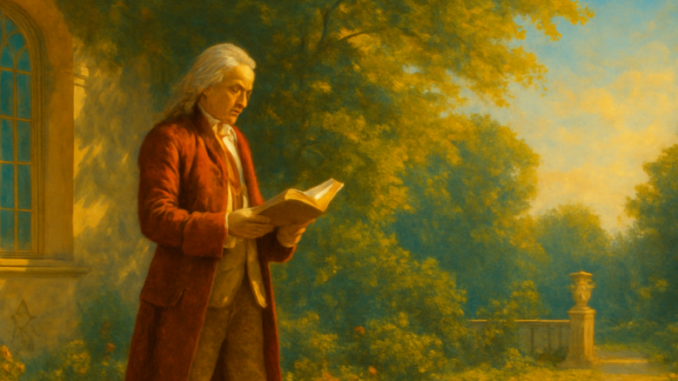
You have probably heard the famous closing line of Voltaire’s Candide: “We must cultivate our garden.” It is a sentence that has made people think for nearly three centuries. But where did this deceptively simple idea come from? Which philosophers and intellectual currents shaped Voltaire’s razor-sharp pen when he wrote this satirical masterpiece? Beneath the surface of what appears to be a lighthearted adventure story lies a rich web of philosophical thought — one that resonates deeply with anyone who has ever worked at shaping the rough stone of their own character.
Leibniz and the Optimism Voltaire Fought Against
At the philosophical heart of Candide lies a direct attack on the optimism of Gottfried Wilhelm Leibniz. This German philosopher championed the idea that we live in “the best of all possible worlds.” God, as a perfect being, could not have created anything less. Voltaire considered this position not merely naive but outright dangerous. The character of Pangloss in Candide is a biting caricature of Leibniz — a man who, no matter how many catastrophes befall him, insists that everything is for the best.
Voltaire wrote Candide shortly after the devastating Lisbon earthquake of 1755, which killed tens of thousands of people. The disaster shook all of Europe and forced philosophers to reconsider their theodicy — the justification of God in the face of evil. For Voltaire, it was inconceivable that such suffering could be part of a perfect divine plan. His satire became a philosophical weapon against blind acceptance and complacent faith in cosmic harmony.
John Locke, Empiricism, and Learning Through Experience
Voltaire’s thinking was profoundly shaped by his time in England, where he encountered the work of John Locke. Locke emphasized that all knowledge derives from experience rather than innate ideas. This empirical attitude permeates Candide: the protagonist does not learn through abstract reasoning but through his often painful encounters with the world. Every journey, every misfortune, and every meeting contributes to his eventual wisdom.
Empiricism also gave Voltaire the philosophical foundation to critique systematic optimism. If knowledge comes from experience, then our judgment about the world must be grounded in what we actually observe. And what Candide observes is a world full of war, injustice, and arbitrary suffering. The garden conclusion follows logically from this empirical lesson: stop speculating about the grand scheme of things and instead work with what you can directly influence.
Epictetus and the Stoic Foundations
Although Voltaire was not a Stoic in any strict sense, his garden metaphor shows striking parallels with Stoic wisdom. Epictetus, the former slave who became one of the most influential Stoic thinkers, drew a sharp distinction between what lies within our power and what does not. Candide’s garden symbolizes exactly this distinction: focus on your own labor, your own virtue, your own small corner of the world.
The garden in Candide is not a retreat from the world but a deliberate choice to act meaningfully within the boundaries of one’s own influence. This Stoic echo resonates powerfully with Masonic thought as well. The lodge is likewise a bounded space where brethren work on themselves — not to escape the outside world, but to grow from within. Marcus Aurelius, whose Meditations belong to the Stoic canon, wrote extensively about the importance of inner work regardless of external circumstances. Voltaire, though more skeptical by nature, shared this focus on personal responsibility.
Pierre Bayle and the Power of Doubt
A lesser-known but crucial influence on Voltaire was Pierre Bayle, the French philosopher and early champion of religious tolerance. Bayle’s Historical and Critical Dictionary was a masterwork of skeptical analysis in which he undermined traditional certainties with piercing questions. Voltaire admired Bayle’s ability to dismantle dogmas without proposing a new one in their place.
In Candide, this influence is evident in the way every philosophical system is systematically dismantled. Pangloss with his optimism, Martin with his pessimism, even the Eldorado utopia — each is tested and found wanting. What remains is not a grand theory but a modest practice. Bayle’s skepticism, filtered through Voltaire’s mind, resolved itself into pragmatism — a willingness to set aside unanswerable questions in favor of tangible, productive action.
Montaigne and the Art of Humble Inquiry
Michel de Montaigne, the father of the essay, also exercised a deep influence on Voltaire’s thinking. Montaigne’s famous question — “Que sais-je?” (What do I know?) — breathes the same intellectual humility that Candide ultimately achieves. After all his adventures, Candide realizes that the great metaphysical questions may simply be unanswerable. What remains is the concrete, the near at hand, the things one can actually shape.
Montaigne’s influence extends beyond philosophical content to literary style. His essayistic approach, blending personal observation with wide-ranging erudition, provided the model for Voltaire’s own writing. The lightness with which Candide treats the weightiest subjects recalls Montaigne’s art of making wisdom accessible without sacrificing depth — a quality that has kept both writers alive in the minds of readers for centuries.
The Garden as a Masonic Symbol
For Freemasons, the garden metaphor carries a special resonance. The garden represents cultivation — the transformation of raw material into something fruitful and purposeful. This aligns closely with the central Masonic image of the rough ashlar being shaped into a perfect cube. Voltaire himself was not a Freemason when he wrote Candide, yet his philosophical conclusion touches the same essential truth: human betterment comes through conscious, daily work.
Consider what the garden represents in this context. It is the domain you can actually influence. To cultivate it means to actively shape your world rather than passively endure it. And the result is not perfection — it never is — but a meaningful existence built through intention and effort. This is precisely the promise of the Masonic journey: not that you will arrive at some final state of completion, but that the work itself gives life its dignity and purpose.
The intellectual background of Candide reveals how Voltaire drew from Leibniz, Locke, the Stoics, Bayle, and Montaigne to arrive at his own unique synthesis. That synthesis is not a closed system but an invitation to act. And therein lies the enduring power of this work: it does not ask for agreement with a doctrine. It asks for personal application — for each of us to pick up our tools and tend our own garden.
Voltaire’s Candide remains one of the most potent philosophical texts ever written, not because it provides answers but because it asks us to stop hiding behind abstract systems and start doing the work that is right in front of us. For Freemasons, this message needs no translation. The rough stone does not shape itself. The garden does not cultivate itself. It is through conscious, humble, and persistent effort that we find meaning — not in grand theories about the universe, but in the quiet, daily labor of becoming better than we were yesterday.
Copyright text & image: devrijmetselaar.nl
Texts are based on the ideas and content of the author of devrijmetselaar.nl, reviewed, corrected, and supplemented with the assistance of OpenAI. Images are created based on the ideas of the author of devrijmetselaar.nl using OpenAI/DALL-E.
Frequently Asked Questions
What is the main philosophical target of Voltaire's Candide?
Voltaire's Candide is primarily an attack on the optimism of Gottfried Wilhelm Leibniz, who believed we live in 'the best of all possible worlds.' The character Pangloss is a caricature of Leibniz, always insisting that everything is for the best despite constant catastrophes. Voltaire wrote this satire shortly after the devastating Lisbon earthquake of 1755, which killed tens of thousands and forced philosophers to reconsider how God's perfection could allow such suffering.
How did John Locke's empiricism influence Voltaire's thinking in Candide?
Voltaire was profoundly influenced by John Locke's empirical philosophy during his time in England. Locke emphasized that all knowledge comes from experience rather than innate ideas. This philosophy is reflected throughout Candide, where the protagonist learns not through abstract reasoning but through painful real-world encounters. Empiricism provided Voltaire the philosophical foundation to critique optimism by arguing that our judgments about the world must be based on what we actually observe, not theoretical speculation.
What does 'We must cultivate our garden' mean in the context of the novel?
The famous closing line 'We must cultivate our garden' represents Voltaire's conclusion drawn from empirical philosophy and the novel's critique of blind optimism. Rather than speculating about grand cosmic schemes or accepting complacent faith in cosmic harmony, Voltaire suggests focusing on practical, tangible work within our own sphere of influence. It represents a rejection of abstract theorizing in favor of concrete action and personal improvement based on actual experience.

Be the first to comment