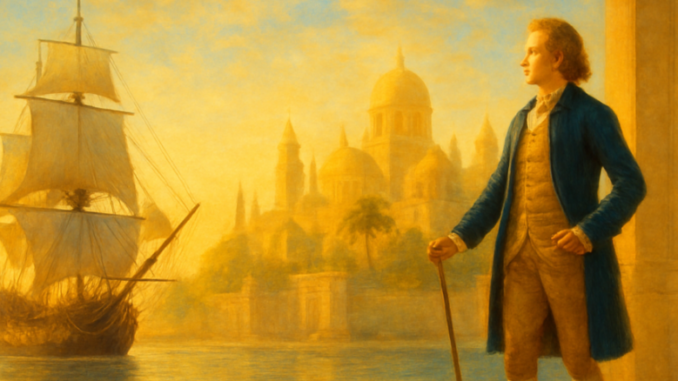
In 1759, Voltaire published his satirical masterpiece Candide, in which the naïve protagonist stumbles upon a seemingly perfect land: El Dorado. This golden realm, hidden deep in the mountains of South America, serves as a philosophical mirror held up to European society. But which thinkers and intellectual currents shaped Voltaire’s vision of this utopia? The roots stretch from Plato’s ideal state to the Renaissance humanists, touching upon questions that Freemasons have grappled with for centuries: how do we build a better world?
The Utopian Tradition Before Voltaire
The concept of an ideal society has a long history in Western thought. Plato, in his Republic, envisioned a community governed by philosopher-kings, where justice reigned as the supreme virtue. This vision remained influential for centuries, inspiring generations of thinkers to formulate their own societal ideals. In 1516, Thomas More published Utopia, describing a fictional island where private property did not exist and religious tolerance prevailed. The very title became synonymous with any imagined perfect land.
Voltaire knew these works intimately. As a voracious reader and tireless correspondent with intellectuals across Europe, he had access to the entire utopian canon. Tommaso Campanella’s The City of the Sun and Francis Bacon’s New Atlantis were part of his frame of reference. Yet Voltaire’s El Dorado differs fundamentally from these predecessors. Where More and Campanella offered detailed blueprints for an ideal state, Voltaire presents an ironic contrast that forces the reader to think — and to question.
Leibniz and the Optimism Under Attack
The central philosophical adversary in Candide is Gottfried Wilhelm Leibniz, the German philosopher who famously claimed that we live in “the best of all possible worlds.” Voltaire harbored a deep ambivalence toward this optimism. The catastrophic Lisbon earthquake of 1755, which killed tens of thousands of people, had profoundly shaken his faith in a justly ordered universe. Within this context, El Dorado functions as a thought experiment: if a perfect world can exist, why does the rest of humanity suffer so terribly?
El Dorado is not a blueprint for a perfect society, but a mirror that makes the shortcomings of our own world painfully visible.
The inhabitants of El Dorado have no priests quarreling over dogmas, no courts of law because there is no crime, and no gold as currency because abundance renders greed obsolete. Voltaire deploys these elements not to sketch a realizable utopia, but to critique Europe’s obsession with wealth, religious intolerance, and legal complexity. It is satire in the service of reason.
Influences from Skepticism and the Enlightenment
Voltaire was strongly influenced by the skeptical tradition, particularly the essays of Michel de Montaigne. This sixteenth-century thinker challenged the certainty of human knowledge and questioned cultural prejudices. In his famous essay On Cannibals, Montaigne defended indigenous peoples against European arrogance. This cultural relativism echoes clearly in El Dorado, where the civilization of its inhabitants far surpasses that of Europe — despite their geographic isolation.
Pierre Bayle, the French philosopher who championed religious tolerance, was another significant source of inspiration. His Historical and Critical Dictionary demonstrated how prejudice and superstition cloud human reason. In El Dorado, the inhabitants worship one God without temples or a priestly caste — an ideal that aligns with the deism embraced by Voltaire and many Enlightenment thinkers. This stripped-down, rational approach to the divine resonated with a broader intellectual movement that valued personal conscience over institutional religion.
El Dorado and Freemasonry: Building Toward Inner Perfection
The quest for the ideal society connects directly to themes that stand at the heart of Freemasonry. The rough ashlar that is shaped into a perfect cube symbolizes the personal development necessary for building a better community. El Dorado presents a people who have collectively completed this inner work: they know no greed, no religious conflict, no need for punishment. It is a civilization of completed builders.
Consider the core values embodied by El Dorado’s society: religious tolerance as the foundation of communal life, the absence of material greed, wisdom elevated above dogma, and a spirit of community without coercion. Each of these principles resonates powerfully with the teachings found within the Masonic lodge.
Voltaire himself was initiated into the Parisian lodge Les Neuf Sœurs in 1778, shortly before his death. Although Candide was written well before his initiation, the Enlightenment ideals that permeate the work and the principles of Freemasonry share the same intellectual soil. Both seek the improvement of humanity through reason, brotherhood, and moral development. El Dorado shows what might be possible when these principles are fully realized — a vision of humanity at its highest potential.
The Paradox of the Unreachable Ideal
Candide leaves El Dorado voluntarily, loaded with treasures that hold great value in the outside world. This departure is philosophically significant. The utopia cannot be exported; it exists only in isolation. Voltaire suggests that perfection is an inner state that cannot be achieved through external circumstances alone. The work within the world remains necessary, however imperfect that world may be.
The famous closing line of Candide — that we must cultivate our garden — forms the practical conclusion. Rather than dreaming of an unreachable paradise, we should work toward concrete improvements in the here and now. This pragmatic wisdom connects Stoic influences, such as the emphasis on what lies within our power, with Enlightenment optimism about human progress. Seneca would recognize the message: happiness lies in labor and virtue, not in external riches.
For Freemasons, this resonance is especially striking. The lodge is not a utopia — it is a workshop. The tools are symbolic, but the work is real. Just as Candide must leave the golden realm and tend his garden, the Freemason must take the lessons of the lodge into the world and apply them in daily life. The pursuit of perfection is not about arriving at a destination; it is about the journey of continuous improvement.
Voltaire’s El Dorado does not stand in isolation. It is deeply rooted in a philosophical tradition of utopian thought, skeptical questioning, and Enlightenment ideals. From Plato to Montaigne, from More to Bayle — each of these thinkers contributed building blocks to the golden realm of Candide. For Freemasons, this chapter offers a powerful mirror. The perfect society begins with the individual — with the daily, patient work of shaping the rough stone. El Dorado reminds us that the ideal may be unreachable, but the striving toward it is what gives our labor meaning.
Copyright text & image: devrijmetselaar.nl
Texts are based on the ideas and content of the author of devrijmetselaar.nl, reviewed, corrected, and supplemented with the assistance of OpenAI. Images are created based on the ideas of the author of devrijmetselaar.nl using OpenAI/DALL-E.
Frequently Asked Questions
What is El Dorado in Voltaire's Candide and what does it represent?
El Dorado is a hidden, seemingly perfect land in the mountains of South America that serves as a philosophical mirror to European society in Voltaire's 1759 satirical masterpiece Candide. Rather than a blueprint for an ideal state, El Dorado is a thought experiment designed to highlight the shortcomings of the real world by contrasting it with a place where crime doesn't exist, priests don't quarrel over dogmas, and greed is obsolete due to abundance.
How did the utopian tradition before Voltaire influence his vision of El Dorado?
Voltaire was familiar with earlier utopian works including Plato's Republic, Thomas More's Utopia, Tommaso Campanella's The City of the Sun, and Francis Bacon's New Atlantis. However, Voltaire's El Dorado differs fundamentally from these predecessors. While More and Campanella offered detailed blueprints for ideal states, Voltaire uses El Dorado ironically to force readers to question and think critically rather than provide a detailed societal plan.
What role does Leibniz's philosophy play in Candide and El Dorado?
Gottfried Wilhelm Leibniz's claim that we live in 'the best of all possible worlds' serves as the central philosophical target of Voltaire's critique in Candide. The catastrophic Lisbon earthquake of 1755, which killed tens of thousands, had shaken Voltaire's faith in a justly ordered universe. El Dorado functions as a counterargument to Leibniz's optimism, asking: if a perfect world can exist, why does humanity suffer so terribly?

Be the first to comment