
Can complete openness in friendship be naïve, or is withholding your true thoughts a betrayal of the bond you share? In his third letter to Lucilius, Lucius Annaeus Seneca poses a paradox that still resonates across the centuries: whoever distrusts a friend does not deserve to be trusted himself. Behind this seemingly simple statement lies a rich philosophical tradition connecting Stoic wisdom with deeper questions about human connection, virtue, and the art of living together.
The Stoic Foundations of Friendship
Seneca wrote his letters to Lucilius around 65 AD, at the height of his philosophical maturity. He drew upon a tradition stretching back to the early Stoa, founded by Zeno of Citium in third-century Athens. For the Stoics, friendship was no sentimental affair — it was a rational bond between virtuous souls. Chrysippus, one of the most important early Stoics, argued that only the wise are capable of true friendship, because only they possess the inner freedom to genuinely choose another person.
This may sound elitist, but Seneca refines the idea. He acknowledges that wisdom is an ideal people strive toward, not a status they achieve. Friendship thus becomes a training ground for virtue — a space where individuals grow together toward that ideal. Stoic friendship is not a contract of mutual benefit, but a shared dedication to the good life.
Aristotle and the Three Forms of Friendship
Seneca’s thinking about friendship is unimaginable without the influence of Aristotle, who distinguished three forms of friendship in his Nicomachean Ethics. The first is based on utility: people are friends because they gain something from one another. The second rests on pleasure: the friendship endures as long as the company remains enjoyable. But the third and highest form is the friendship of character, in which people love each other for who they truly are.
Seneca aligns himself with this framework when he warns Lucilius against extremes: do not distrust everyone, but do not trust blindly either. A true friend has undergone a process of being tested — not to put them on trial, but to come to know them deeply. This distinguishes Seneca’s Stoicism from naïve idealism. Friendship requires judgment, but that judgment must be completed before the friendship truly begins.
Once friendship is established, true friendship demands no further caution. Whoever distrusts a friend reveals that he himself is not worthy of trust.
Epicurus as an Unexpected Ally
Although Seneca was a Stoic, he never shied away from learning from other philosophical schools. Throughout his letters, he regularly quotes Epicurus, whose philosophy is generally seen as the antithesis of Stoicism. Yet both schools shared a deep respect for friendship. Epicurus viewed friends as indispensable for a happy life — not a luxury, but a necessity. His famous statement that it matters not what you eat, but with whom you eat, reflects a conviction Seneca would readily endorse.
For Epicurus, friendship was linked to security and inner peace. Seneca deepens this by emphasizing mutual self-development. Friends are not merely refuges from life’s storms; they are mirrors in which we learn to see our own soul. This idea resonates powerfully within Freemasonry, where brethren help one another shape the rough stone into something more perfect.
The Roman Context: Patronage and Sincerity
Seneca did not write in a philosophical vacuum. Nero’s Rome was a world of complex social networks, where friendship was often entangled with political interest. The patronage system bound people to one another through mutual obligations that had little to do with genuine affection. Seneca knew this system intimately. As an advisor to the emperor, moving in the highest circles of power, he understood how easily friendship could degenerate into opportunism.
His letter to Lucilius is therefore also a quiet critique of this culture. By advocating absolute openness between friends, Seneca offers a counterweight to the performative displays of Roman social life. This makes his message universal: in any society where interests and relationships become intertwined, the question of authentic connection remains urgent.
Friendship as a Building Block of Brotherhood
Freemasonry has a tradition of fraternal bonds that reveals striking parallels with Seneca’s ideal. In the lodge, people meet as equals regardless of social standing. The ritual framework creates a space where trust does not need to be forced but can grow naturally from a shared commitment to self-improvement. The symbols of the square and compasses remind every brother to measure his actions against ethical standards — precisely as Seneca urged Lucilius to shape his character.
Stoic friendship and Masonic brotherhood share a core insight: connection is not a given but an achievement. It must be built, maintained, and protected against the erosion of everyday interests. Seneca’s conviction that friendship demands complete openness mirrors the Masonic principle that genuine growth is only possible in a climate of mutual trust.
An Open Question
Seneca does not end his letter with a definitive answer, and that silence is telling. He allows the tension to stand — between caution and surrender, between judgment and trust. The philosophical tradition from which he draws, the voices of Zeno, Chrysippus, Aristotle, and Epicurus, offers no airtight formula. Instead, these thinkers hand us tools for reflection, not templates for imitation.
What does it truly mean to place your full trust in someone in a world where motives are seldom pure? Is it possible to achieve the kind of wise friendship Seneca describes — a bond that is both deliberate and unconditional? These are not questions with easy answers. They are the kind of questions that demand ongoing contemplation, the sort of inner work that both Stoic philosophy and Freemasonry place at the very center of a meaningful life.
Seneca’s third letter remains a remarkable meditation on the nature of trust and the demands of genuine friendship. By weaving together Stoic discipline, Aristotelian insight, and Epicurean warmth, he creates a vision of human connection that transcends his own era. For Freemasons, his words carry a special resonance: the lodge is, at its best, exactly the kind of space Seneca envisioned — a place where trust is earned through shared virtue, where openness is not weakness but strength, and where the rough stone of character is shaped through the steady hands of brotherhood. The question he leaves with us is not whether such friendship is possible, but whether we have the courage to pursue it.
Copyright text & image: devrijmetselaar.nl
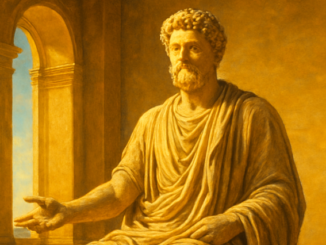
Texts are based on the ideas and content of the author of devrijmetselaar.nl, reviewed, corrected, and supplemented with the assistance of OpenAI. Images are created based on the ideas of the author of devrijmetselaar.nl using OpenAI/DALL-E.
Frequently Asked Questions
What is the main paradox about friendship that Seneca presents in Letter III?
Seneca presents the paradox that whoever distrusts a friend does not deserve to be trusted himself. This seemingly simple statement raises a fundamental question about whether complete openness in friendship is naïve or whether withholding your true thoughts constitutes a betrayal of the bond you share.
According to Stoic philosophy, who is capable of true friendship?
According to early Stoics like Chrysippus, only the wise are capable of true friendship because they possess the inner freedom to genuinely choose another person. However, Seneca refines this idea by acknowledging that wisdom is an ideal people strive toward rather than a status they achieve, making friendship a training ground for virtue where individuals grow together toward that ideal.
What are Aristotle's three forms of friendship, and which one does Seneca advocate for?
Aristotle identified three forms of friendship: utility-based (gaining something from each other), pleasure-based (enjoying each other's company), and character-based (loving each other for who they truly are). Seneca aligns himself with Aristotle's framework and advocates for the highest form—the friendship of character—which requires testing and deep knowledge of the other person before true friendship begins.



Be the first to comment