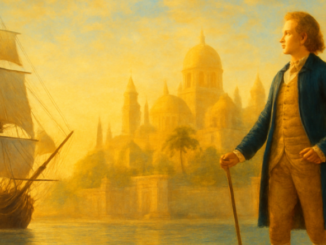
Symbolic golden city of El Dorado representing Voltaire's philosophical utopia
Symbolism & Rituals

Voltaire and El Dorado: Philosophical Roots of the Utopia

In 1759, Voltaire published his satirical masterpiece Candide, in which the naïve protagonist stumbles upon a seemingly perfect land: El Dorado. This golden realm, hidden deep in the mountains of South America, serves as a philosophical mirror held up to European society. But which thinkers and intellectual currents shaped Voltaire’s vision of this utopia? The roots stretch from Plato’s ideal state to the Renaissance humanists, touching upon questions that Freemasons have grappled with for centuries: how do we build a better world? The Utopian Tradition Before Voltaire The concept of an ideal society has a long history in Western thought. Plato, in his Republic, envisioned a community governed by philosopher-kings, where justice reigned as the supreme virtue. This vision remained influential for centuries, inspiring generations of thinkers to formulate their own societal ideals. In 1516, Thomas More published Utopia, describing a fictional island where private property did not exist and religious tolerance prevailed. The very title became synonymous with any imagined perfect land. Voltaire knew these works intimately. As a voracious reader and tireless correspondent with intellectuals across Europe, he had access to the entire utopian canon. Tommaso Campanella’s The City of the Sun and Francis Bacon’s New Atlantis were […]

Open book with garden and rough ashlar symbolizing Voltaire and Freemasonry
Symbolism & Rituals

Voltaire’s Candide: Why the Pursuit of Good Remains a Struggle

What does it truly mean to pursue the good in a world full of setbacks? Voltaire posed this question more than 250 years ago in his famous satirical novel. Today, we revisit that question — not as literary historians, but as seekers looking for the connection between philosophical insight and the values that Freemasonry holds dear. This is a reflection on optimism, virtue, and the inevitable struggle that accompanies the good life. Why Did Voltaire Take Aim at Naïve Optimism? Voltaire lived during a period of sweeping intellectual transformation. The Enlightenment ushered in a new faith in reason, but also in the notion that we inhabit “the best of all possible worlds.” This brand of optimism, popularized by the philosopher Gottfried Wilhelm Leibniz, was demolished by Voltaire with biting irony. His protagonist Candide travels through a world ravaged by war, natural disasters, and human cruelty, while his tutor Pangloss insists that everything is for the best. But was Voltaire a pessimist? That would be too simple. Voltaire did believe in progress — but progress that must be fought for. The good does not arise on its own. It demands effort, reflection, and the deliberate cultivation of virtue. And it is […]

Voltaire writing Candide surrounded by Enlightenment philosophical symbols
Symbolism & Rituals

Voltaire and Candide: Philosophical Roots of the Struggle for Good

It is 1759. In a Parisian salon, a grey-haired man hunches over a manuscript. His pen scratches furiously across the paper while carriages rattle past outside. François-Marie Arouet — better known as Voltaire — is writing sentences that will force an entire continent to reconsider the nature of good and evil. What drove this thinker to produce such biting satire, and which philosophical traditions fuelled his lifelong struggle? The Shadow of Leibniz To understand Voltaire’s Candide, we must first reckon with the philosopher he set out to demolish: Gottfried Wilhelm Leibniz. In his Theodicy of 1710, the German polymath argued that we inhabit “the best of all possible worlds.” God, as a perfect being, could have created nothing less than the most perfect reality. Every instance of evil we perceive, Leibniz reasoned, is a necessary component of some greater good that lies beyond our comprehension. Voltaire initially felt some sympathy for this optimistic worldview. But the Lisbon earthquake of 1755 — which killed tens of thousands of men, women, and children in a single morning — shattered that sympathy beyond repair. How could a loving God allow innocent children to be buried alive under rubble? The abstract reasoning of Leibniz […]

No Picture
Philosophy & Ethics

Freemasonry and Philosophy: The Ethical Foundation

Freemasonry is far more than a fraternal organization with elaborate rituals and symbolic regalia. At its heart, it is a philosophical and ethical system — a structured approach to self-improvement, moral reasoning, and the pursuit of truth. The intersection of freemasonry philosophy ethics has shaped some of the most thoughtful minds in Western history, offering its members a framework through which to examine their place in the world, their duties to their fellow human beings, and the nature of virtue itself. This pillar page explores the deep philosophical roots of Freemasonry, its core ethical principles, the thinkers and traditions that have influenced it, and why its moral teachings remain profoundly relevant in the modern world. Historical Background: Philosophy and the Origins of Freemasonry To understand the ethical foundations of Freemasonry, one must first appreciate the historical context in which the fraternity emerged and evolved. Although the precise origins of Freemasonry are debated by historians, the formation of the first Grand Lodge in London in 1717 marks the beginning of what is known as “speculative” Freemasonry — a practice that drew on the symbolic tools and language of medieval stonemasons to construct a philosophical and moral edifice rather than a physical […]

No Picture
History

History of Freemasonry in the Netherlands

The history of Freemasonry in the Netherlands is a fascinating journey through centuries of intellectual curiosity, civic engagement, and brotherhood. Since the first Dutch lodge was established in the early eighteenth century, Freemasonry has woven itself into the cultural, philosophical, and social fabric of the Low Countries. From the Golden Age salons of The Hague to the clandestine wartime meetings during the German occupation, Dutch Freemasonry has endured and evolved — shaped by enlightenment ideals, political upheaval, and an enduring commitment to the moral and spiritual development of its members. Understanding this history offers valuable insight not only into the Craft itself, but also into the broader story of Dutch society. The Origins of Freemasonry in the Netherlands To understand the history of Freemasonry in the Netherlands, one must first appreciate the broader European context from which it emerged. Modern speculative Freemasonry traces its institutional origins to the founding of the United Grand Lodge of England in London in 1717. The movement spread rapidly across Europe, carried by merchants, diplomats, military officers, and intellectuals who were drawn to its emphasis on reason, tolerance, and fraternal virtue. The Netherlands — a mercantile republic with strong ties to England and a tradition […]

Historical illustration representing the Enlightenment and Freemasonry connection
History

The Enlightenment and Freemasonry: Two Related Movements

When people learn you’re a Freemason, the same question often comes up: doesn’t that have something to do with those secret societies from the eighteenth century? It’s an understandable question. The Enlightenment and Freemasonry emerged during the same period and shared similar ideals. Yet the two movements are frequently conflated or even treated as one and the same. In this article, I’ll clearly explain what each movement represents, where they intersect, and where they fundamentally differ — because placing them side by side is one of the best ways to understand what Freemasonry truly is. The Enlightenment: An Intellectual Revolution The Enlightenment was a philosophical movement that emerged across Europe during the seventeenth and eighteenth centuries. Thinkers such as Voltaire, Jean-Jacques Rousseau, Immanuel Kant, and John Locke challenged superstition, religious dogma, and absolute power. They believed that through reason and science, humanity could arrive at a better understanding of the world. Kant’s motto — Sapere aude, or “dare to think” — captured this attitude perfectly. This intellectual movement led to concrete societal changes. The separation of church and state, the rise of democratic ideals, and the emphasis on human rights can all be traced directly back to Enlightenment thinkers. It […]

Masonic square and compasses with rough ashlar symbolizing ethical growth
Philosophy & Ethics

Ethics Without Dogma: The Philosophical Quest of Freemasons

In an age where ethical debates are increasingly reduced to rigid positions and online discussions devolve into moral tribunals, a pressing question emerges: is there still room for nuanced thinking about right and wrong? Freemasonry offers a surprising answer — not by prescribing ready-made rules, but by practicing an ancient philosophical method in which doubt is not a weakness, but the first step toward wisdom. The Return of the Great Ethical Conversation The societal debate about ethics has reached a new intensity. From artificial intelligence to climate justice, from genetic modification to the boundaries of free speech — moral convictions clash at every turn. What stands out is not so much the diversity of opinions, but the absolute certainty with which they are proclaimed. Nuance has become a rare commodity. Yet there is a place where the ethical conversation unfolds differently. Within the privacy of the Masonic lodge, the goal is never to have the final word, but to reach the next insight. Here, philosophy is not practiced as an academic discipline but as a living art. The question is not who is right, but what does justice to human dignity. Philosophy as a Tool, Not a Doctrine Freemasonry has […]