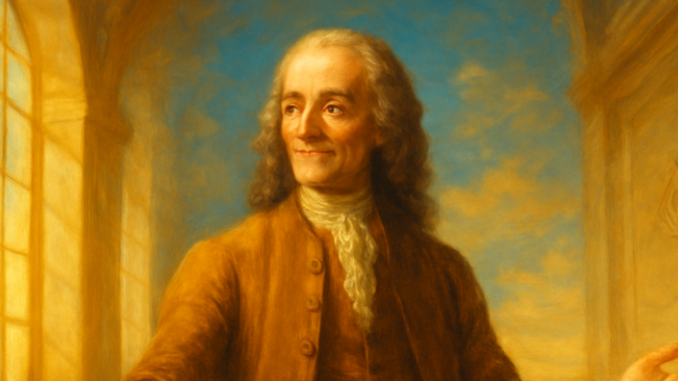
It is 1759. In a Parisian salon, a grey-haired man hunches over a manuscript. His pen scratches furiously across the paper while carriages rattle past outside. François-Marie Arouet — better known as Voltaire — is writing sentences that will force an entire continent to reconsider the nature of good and evil. What drove this thinker to produce such biting satire, and which philosophical traditions fuelled his lifelong struggle?
The Shadow of Leibniz
To understand Voltaire’s Candide, we must first reckon with the philosopher he set out to demolish: Gottfried Wilhelm Leibniz. In his Theodicy of 1710, the German polymath argued that we inhabit “the best of all possible worlds.” God, as a perfect being, could have created nothing less than the most perfect reality. Every instance of evil we perceive, Leibniz reasoned, is a necessary component of some greater good that lies beyond our comprehension.
Voltaire initially felt some sympathy for this optimistic worldview. But the Lisbon earthquake of 1755 — which killed tens of thousands of men, women, and children in a single morning — shattered that sympathy beyond repair. How could a loving God allow innocent children to be buried alive under rubble? The abstract reasoning of Leibniz suddenly seemed obscene against the backdrop of so much pointless suffering.
Enlightenment Thinking and the Authority of Reason
Voltaire was a child of the Enlightenment — that sweeping intellectual movement which elevated human reason to the highest authority. He shared with thinkers like John Locke and Isaac Newton a deep confidence in empirical investigation and critical thought. Yet where some Enlightenment philosophers leaned toward a cool, detached rationality, Voltaire always maintained a passionate engagement with human suffering. His philosophy was never merely intellectual; it was fired by moral outrage at injustice.
Voltaire taught us that goodness is not found in abstract systems, but in the daily struggle to cultivate our garden.
The influence of Pierre Bayle cannot be overlooked here. This French philosopher had deployed a devastating scepticism against all dogmatic systems in his famous Dictionnaire. Bayle demonstrated how our most cherished certainties are often built on quicksand. Voltaire adopted this critical stance wholeheartedly — but added something essential: the conviction that despite our uncertainty, we can and must still act.
The Stoic Undercurrent
Although Voltaire never explicitly acknowledged the Stoics as his teachers, their thinking echoes unmistakably through his work. Seneca and Marcus Aurelius taught that we have control only over our own actions and judgments — never over the external world. This wisdom reverberates in the famous closing words of Candide: “Il faut cultiver notre jardin” — we must cultivate our garden.
This is not passive resignation. It is active wisdom. The Stoics held that virtue lies in fulfilling our duties within our own sphere of influence. Voltaire translates this into a practical ethics: instead of speculating about cosmic justification, we should direct our energies toward the concrete improvement of our immediate surroundings. It is a philosophy of engagement, not retreat.
Renaissance Humanism as Fertile Ground
The roots reach deeper still. The humanism of the Renaissance, championed by thinkers such as Erasmus and Michel de Montaigne, had placed the human being at the centre of philosophical inquiry. Montaigne was a master at unmasking human vanity and self-deception. His motto — “Que sais-je?” (What do I know?) — became a compass for later sceptics and truth-seekers alike.
Voltaire admired Montaigne’s honesty and his refusal to accept easy answers. But where Montaigne tended toward a gentle relativism, Voltaire chose battle. He did not merely wish to describe how people go astray — he wanted to actively liberate them from the chains of superstition and injustice.
Freemasonry and the Search for Light
It is no coincidence that Voltaire was initiated into the Parisian lodge Les Neuf Sœurs in 1778, shortly before his death. Freemasonry shared his longing for enlightenment, tolerance, and moral elevation. The Masonic symbolism of the rough and polished ashlar mirrors precisely the struggle for goodness that Candide undergoes throughout the novel: the transformation of raw, unworked material into something of value through labour and reflection.
The rough ashlar symbolises the individual in their natural, unrefined state. The polished ashlar represents the result of sustained self-improvement. And the cultivation of the garden — Voltaire’s central metaphor — is the daily practice of that transformation. It is the work upon the self that every Freemason recognises as the heart of the Craft.
Voltaire’s message resonates deeply with the Masonic conviction that truth is never handed to us ready-made but must be discovered through personal effort. The Light that the Freemason seeks is no dogmatic certainty — it is the gradual illumination that comes through honest inquiry and moral labour.
A Philosophy of Action
What sets Voltaire apart from many of his predecessors is his emphasis on doing. Aristotle had already taught that virtue is a matter of habit and practice, not abstract knowledge. Voltaire radicalises this insight: philosophy that makes no difference in the world is idle pastime. The true philosopher is not the one who constructs the finest theories, but the one who alleviates the most suffering.
Candide travels a journey from naïve optimism, through cynical nihilism, to a wisdom that transcends both. He learns that the world is neither perfect nor hopeless. The struggle for goodness is not a matter of victory or defeat but of steadfast dedication to what lies within our reach.
The philosophical landscape behind Voltaire’s Candide reveals a rich interplay between critique and construction, between doubt and devotion. From Leibniz’s cosmic optimism to Stoic self-mastery, from Renaissance humanism to Enlightenment rationalism — all these currents converge in a work that invites us to stop speculating about the perfection of the universe and instead to cultivate our own garden. For the searching mind — and for every Freemason committed to the unending work of self-improvement — Voltaire’s message remains as vital today as it was in 1759: the good is not given; it must be built, stone by stone, day by day.
Copyright text & image: devrijmetselaar.nl
Texts are based on the ideas and content of the author of devrijmetselaar.nl, reviewed, corrected, and supplemented with the assistance of OpenAI. Images are created based on the ideas of the author of devrijmetselaar.nl using OpenAI/DALL-E.
Frequently Asked Questions
What philosophical idea did Voltaire attack in Candide?
Voltaire attacked Gottfried Wilhelm Leibniz's optimism, which argued that we live in "the best of all possible worlds." The Lisbon earthquake of 1755, which killed tens of thousands of innocent people, convinced Voltaire that Leibniz's abstract reasoning was obscene when confronted with real human suffering.
How did the Enlightenment influence Voltaire's thinking?
Voltaire was shaped by Enlightenment ideals that elevated human reason and empirical investigation as the highest authorities. However, unlike some detached rationalists, Voltaire combined this critical thinking with passionate moral outrage at injustice and a deep concern for human suffering.
What was Pierre Bayle's contribution to Voltaire's philosophy?
Pierre Bayle demonstrated through his Dictionnaire that our most cherished certainties are often unfounded. Voltaire adopted Bayle's scepticism toward dogmatic systems but added his own conviction that despite uncertainty, we must still act and work for goodness in the world.

Be the first to comment