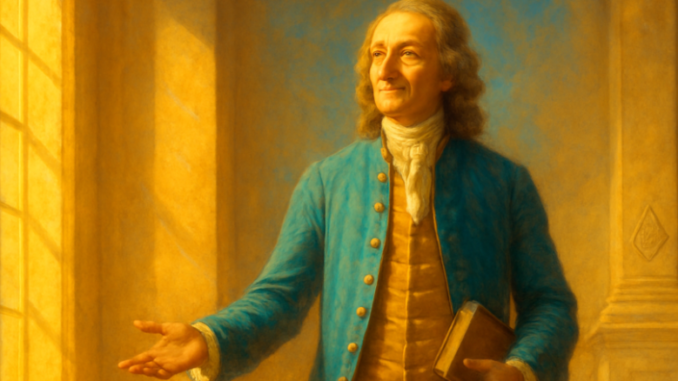
Can a person truly know anything, or are we merely grasping at shadows? This is the question Voltaire raises in his third philosophical letter, where he examines the ideas of John Locke. His answer — a radical rejection of innate ideas and a full embrace of sensory experience as the source of all knowledge — touches on a fundamental tension that lives at the very heart of Freemasonry. How do knowledge and mystery relate to one another? And what does it mean to search for truth within a brotherhood that acknowledges both light and darkness?
The Blank Slate and the Searching Mind
Voltaire presents Locke as the philosopher who finally had the courage to say aloud what others had only whispered: the human mind is not born as a storehouse of eternal truths, but as a blank slate. All knowledge arises from experience — from the impressions our senses deliver and the reflections our minds perform upon them. While this idea was not entirely new in the history of philosophy, Locke gave it a systematic treatment that Voltaire deeply admired.
For the Freemason, this image of the tabula rasa stirs a remarkable sense of recognition. The candidate enters the lodge blindfolded, stripped of metals and outward signs of rank. He arrives as someone who does not yet know, who is willing to learn anew. The rough ashlar waiting to be shaped is no different from Locke’s blank slate: a starting point of possibility, not of perfection.
Experience as Initiation
What drew Voltaire so strongly to Locke’s thinking was its humility. Where philosophers like René Descartes and Gottfried Wilhelm Leibniz assumed that certain truths were hardwired into the mind from birth, Locke insisted that we can only arrive at understanding step by step, through patient observation and careful thought. There are no royal roads to knowledge.
True knowledge does not come from what we are told, but from what we live through and think through ourselves.
This idea finds a powerful reflection in the ritual character of Freemasonry. The degrees are not taught through lectures alone — they are experienced in ceremonies that engage every sense. The initiate hears, feels, smells, and sees the symbols before he understands them. Experience precedes interpretation, precisely as Locke argued that impressions precede ideas. The ritual is not an illustration of a lesson already learned; it is the lesson itself, unfolding in real time through the body and the senses.
The Boundaries of What Can Be Known
Yet there is a paradox embedded in Voltaire’s praise of Locke. If all knowledge comes from experience, what about those things that lie beyond the reach of experience? The nature of the soul, the existence of a higher reality, the meaning of symbols that point toward the ineffable? Voltaire visibly wrestles with these questions, and it is precisely in this struggle that he speaks most directly to the Freemason.
The lodge acknowledges both the light of reason and the darkness of mystery. The Masonic search for truth is not a straight line from ignorance to omniscience, but a spiral in which every discovery raises new questions. The symbols of the compasses and the square, of the sun and the moon, of the rough and polished stone — these are not answers. They are invitations to further contemplation. They do not close the door on inquiry; they open it wider.
Connection Through Shared Not-Knowing
Here, Voltaire’s admiration for Locke and the Masonic values of brotherhood and connection meet in an unexpected way. If no one comes into the world with inborn wisdom — if all of us begin the same journey from experience toward understanding — then there is no ground for intellectual arrogance. The philosopher and the laborer, the scholar and the unlettered, they share the same fundamental condition: all of them grope in the dark, all of them seek the light.
Voltaire saw in England a society where this principle, however imperfectly, found expression in religious tolerance and intellectual freedom. Freemasonry, which was taking its modern form in that same era with James Anderson’s Constitutions of 1723, embodied this ideal even more explicitly. Men of different faiths and social stations met as brothers, united not by dogma but by a shared quest for meaning and truth.
This is one of Freemasonry’s most enduring contributions to the Enlightenment ideal: the conviction that what unites us is more important than what divides us, and that our common condition of not-knowing can become the very foundation of genuine fellowship.
The Unfinished Search
What stays with us after reading Voltaire’s letter on Locke? Perhaps this: that honesty about the limits of our knowledge is not a weakness but a virtue. Locke had the courage to admit that he did not know how matter could think, that he could not solve the riddle of consciousness. Voltaire admired him precisely for that intellectual modesty.
The Freemason recognizes in this the core value of self-reflection. It is not the illusion of perfection but the awareness of imperfection that drives inner growth. The rough ashlar is not polished in a single day, and the search for truth has no endpoint this side of the grave. What connects us is not the destination but the journey itself — the shared longing for light in a world that reveals itself to us only in fragments.
Consider these guiding principles drawn from Voltaire’s engagement with Locke:
- Knowledge grows through experience, not through assumptions.
- Humility about our limitations connects us as equals.
- Symbols invite ongoing contemplation rather than fixed conclusions.
- The search itself is more valuable than any imagined endpoint.
Voltaire’s letter on Locke is far more than a philosophical treatise — it is a call for intellectual honesty and human connection. The Freemason who reads this text will not find ready-made answers, but will discover a kindred spirit: someone who had the courage to acknowledge that the mystery is greater than our understanding, and who found in that very acknowledgment a basis for brotherhood. Perhaps that is the deepest insight Voltaire leaves us: wisdom does not belong to the one who possesses the most answers, but to the one who dares to keep asking the right questions.
Copyright text & image: devrijmetselaar.nl
Texts are based on the ideas and content of the author of devrijmetselaar.nl, reviewed, corrected, and supplemented with the assistance of OpenAI. Images are created based on the ideas of the author of devrijmetselaar.nl using OpenAI/DALL-E.
Frequently Asked Questions
What is the connection between Locke's blank slate theory and Freemasonry initiation?
Locke's concept of the tabula rasa (blank slate) — the idea that the human mind begins empty and gains knowledge through sensory experience — directly parallels the Masonic initiation process. Both emphasize beginning without preconceptions: the Masonic candidate enters the lodge blindfolded and stripped of rank, arriving as someone ready to learn anew, much like Locke's blank slate awaiting impressions. The rough ashlar awaiting shaping is a physical embodiment of this philosophical concept.
How does Voltaire's interpretation of Locke relate to Masonic ritual and learning?
Voltaire admired Locke's insistence that knowledge comes through patient observation and lived experience rather than innate truths or lectures alone. This directly reflects Masonic practice, where degrees are experienced through ceremonial engagement of all senses — hearing, feeling, smelling, and seeing — rather than being merely taught. In both philosophies, experience precedes interpretation, making the ritual itself the lesson rather than an illustration of one.
What is the fundamental tension Voltaire identifies between knowledge and mystery in Freemasonry?
Voltaire raises the question of how knowledge and mystery relate within Freemasonry's framework, which acknowledges both light and darkness. This tension stems from Locke's epistemology: while sensory experience provides knowledge, there remains a boundary to what can be known. Freemasonry similarly balances the pursuit of truth and enlightenment with the recognition that certain mysteries cannot be fully grasped, embodying this philosophical paradox at its core.


Be the first to comment