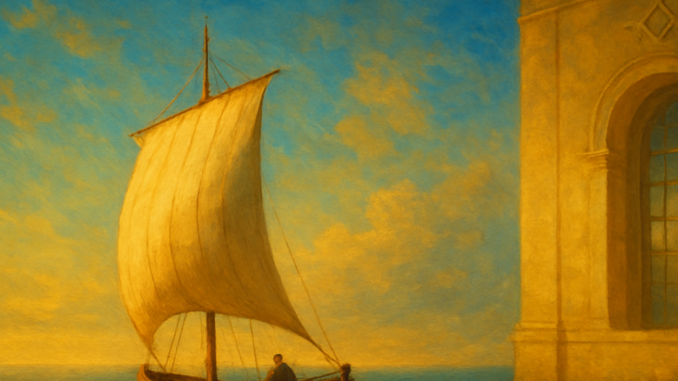
What happens when one of history’s sharpest minds flees his homeland and discovers, in exile, a society where religious diversity leads not to chaos but to prosperity? François-Marie Arouet — better known as Voltaire — had exactly that experience in England. He wrote about it in his Letters on the English, and his second letter, devoted to the Anglicans, paints a religious landscape that filled him with both astonishment and admiration. For those familiar with Freemasonry, his observations resonate in a remarkably powerful way. Voltaire touches on values the Craft has cherished for centuries: tolerance, the art of living together, and the ability to bridge differences without erasing them.
The Paradox of a State Church
Voltaire opens his letter with an apparent contradiction. England has a state church — the Church of England — which officially claims to represent the one true faith. Yet at the same time, he observes a society in which dissenters, Catholics, Quakers, and Jews live and trade alongside one another. How can a state church exist without producing the tyranny Voltaire knew so well from France?
This question forces us to reconsider the very nature of religious institutions. Is a church by definition an instrument of oppression, or can it also serve as a stabilizing force that leaves room for other voices? The Anglican Church, Voltaire suggests, had learned to temper its power. It still claimed a monopoly on truth, but it no longer enforced that claim at the point of a sword. This pragmatism — born out of the bloody religious conflicts of the sixteenth and seventeenth centuries — created a space where difference could exist without leading to destruction.
For Freemasonry, which found its modern form in exactly this English context, such a climate was essential. The first Grand Lodge was founded in London in 1717 — in a society that had learned, through hard experience, that religious uniformity is both impossible and perhaps undesirable.
Tolerance as Practical Wisdom
Voltaire describes not so much a theological tolerance as a commercial one. On the Royal Exchange, he observes with characteristic sharpness, the Jew does not call the Christian an infidel, and the Muslim does not treat the Lutheran as damned. They exchange goods, and that shared interest transcends their religious differences. This is not sentimental fraternity — it is rational self-interest that produces peaceful coexistence.
But the question naturally arises: is this enough? Is tolerance born from economic utility not a rather meager substitute for genuine brotherhood? True connection does not come from ignoring differences, but from finding a common foundation that runs deeper than dogma.
This is precisely what Freemasonry strives for. The Craft does not ask its members to abandon their religious convictions, but to find a level of connection that transcends those convictions. The Great Architect of the Universe is not a confessional deity — it is a symbol of the transcendent that all Brethren share, regardless of their personal faith. This is not relativism. It is the recognition that the search for truth is a shared human endeavor.
The Shadow of Power
Voltaire is no naive admirer, however. He notes that Anglican clergy are not free from the ambitions that characterize all human institutions. Bishops seek influence, and the church as an institution has its own interests to protect. The tolerance that distinguishes England is not solely the result of moral enlightenment — it also stems from a balance of power in which no single religious group is strong enough to dominate the others. This sober insight fits with Voltaire’s broader philosophy: institutions are the work of human hands, and human work is always imperfect.
For the Freemason, this observation holds up a mirror. The Lodge, too, is a human institution, subject to the same forces of ambition, vanity, and self-preservation. The rituals and symbols of the Craft are designed to tame these forces — to cultivate the virtue needed to wield power without abusing it. James Anderson, whose Constitutions of 1723 gave shape to modern Freemasonry, understood this well. He wrote rules not because Brethren are naturally virtuous, but because they must be shaped to become so.
The Art of Asking Questions
What Voltaire ultimately discovered in England was not a perfect system, but a society that had learned to live with imperfection. The Anglican Church was a compromise, tolerance a necessity, peace a fragile equilibrium. Yet this was enough to create space for thinkers, scientists, and seekers. Isaac Newton could pursue his research, John Locke could develop his philosophy, and Freemasonry could open its doors to men of all faiths.
Freemasonry shares with Voltaire a fundamental disposition: the willingness to ask questions without demanding immediate answers. In the Lodge, a Brother is not told what to believe — he is invited to seek for himself. The symbols of the square and compasses, of the rough and perfect ashlar, are not dogmas but tools for reflection. They work precisely because they are open to multiple interpretations, just as English tolerance worked because it left room for difference.
An Unfinished Search
Voltaire’s letter on the Anglicans does not end with a conclusion — it ends with an observation. He leaves the reader with the image of a society in motion: not perfect but functioning, not fully enlightened but moving toward the light. This is perhaps the deepest resonance with Freemasonry. Both traditions refuse to close the search for truth with a definitive answer.
The Craft does not call itself a possessor of truth, but a seeker of it. Every degree, every ritual, every meeting is a step on a path that is never fully traveled. In this, the Masonic journey mirrors the very society Voltaire admired: imperfect, ongoing, and always striving toward something greater than what has already been achieved.
Voltaire’s reflections on the Anglicans remind us that tolerance is neither an accident nor a luxury — it is a discipline, hard-won and easily lost. Freemasonry, born in the same crucible of religious conflict and pragmatic coexistence, carries this lesson at its very core. The Lodge exists not as a place where all questions have been answered, but as a space where they can be asked freely, among Brothers who have learned that the search itself is what binds them together. In a world still wrestling with the challenge of living alongside difference, both Voltaire’s wisdom and the Masonic tradition offer something enduringly valuable: the courage to seek light without claiming to have already found it.
Copyright text & image: devrijmetselaar.nl
Texts are based on the ideas and content of the author of devrijmetselaar.nl, reviewed, corrected, and supplemented with the assistance of OpenAI. Images are created based on the ideas of the author of devrijmetselaar.nl using OpenAI/DALL-E.
Frequently Asked Questions
How did Voltaire's observations of Anglican England relate to Freemasonry?
Voltaire observed that England's Anglican Church, despite being a state church, allowed religious diversity and coexistence without tyranny. This climate of tolerance was essential for Freemasonry's development, as the modern Craft was founded in London in 1717 within a society that had learned through bloody religious conflicts that uniformity was both impossible and undesirable. Voltaire's observations resonate with values Freemasonry has cherished for centuries: tolerance, living together peacefully, and bridging differences.
What paradox did Voltaire identify in the Anglican Church?
Voltaire noted that England had an established state church claiming to represent the one true faith, yet simultaneously hosted a diverse religious society where dissenters, Catholics, Quakers, and Jews lived and traded peacefully together. This apparent contradiction demonstrated that a state church could exist without producing the oppression Voltaire witnessed in France, suggesting the Anglican Church had learned to temper its power rather than enforce religious claims through force.
How did Voltaire describe tolerance in English society?
Voltaire characterized English tolerance not as sentimental fraternity but as practical wisdom rooted in commercial self-interest. He observed on the Royal Exchange that people of different faiths—Jews, Christians, Muslims, and Lutherans—conducted business together without religious conflict. This shared economic interest transcended theological differences and produced peaceful coexistence, demonstrating that pragmatism born from historical religious violence could create space for peaceful diversity.

Be the first to comment