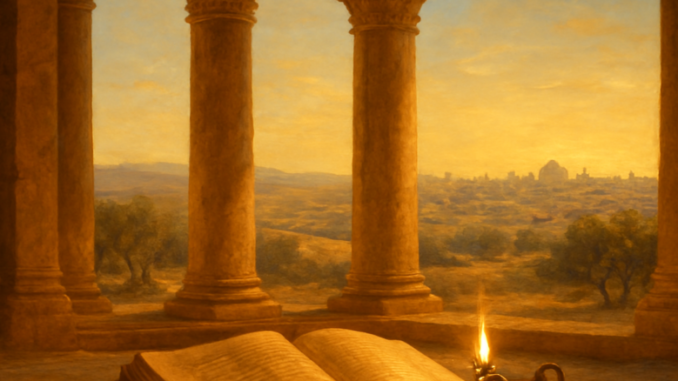
There is a remarkable tension at the heart of Paul’s First Letter to the Thessalonians: he calls for vigilance as though the end is near, yet simultaneously urges the patient building of a loving community. How can urgency and patience coexist? This paradox lies at the core of a text that proves surprisingly relevant for anyone reflecting on moral growth and brotherhood — including those who walk the Masonic path.
The Paradox of the Watchful Builder
Paul wrote this letter around 50 AD to a young community in Thessalonica, a port city in northern Greece. It is the oldest known text in the New Testament — older even than the Gospels. What stands out immediately is the dual message: on the one hand, Paul expects the end of days to arrive soon; on the other, he offers detailed instructions for daily life. Work with your hands. Encourage the fainthearted. Be patient with everyone.
At first glance, this seems contradictory. Why invest in relationships and craftsmanship if everything is about to end? And yet, there is a deeper truth hidden in this tension. The attitude of watchfulness does not replace the work of community building — it intensifies it. Those who watch live with attention. Those who live with attention build more carefully.
Children of the Light
In the fifth chapter of this letter, we encounter a powerful image that any Freemason will recognize. Paul draws a distinction between children of the night and children of the light. Night represents ignorance, complacency, and moral slumber. Light symbolizes awareness, sobriety, and ethical action. The believer is called to be watchful — clear-headed, not intoxicated by darkness.
Watchfulness, then, is not passive waiting. It is the active building of oneself and the community in which one lives.
The symbolism of light versus darkness is universal. In Freemasonry, the search for light is a central motif. The candidate enters the lodge in symbolic blindness and gradually receives more light as his understanding grows. This is not a one-time event but a continuous process. For Paul, too, light is not a possession but a charge: conduct yourself as a child of the light.
The Armor of Faith, Hope, and Love
Paul employs the image of armor: a breastplate of faith and love, a helmet that symbolizes hope. This is not a call to battle against others but to inner protection. The metaphor suggests that moral growth requires effort — that virtues must be practiced the way a soldier maintains his equipment. The triad of faith, hope, and love would later become one of the most celebrated formulas in the Christian tradition.
For the Freemason, this evokes the working tools used in the lodge. The square and compasses are not magical objects but symbols of self-discipline and justice. They remind the brother that he must continually work on himself. Like Paul’s armor, they are instruments for the inner journey, not weapons against the outside world.
Brotherhood as a Building Project
One of the most striking aspects of this letter is its emphasis on community. Paul speaks repeatedly about encouraging one another, admonishing the disorderly, and supporting the weak. The congregation is not a collection of isolated individuals but an organic whole in which every member bears responsibility for every other. This vision of brotherhood closely aligns with what Freemasonry understands as building the temple of humanity.
Aristotle wrote that man is a political animal, destined to live in community. The Thessalonians letter adds that such community must be actively maintained. It does not emerge on its own — it is built, stone by stone, through acts of charity and mutual encouragement. The building metaphor is not explicit in the text, but it resonates clearly in Paul’s call to constructive action.
A Counterpoint: The Limits of Urgency
We should not smooth over the tension in this text. Paul’s expectation that the end was near turned out to be unfounded. Two thousand years later, that second coming has still not occurred. Critical readers may see this as a weakness. At the same time, history shows that this very sense of urgency has motivated generations to ethical action. The question then becomes: do we need urgency to stay morally awake?
Montaigne, who reflected on death repeatedly throughout his essays, might answer that the awareness of finitude is not a threat but a gift. It reminds us that our time is limited and therefore precious. Whether that finitude is collective or personal matters less than the attitude it inspires — one of watchful attention to the present moment.
The Lodge as a Watchtower
The Masonic lodge can be understood as a space in which the paradox of 1 Thessalonians is lived out. Brethren come together to work on themselves and on their mutual bonds, knowing that this work is never finished. The rituals emphasize both the finitude of human life and the timelessness of the values being pursued. One watches not in fear but in hope. One builds not in haste but with care.
Consider the key principles that emerge from this reading:
Watchfulness as an active way of life. Light as a symbol of moral consciousness. Brotherhood as a continuous building project. Virtue as armor, not as a sword.
Paul’s letter to the Thessalonians is not a theological treatise but a practical guide. It does not demand blind faith but active engagement. In that sense, it speaks just as clearly to the modern reader who seeks meaning without dogma — and to every Freemason who understands the craft as an ongoing moral endeavor.
A question remains: if watchfulness means that we continuously build ourselves and our community, what happens when we fall asleep? Perhaps that is precisely the darkness Paul speaks of — not the absence of physical light, but the temptation to stop working on what connects us. The invitation still stands, as open and urgent as it was two thousand years ago.
Copyright text & image: devrijmetselaar.nl
Texts are based on the ideas and content of the author of devrijmetselaar.nl, reviewed, corrected, and supplemented with the assistance of OpenAI. Images are created based on the ideas of the author of devrijmetselaar.nl using OpenAI/DALL-E.
Frequently Asked Questions
What is the connection between 1 Thessalonians and Freemasonry?
Both traditions emphasize the journey from darkness to light as a metaphor for spiritual and moral growth. Paul's call to be 'children of the light' mirrors the Masonic initiation process, where candidates progress from symbolic blindness toward greater understanding and enlightenment through continuous self-improvement.
How does the concept of 'watchfulness' relate to Masonic practice?
In both Paul's letter and Freemasonry, watchfulness means active, attentive engagement rather than passive waiting. Masons are called to live with awareness and sobriety, building themselves and their communities through deliberate practice—much like Paul urged the Thessalonians to combine urgency with patient, careful community building.
What does the 'armor of faith, hope, and love' mean in a Masonic context?
Just as Paul's armor represents inner spiritual protection through virtue, Masonic working tools like the square and compasses symbolize self-discipline and the continuous work required for moral development. Both traditions teach that these are instruments for personal transformation, not conflict with others.
Why is the light symbolism important in both Freemasonry and Christian teaching?
Light represents awareness, ethical action, and understanding in both traditions. For Paul, believers are called to conduct themselves as 'children of the light,' while in Freemasonry, candidates receive increasing light as their knowledge and understanding grow, emphasizing that enlightenment is an ongoing, active process of learning and self-improvement.


Be the first to comment