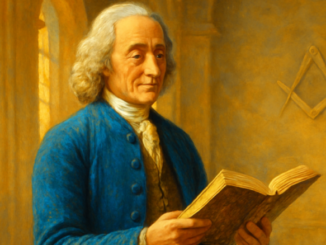
Explore the Anglican Church’s influence on Freemasonry, religious freedom, and tolerance. Discover philosophical connections between Enlightenment thought and fraternal brotherhood.

Symbolism & Rituals
Voltaire on the Anglicans: Religious Freedom and Brotherhood
What happens when one of history’s sharpest minds flees his homeland and discovers, in exile, a society where religious diversity leads not to chaos but to prosperity? François-Marie Arouet — better known as Voltaire — had exactly that experience in England. He wrote about it in his Letters on the English, and his second letter, devoted to the Anglicans, paints a religious landscape that filled him with both astonishment and admiration. For those familiar with Freemasonry, his observations resonate in a remarkably powerful way. Voltaire touches on values the Craft has cherished for centuries: tolerance, the art of living together, and the ability to bridge differences without erasing them. The Paradox of a State Church Voltaire opens his letter with an apparent contradiction. England has a state church — the Church of England — which officially claims to represent the one true faith. Yet at the same time, he observes a society in which dissenters, Catholics, Quakers, and Jews live and trade alongside one another. How can a state church exist without producing the tyranny Voltaire knew so well from France? This question forces us to reconsider the very nature of religious institutions. Is a church by definition an instrument […]