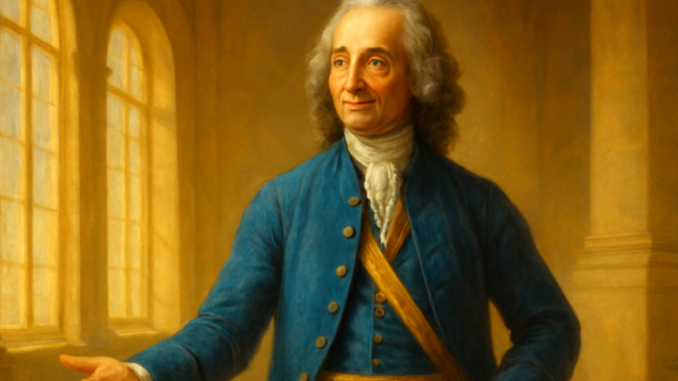
What drove one of the sharpest minds of the eighteenth century to become a Freemason at the age of eighty-four? Voltaire — the man who challenged kings and defied churches — chose to be initiated into the Parisian lodge Les Neuf Sœurs in 1778. Was this the whim of an aging philosopher, or the logical culmination of a lifetime spent in pursuit of reason, tolerance, and truth? A closer look at the thinkers and traditions that shaped Voltaire reveals why Freemasonry was far more than a social club for him — it was the embodiment of everything he believed in.
Why Did Voltaire Join Freemasonry?
At first glance, it seems paradoxical. Voltaire was a famous skeptic, a relentless critic of dogma and superstition. Why would such a man join a fraternity steeped in ritual, symbolism, and mystery? The answer lies in the philosophical tradition Voltaire cherished throughout his life. Eighteenth-century Freemasonry was not a religious movement — it was a meeting place for like-minded individuals united by shared values: tolerance, brotherhood, and the unending search for truth.
For Voltaire, this was precisely what he had been seeking. He had spent decades championing religious tolerance and fighting fanaticism. In the lodge, he found a community that put these ideals into practice, regardless of its members’ religious or social backgrounds. Freemasonry offered a space where belief in a Supreme Being was expected, but no specific creed was imposed — a distinction that mattered deeply to a man who had suffered persecution for his convictions.
The Philosophers Who Shaped Voltaire’s Thinking
To understand why Voltaire felt at home in Freemasonry, we need to trace his intellectual roots. His stay in England from 1726 to 1728 was transformative. There he discovered the work of John Locke, whose philosophy of tolerance and empiricism left a deep impression. Locke argued that knowledge comes from experience, not from innate ideas or ecclesiastical authority. This aligned seamlessly with Voltaire’s own distaste for dogmatism and blind obedience.
Voltaire also immersed himself in the work of Isaac Newton — not merely as a physicist, but as a symbol of an entirely new way of thinking. Newton demonstrated that nature is comprehensible through reason and observation. This deistic worldview, in which a Creator sets the universe in motion but does not interfere in daily affairs, became a cornerstone of Voltaire’s philosophy. And it is precisely this deism that resonated so naturally with Freemasonry, where belief in a Great Architect of the Universe is expected, but no particular religion is prescribed.
Voltaire and the Stoic Tradition
Although Voltaire was not a Stoic in the strict sense, he drew significantly from that tradition. Thinkers like Seneca and Marcus Aurelius emphasized the power of reason, self-discipline, and cosmopolitanism. Voltaire admired their capacity to endure personal suffering with dignity — a theme that echoed through his own life, marked as it was by exile, censorship, and persecution.
Voltaire’s initiation into Freemasonry was not a departure from his philosophy — it was its crowning moment: a formal entry into a brotherhood that celebrated reason, tolerance, and human dignity.
The Stoic emphasis on the universal bond between all people, regardless of origin or status, resonates powerfully with Masonic values. When Voltaire argued in his writings for a humanity that transcends national and religious boundaries, he spoke a language every Freemason recognizes. The lodge, in its ideal form, is exactly such a space — a place where people meet on the level, stripped of the distinctions that divide them in the outside world.
The Influence of Renaissance Humanism
Voltaire also stood in a longer tradition stretching back to the Renaissance. Thinkers like Michel de Montaigne had emphasized the importance of self-reflection and intellectual humility as early as the sixteenth century. Montaigne’s famous question — “Que sais-je?” (What do I know?) — reflects a skeptical attitude that Voltaire shared wholeheartedly. Knowledge is provisional, and the wise person acknowledges the limits of understanding.
This humanistic skepticism is woven into the very fabric of Freemasonry. The symbols and rituals invite reflection rather than the acceptance of absolute truths. The rough ashlar — the unfinished stone that symbolizes the individual’s ongoing work on the self — is an image that must have spoken deeply to Voltaire. For him, the examined life was not merely a philosophical ideal; it was a daily practice.
How the Enlightenment Fit Into the Picture
Voltaire was, of course, one of the driving forces behind the Enlightenment. But he stood on the shoulders of predecessors. Pierre Bayle, the French philosopher who defended religious tolerance from his base in Rotterdam, was a significant influence. Bayle’s “Dictionnaire historique et critique” demonstrated that critical thinking and respect for dissenting views could go hand in hand — a lesson Voltaire took to heart.
The Enlightenment as a movement shared core values with Freemasonry: trust in human reason as a guide for life; rejection of blind authority, whether ecclesiastical or royal; the ideal of progress through knowledge and education; and the conviction that all people are fundamentally equal in dignity. These were not abstract principles for Voltaire — they were lived commitments that found their institutional expression in the lodge.
The lodge Les Neuf Sœurs, where Voltaire was initiated, was a gathering place for enlightened minds. Benjamin Franklin was a member, alongside countless scientists, artists, and writers. For Voltaire, joining this lodge was no mystical flight of fancy — it was an affirmation of everything he had ever stood for.
What This Tells Us About Masonic Values
Voltaire’s initiation illustrates that Freemasonry has never been an intellectual vacuum. It has always attracted individuals who had already wrestled with the great questions of human existence. The rituals and symbols provided a framework for deepening that reflection in the company of others — not by imposing answers, but by encouraging the right questions.
The philosophical roots that Voltaire brought with him — from Locke to Seneca, from Montaigne to Newton — remain recognizable in contemporary Freemasonry. The Craft is not about adopting a doctrine. It is about continually asking questions, working on oneself, and respecting others in their own search for truth. These are values that transcend any particular era, and they are as vital today as they were when Voltaire walked through the doors of Les Neuf Sœurs nearly 250 years ago.
Voltaire’s entry into Freemasonry was no accident at the end of a long life — it was the natural outcome of decades of philosophical inquiry. The traditions that shaped him — Locke’s empiricism, Newton’s deism, Montaigne’s self-reflection, and the Stoics’ universal humanism — all converged in the Masonic lodge. His initiation reminds us that Freemasonry, at its best, is a living tradition: a space where the pursuit of reason, the practice of tolerance, and the commitment to human dignity come together in a brotherhood that continues to inspire.
Copyright text & image: devrijmetselaar.nl
Texts are based on the ideas and content of the author of devrijmetselaar.nl, reviewed, corrected, and supplemented with the assistance of OpenAI. Images are created based on the ideas of the author of devrijmetselaar.nl using OpenAI/DALL-E.

Be the first to comment