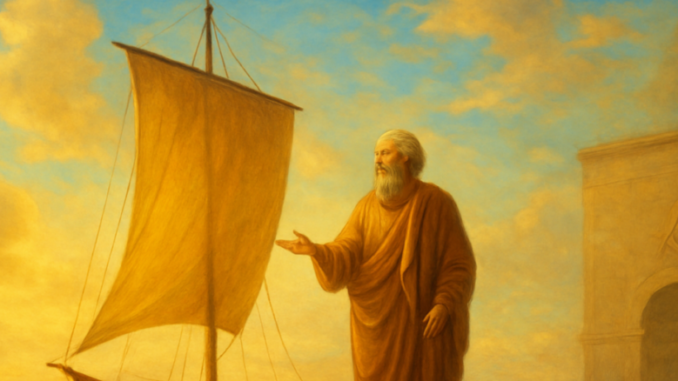
Imagine standing in your workshop, tools in hand, ready to create something. Not just anything — the most beautiful, most harmonious object you can conceive. This image lies at the heart of Plato’s Timaeus, a dialogue in which the philosopher describes how a divine craftsman shaped the universe. Written around 360 BC, this remarkable text offers surprisingly practical insights for anyone who builds — whether that means constructing something tangible or shaping one’s own character.
The Central Idea: The Universe as Conscious Design
In the Timaeus, Plato has the philosopher of the same name recount the origin of the cosmos. The central figure is the Demiurge — a word that literally means ‘craftsman’ or ‘maker.’ This divine creator looked upon the eternal, perfect Forms and used them as a blueprint to shape the physical world. The universe, then, is no accident. It is the result of purposeful craftsmanship.
This sets the Timaeus apart from many other creation stories. The Demiurge does not create out of nothing. Instead, he orders pre-existing, chaotic matter according to rational principles. He works like an architect following a ground plan, or like a sculptor who already perceives the hidden form within a block of rough marble. Creation here is an act of ordering, not of magic.
The Structure of the Dialogue
The Timaeus picks up where an earlier dialogue, the Republic, left off. Socrates asks his companions to bring his ideal state to life through narrative. Critias promises to tell the story of legendary Atlantis, but first Timaeus delivers a cosmological introduction. That introduction grows into the true heart of the entire dialogue.
Timaeus describes, in sequence, the creation of the World Soul, the formation of the heavenly bodies, the construction of the human soul and body, and the workings of sense perception. Every section follows the same logic: the higher, rational principle gives form to the lower, material one. The cosmos is literally an ordered whole in which everything has its proper place.
The Demiurge as Divine Master Builder
For Plato, the Demiurge is not an omnipotent god in the later monotheistic sense. He is more akin to a master craftsman who works with the materials at hand. The eternal Forms serve as his design; chaotic primordial matter is his raw material. Between these two stands his own goodness — his desire to make the universe as beautiful and as good as it can possibly be.
The Demiurge did not create the universe from nothing. He ordered chaos into harmony, much as a skilled craftsman transforms raw material into a work of art.
This conception has deep roots in the Greek understanding of craft and technique. The finest artisans do not merely imitate nature — they grasp the underlying principles and apply them. The Demiurge does the same on a cosmic scale. He understands the mathematical proportions that make beauty and stability possible and builds them into the very fabric of the universe. For those familiar with Masonic philosophy, this image of a Grand Architect working with geometry and proportion to bring order out of chaos will resonate powerfully.
Key Examples from the Text
Plato uses vivid, concrete images to make his abstract ideas accessible. One of the most famous is his description of the universe as a living being. The Demiurge endowed the cosmos with a soul so that it could move and sustain itself. The heavenly bodies revolve in regular orbits, performing an eternal dance that mirrors the order of the whole.
Another striking example concerns the four elements: fire, air, water, and earth. Plato links each element to a regular polyhedron — the so-called Platonic solids. Fire corresponds to the tetrahedron (pyramid), earth to the cube, and so on. These mathematical structures explain why the elements behave as they do. It is cosmology expressed as geometry.
Several other key ideas emerge throughout the dialogue. The World Soul serves as the bridge between the rational and the material. Time itself comes into being alongside the universe, described memorably as a ‘moving image of eternity.’ The human soul is akin to the World Soul and therefore possesses the capacity to comprehend the cosmos. And the body is understood as a vehicle for the soul, designed to make its journey through life possible.
Why the Timaeus Still Matters
Why would anyone in the twenty-first century bother reading the Timaeus? Because Plato poses a question that remains profoundly relevant: how do you bring order out of chaos? Whether you are building a house, leading an organization, or working on your own character, you face the same challenge as the Demiurge. You have a vision of how things should be. You have material that resists your efforts. And you must bridge the gap between the two.
The Timaeus suggests that this process begins with a clear image of the good. The Demiurge looked first to the eternal Forms before he began to build. Only then did he turn his hand to matter. This is eminently practical advice: begin with the end in mind. Know what you want to achieve before you get your hands dirty. In Freemasonry, this principle finds expression in the importance placed on contemplation and design before action — the tracing board precedes the building.
The Dialogue in a Broader Perspective
For centuries, the Timaeus was one of Plato’s most widely read works. Thinkers such as Aristotle, Plotinus, and Augustine all wrestled with the questions it raises. The image of a divine craftsman working with mathematical precision resonated deeply with traditions that value craftsmanship as a spiritual practice. The idea that the cosmos has a rational design remained influential well into the Scientific Revolution and continued to inspire philosophical and esoteric traditions alike.
For modern readers, the Timaeus offers a window into a worldview where beauty, truth, and goodness converge. According to Plato, the best way to make something is also the most ethical and the most true. This is not a nostalgic longing for a lost past — it is an invitation to see your own work, however humble, as participation in something far greater than yourself.
Plato’s Timaeus is far more than an ancient cosmological treatise. It is a handbook for anyone who builds. The Demiurge shows us that creation means looking toward the ideal, working with what is at hand, and striving toward harmony. Whether you are engaged in a project or working on yourself, the lesson is the same: begin with a clear vision, work with patience, and understand that every act of ordering is a small reflection of the cosmic design. For those who walk the Masonic path, this insight carries a particular weight — the work of the craftsman is never merely physical, but always a step toward the perfection of the whole.
Copyright text & image: devrijmetselaar.nl
Texts are based on the ideas and content of the author of devrijmetselaar.nl, reviewed, corrected, and supplemented with the assistance of OpenAI. Images are created based on the ideas of the author of devrijmetselaar.nl using OpenAI/DALL-E.


Be the first to comment