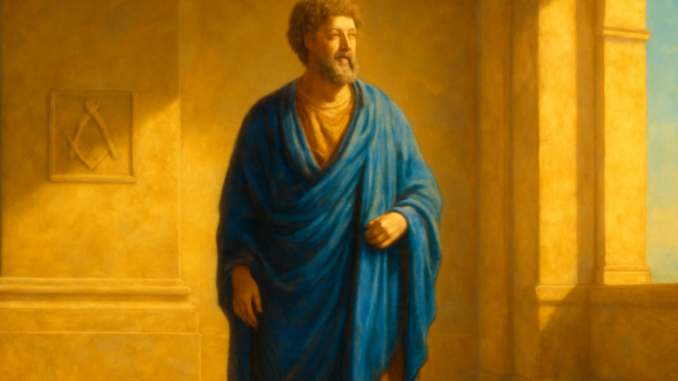
Why would a Roman emperor force himself out of bed before sunrise, even when every fiber of his body resisted? This question confronts us when reading Book V of the Meditations of Marcus Aurelius. The answer lies not in imperial discipline alone, but in ancient philosophical traditions that laid the groundwork for his thinking about duty and strength of character — traditions that continue to resonate deeply within Freemasonry.
The Core of Stoic Duty
Stoic philosophy, founded by Zeno of Citium around 300 BCE, forms the bedrock upon which Marcus Aurelius built his reflections. The Stoics taught that every human being fulfills a specific role within the cosmic order. Duty, in this view, is not an external constraint imposed from above — it is the natural consequence of understanding your place in the greater whole. When Marcus Aurelius speaks in Book V about rising from bed as a duty, he is invoking this deeper principle: you were born to act in accordance with your nature as a rational, social being.
The early Stoics, including Chrysippus and Cleanthes, developed the concept of kathêkon, often translated as “appropriate action” or “duty.” This idea differs from modern notions of obligation because it is not primarily about rules or commandments. Instead, it centers on recognizing what is fitting for a being of your particular nature. A bee makes honey because that is its nature. A human being acts justly and wisely because that is theirs.
The Teachers Who Shaped an Emperor’s Mind
Epictetus, the former slave who became one of the most influential Stoic philosophers, stands at the center of Marcus Aurelius’s intellectual formation. Although the emperor never met Epictetus in person, he studied his Discourses and Enchiridion thoroughly. The famous opening of Book V — in which Marcus addresses himself upon waking — directly echoes Epictetus’s pedagogical method: the inner dialogue as a tool for self-transformation.
Seneca, the Roman statesman and philosopher, offered a different model. Where Epictetus was the stern teacher, Seneca demonstrated how philosophy could coexist with political responsibility. His Letters to Lucilius address themes that resonate directly with Book V: How do you remain steadfast amid worldly concerns? How do you combine a contemplative life with active citizenship?
Duty in the Stoic sense is not a burden you carry — it is the expression of who you truly are when you live in harmony with your rational nature.
Character Strength and the Greek Virtue Tradition
The emphasis on strength of character in Book V is rooted in the Greek tradition of the cardinal virtues. Plato described four principal virtues in his dialogues: wisdom, courage, temperance, and justice. Aristotle refined this framework in his Nicomachean Ethics with the concept of hexis — a stable disposition or character trait acquired through practice. Marcus Aurelius inherited this tradition through the Stoic reinterpretation of it.
For the Stoics, all virtues were ultimately aspects of one fundamental virtue: practical wisdom. Character strength — what the Greeks called karteria — is the capacity to hold fast to rational insight despite emotional resistance. When Marcus Aurelius admonishes himself to get up, he is exercising exactly this quality. He transforms an everyday moment into an opportunity for moral growth.
The Connection to Freemasonry
The parallels between Stoic duty and Masonic ethics are striking. Both traditions emphasize that true virtue does not consist in outward display, but in the inner disposition of the practitioner. The Freemason works upon his rough ashlar not for applause, but because this labor gives expression to his essential calling as a human being.
The symbolic tools of Freemasonry — particularly the square and compasses — point toward the same discipline that Marcus Aurelius describes. The square calls for rectitude in action; the compasses for keeping due measure. Both are instruments for character formation, not through external control, but through voluntary self-mastery.
Just as Marcus Aurelius used philosophical principles to govern both empire and self, the Freemason uses symbolic tools and moral teachings to build an inner temple worthy of the name. The method differs; the aspiration is the same.
Why This Still Matters
The philosophical background of Book V reveals something essential: duty need not be synonymous with unfreedom. In the Stoic vision — and in the Masonic tradition that inherited so much of it — fulfilling one’s duty is the highest form of freedom. You are free when you act from genuine understanding of what is truly good, not when you are enslaved by shifting moods and impulses.
Marcus Aurelius wrote his meditations in a military tent on the Danube frontier, surrounded by war and uncertainty. Yet he found in the philosophical traditions of his predecessors a firm anchor. Epictetus had taught him that only his own thoughts and choices were truly under his control. Seneca had shown him how wisdom and power could be united. The cardinal virtues offered a compass for moral orientation.
The thinkers who shaped this tradition — Zeno of Citium as the founder of Stoicism and its doctrine of duty, Epictetus as the master of inner freedom and self-dialogue, Seneca as the bridge between philosophy and statesmanship, and Plato and Aristotle as the wellsprings of virtue ethics — together form the philosophical landscape in which Book V finds its deepest meaning. They offer no ready-made answers, but tools for those willing to take up the work of self-examination.
The question with which we began — why an emperor would force himself to rise — receives a surprising answer in this light. Marcus Aurelius did not get up despite himself, but as himself. The philosophical traditions that formed him, from the early Stoa to Greek virtue ethics, taught him that strength of character is not a battle against one’s own nature, but its fulfillment. For Freemasons, who likewise devote themselves to inner building, this lesson remains as relevant as ever: the rough ashlar is shaped not by reluctant obedience, but by the free and willing hand of one who understands why the work matters.
Copyright text & image: devrijmetselaar.nl
Texts are based on the ideas and content of the author of devrijmetselaar.nl, reviewed, corrected, and supplemented with the assistance of OpenAI. Images are created based on the ideas of the author of devrijmetselaar.nl using OpenAI/DALL-E.
Frequently Asked Questions
What is the connection between Marcus Aurelius's philosophy and Freemasonry?
Marcus Aurelius's Stoic philosophy, particularly his concept of duty and character strength outlined in Book V of the Meditations, shares fundamental principles with Freemasonry. Both traditions emphasize understanding one's place within a greater whole, acting in accordance with rational nature, and developing moral character through self-discipline and contemplation. These philosophical roots continue to resonate deeply within Masonic teachings about duty, virtue, and personal transformation.
What is kathêkon and how does it relate to duty?
Kathêkon, a Stoic concept often translated as 'appropriate action' or 'duty,' represents actions that are fitting for a being of your particular nature. Unlike modern notions of obligation based on rules or commandments, kathêkon is about recognizing what naturally aligns with your essence. For humans, this means acting justly and wisely because it is our nature to do so, not because we are forced to by external constraints.
How did Epictetus and Seneca influence Marcus Aurelius's thinking about duty?
Marcus Aurelius studied both philosophers extensively, though he never met Epictetus in person. Epictetus, a former slave, taught through inner dialogue and self-transformation—a method directly reflected in Book V where Marcus addresses himself upon waking. Seneca, a Roman statesman, demonstrated how philosophy could coexist with political responsibility, addressing themes of steadfastness amid worldly concerns and combining contemplative life with active citizenship, both central to Marcus Aurelius's understanding of duty.


Be the first to comment