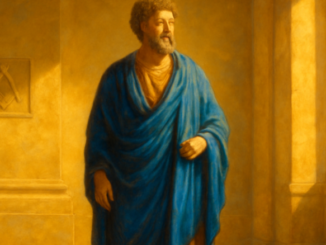
Statue of Marcus Aurelius symbolizing Stoic duty and Masonic character
Marcus Aurelius – Meditations

Marcus Aurelius Book V: The Philosophical Roots of Duty

Why would a Roman emperor force himself out of bed before sunrise, even when every fiber of his body resisted? This question confronts us when reading Book V of the Meditations of Marcus Aurelius. The answer lies not in imperial discipline alone, but in ancient philosophical traditions that laid the groundwork for his thinking about duty and strength of character — traditions that continue to resonate deeply within Freemasonry. The Core of Stoic Duty Stoic philosophy, founded by Zeno of Citium around 300 BCE, forms the bedrock upon which Marcus Aurelius built his reflections. The Stoics taught that every human being fulfills a specific role within the cosmic order. Duty, in this view, is not an external constraint imposed from above — it is the natural consequence of understanding your place in the greater whole. When Marcus Aurelius speaks in Book V about rising from bed as a duty, he is invoking this deeper principle: you were born to act in accordance with your nature as a rational, social being. The early Stoics, including Chrysippus and Cleanthes, developed the concept of kathêkon, often translated as “appropriate action” or “duty.” This idea differs from modern notions of obligation because it is […]
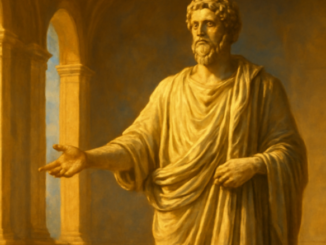
Ancient rock standing firm against ocean waves symbolizing Stoic resilience
Marcus Aurelius – Content & Summary

Marcus Aurelius Book V: Duty and Strength of Character

The fifth book of Marcus Aurelius’ Meditations opens with a remarkably intimate scene: the Roman emperor urging himself to get out of bed. This seemingly mundane moment carries a far deeper message. It is not about waking early — it is about the willingness to fulfill your duty, even when every fiber of your being resists. In Book V, Marcus Aurelius examines what it means to show true character when life pushes back, and how a sense of duty shapes us into who we are truly capable of becoming. The Morning as a Symbolic Starting Point Marcus Aurelius begins Book V with an inner dialogue that most of us will recognize instantly. He describes how the warmth of the bed beckons, how the mind invents reasons to stay lying down just a little longer. Yet he reminds himself that he was not born for comfort — he was born to act. The morning becomes a symbol for every new beginning, every choice where ease and duty stand in opposition. The moment of waking represents the awakening of consciousness to its responsibility. This image of the morning struggle touches on a universal human experience. It is not only the physical act […]