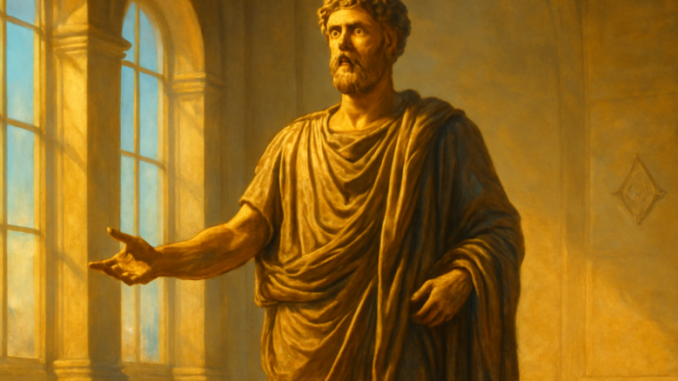
You are about to judge someone. Perhaps a colleague who is always late, a neighbor who neglects their yard, or a brother in the lodge who holds views different from your own. In that moment of judgment, it is not the other person who determines your state of mind — it is you. Marcus Aurelius understood this nearly two thousand years ago. In Book VIII of his Meditations, the Roman emperor reveals how our prejudices hold us captive and how we can set ourselves free. These insights find a remarkably direct application in Freemasonry, where the work of smoothing the rough ashlar begins with recognizing our own imperfections.
The Core of Book VIII: You Are Your Judgment
Marcus Aurelius writes in Book VIII that it is not events themselves that wound us, but the judgments we pass upon them. It sounds simple, but the implications are profound. When someone insults you, it is not the insult that causes pain — it is your own reaction to it. You choose to feel hurt. This core Stoic principle demands radical self-reflection: are you willing to put your own thinking under scrutiny?
In practical terms, this means something very concrete. When you notice irritation rising in response to someone’s behavior, pause. Ask yourself what judgment you are making. Is that judgment based on facts, or on assumptions? More often than not, you will discover that your prejudice reveals more about you than it does about the other person. Marcus Aurelius invites us to see this discovery not as a weakness, but as the first step toward wisdom.
The Hoodwink: A Symbol of Setting Aside Prejudice
In Freemasonry, the hoodwink — the blindfold — plays a central role during initiation. The candidate enters the lodge blindfolded, literally in darkness. This ritual points to something far deeper than mere ignorance. It symbolizes the necessity of shedding old prejudices before one can receive the light. You cannot truly see when you already think you know everything. The hoodwink compels the candidate to trust, to listen without judgment, and to surrender to an experience beyond his control.
This ritual moment mirrors exactly what Marcus Aurelius describes. As long as you cling to your prejudices, you remain in darkness. Letting go of those judgments is not a loss — it is a liberation. The hoodwink is removed, light breaks through, and you see reality as it truly is, not as you assumed it to be.
Prejudices are the hoodwink we impose upon ourselves. Both Marcus Aurelius and Freemasonry invite us to remove that blindfold consciously and deliberately.
Practical Steps for Recognizing Your Prejudices
How do you apply this wisdom in your daily life? Marcus Aurelius does not offer abstract philosophy — he provides practical tools. Here are concrete steps you can take starting today:
First, keep a journal for one week tracking every time you pass judgment. Note the situation, your judgment, and your emotional reaction. You will start to see patterns emerge. Second, ask yourself with each judgment: do I know this for certain, or am I assuming? Learn to distinguish between fact and interpretation. Third, imagine that the other person has good intentions. Marcus Aurelius recommends that whenever you feel irritated, consider that the other person is acting from their own understanding, not to deliberately harm you. Fourth, discuss your judgments with someone you trust. In Freemasonry, the brotherhood provides a safe space to examine your own patterns of thought without fear of ridicule.
These steps are not a one-time exercise. They are a lifelong practice. The rough ashlar is not polished in a single day.
Brotherhood Without Prejudice
Freemasonry brings together people from vastly different backgrounds, professions, and beliefs. In the lodge, a physician sits beside a craftsman, a believer beside an agnostic. This diversity only works when brothers are willing to set aside their prejudices. The lodge is not a place for class distinctions or ideological battles. It is a workshop where everyone stands equal in the search for light and truth.
Marcus Aurelius would recognize this immediately. He writes in Book VIII about the interconnectedness of all people as parts of a greater whole. When you condemn another person, you sever yourself from that whole. When you suspend your judgment and truly listen, you restore the connection. This is the essence of brotherhood — meeting one another not despite our differences, but through them.
From Insight to Daily Application
The real test comes outside the lodge, beyond the quiet moment of reflection. When you are stuck in traffic tomorrow morning and someone cuts you off, what do you do? When a family member says something that irritates you, how do you respond? Marcus Aurelius challenges you to remember in those moments: this is my judgment, not reality. I can choose how I react.
This is not passivity. You are not accepting everything uncritically. Rather, you are learning to distinguish between what you can influence and what you cannot. Adjusting your judgment is not weakness — it is mastery over yourself. And that is precisely what Freemasonry strives toward: not changing the world, but changing yourself so that you can contribute more meaningfully to the world.
A Daily Exercise in Self-Awareness
Each evening, take five minutes to look back on your day. Where did you pass judgment? Was that judgment helpful or harmful? What would Marcus Aurelius have done? This simple reflection, applied consistently, slowly transforms your automatic reactions. You will not become perfect, but you will become more conscious. And consciousness is the first step toward genuine connection.
Marcus Aurelius and Freemasonry speak the same language when it comes to prejudice. Both call for radical honesty about your own thinking. Both point to the same truth: connection with others begins with letting go of what you think you know. Removing the hoodwink is not a one-time act performed during initiation — it is a daily choice. Every time you recognize a judgment and dare to question it, you smooth another edge of your rough ashlar. Every time you listen without condemning, you strengthen the bonds of brotherhood. The work is never finished, but every conscious moment of self-examination brings you closer to the light.
Copyright text & image: devrijmetselaar.nl
Texts are based on the ideas and content of the author of devrijmetselaar.nl, reviewed, corrected, and supplemented with the assistance of OpenAI. Images are created based on the ideas of the author of devrijmetselaar.nl using OpenAI/DALL-E.



Be the first to comment