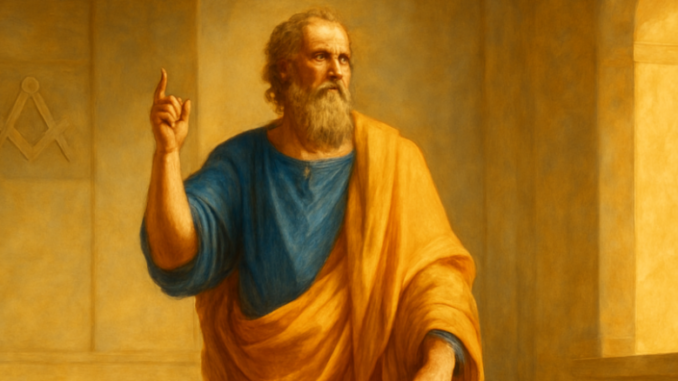
There is a paradox at the very heart of Western philosophy: the wisest man in Athens claimed to know nothing. When Socrates stood before the court, he was not so much defending his life as defending a way of life. The Apology that Plato recorded is far more than a legal document — it is a philosophical manifesto whose influence has echoed through the centuries, from the Stoics to Freemasonry. The question it raises still lingers: what does it truly mean to know yourself?
The Legacy of Delphi
Above the entrance to the Temple of Apollo at Delphi stood the famous inscription: “Know Thyself.” This oracle would become the starting point for Socrates’ entire philosophical quest. When his friend Chaerephon asked the oracle whether anyone was wiser than Socrates, the priestess answered that no one was. This response presented Socrates with a riddle that would define the rest of his life. How could he be the wisest man when he was so acutely aware of his own ignorance?
The Apology shows how Socrates resolved this apparent contradiction. By questioning politicians, poets, and craftsmen, he discovered that they believed they knew things they did not actually know. His own wisdom, he concluded, consisted precisely in the awareness of his limitations. This insight would lay the groundwork for what later became known as the Socratic method: the art of asking questions that unsettle entrenched certainties.
Pre-Socratic Echoes and the Daimonion
Although Socrates explicitly distanced himself from the natural philosophers who preceded him, the Apology carries unmistakable traces of earlier thinkers. His emphasis on the inner life mirrors the turn that Heraclitus had already initiated with his declaration that he had searched himself. Pythagoras, too, with his brotherhoods devoted to self-purification and moral improvement, set a precedent for the philosophical way of life that Socrates embodied.
Particularly striking is the role of what Socrates called his daimonion — an inner divine voice that warned him whenever he was about to do something wrong. This concept sits at the boundary between religion and philosophy. It suggests a personal access to the divine that bypasses official religious institutions, which was precisely the accusation that led to his condemnation. The tension between individual conscience and collective religious practice would become a recurring theme in Western intellectual history.
Stoic Resonance and Later Influence
The Stoics, who founded their philosophical school a few generations after Plato, recognized Socrates as their spiritual ancestor. His fearlessness in the face of death, his conviction that virtue matters more than self-preservation, and his emphasis on inner freedom became core principles of Stoicism. Marcus Aurelius, in his Meditations, returned repeatedly to Socratic themes, placing self-examination and moral autonomy at the center of his reflections.
“The unexamined life is not worth living.” This Socratic declaration forms the philosophical nucleus from which later traditions of self-knowledge — including Freemasonry — have drawn their inspiration.
Seneca, writing in first-century Rome, likewise drew on Socrates’ example. In his letters to Lucilius, he stressed that philosophy is not a theoretical exercise but a daily practice of self-transformation. The Apology provided living proof that a philosopher must be willing to defend his principles even unto death.
The Rough Stone and the Socratic Ideal
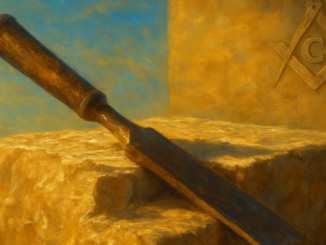
Here we arrive at the connection with Freemasonry — a connection that is far from accidental. The symbol of the rough ashlar, shaped through patient labor upon oneself into a perfect cube, mirrors precisely the Socratic program of self-examination and moral refinement. Just as Socrates invited his interlocutors to question their assumptions, the lodge invites its members to look at themselves with a critical eye.
The inscription “Know Thyself” appears in Masonic texts as a foundational charge. This is not coincidence but inheritance. Through the Renaissance, when humanists like Marsilio Ficino and Pico della Mirandola rediscovered and translated Plato’s dialogues, Socratic ideas flowed into the intellectual circles from which modern Freemasonry would eventually emerge. The emphasis on self-improvement, on cultivating virtue through reflection, connects the fifth-century Athenian marketplace with the eighteenth-century lodges of London and Paris.
The Trial as Symbol
The trial of Socrates carries its own symbolic weight. The philosopher stands opposed to the very community he serves yet also disturbs. His refusal to cease his questioning, even when his life hangs in the balance, symbolizes the tension between individual truth-seeking and societal conformity. This tension remains relevant in any community that values both tradition and critical thinking.
Freemasonry operates within a comparable dynamic. It offers ritual forms and symbolic language, yet at the same time expects each member to construct his own meaning. Ritual is not dogma but an invitation to interpretation. Just as Socrates claimed he was no teacher but merely a midwife helping others bring their own insights into the world, the lodge presents symbols without fixed exegesis.
The Question That Remains Open
What the Apology ultimately offers is not an answer but a method. Socrates does not prove that he is innocent of the charges brought against him. He demonstrates that the charges ask the wrong question. The real question is not whether he corrupts the youth, but whether a life without self-examination can truly be called a human life at all.
This shift from answer to question characterizes both Socratic philosophy and the Masonic approach to meaning-making. The symbols of Freemasonry — from the square and compasses to the blazing star — are not puzzles with solutions but invitations to ongoing reflection. They function much as Socrates’ questions did in the Athenian agora: not to close a discussion, but to open one that never fully ends.
Plato’s Apology remains one of the most powerful texts in Western thought because it refuses to offer easy answers. It challenges us, as Socrates challenged the Athenians, to examine our lives with honesty and courage. For Freemasons, the resonance is profound: the rough stone is never finished, the work of self-knowledge is never complete. The Delphic command to “Know Thyself” is not a destination but a lifelong journey — one that began on the steps of an ancient Greek temple and continues in every lodge where a Brother picks up his working tools and turns inward.
Copyright text & image: devrijmetselaar.nl
Texts are based on the ideas and content of the author of devrijmetselaar.nl, reviewed, corrected, and supplemented with the assistance of OpenAI. Images are created based on the ideas of the author of devrijmetselaar.nl using OpenAI/DALL-E.
Frequently Asked Questions
What is the main paradox that Socrates resolves in Plato's Apology?
The paradox is that Socrates, declared the wisest man in Athens by the Oracle at Delphi, claimed to know nothing. He resolved this by realizing that his wisdom consisted in being aware of his own limitations and ignorance, while others falsely believed they knew things they did not. This insight forms the foundation of the Socratic method.
What does the inscription 'Know Thyself' at the Temple of Apollo mean in the context of this article?
The inscription 'Know Thyself' above the Temple of Apollo at Delphi served as the starting point for Socrates' entire philosophical quest. It represents the central question of Western philosophy: what does it truly mean to know yourself? This concept became central to Socrates' teaching and continues to influence philosophical thought through movements like Stoicism and Freemasonry.
What is the daimonion and why was it controversial?
The daimonion is an inner divine voice that Socrates described as warning him whenever he was about to do something wrong. It represents personal access to the divine that bypasses official religious institutions. This concept was controversial and actually contributed to the accusations against Socrates, as it suggested a form of spirituality independent from collective religious practice, which challenged the established order.

Be the first to comment