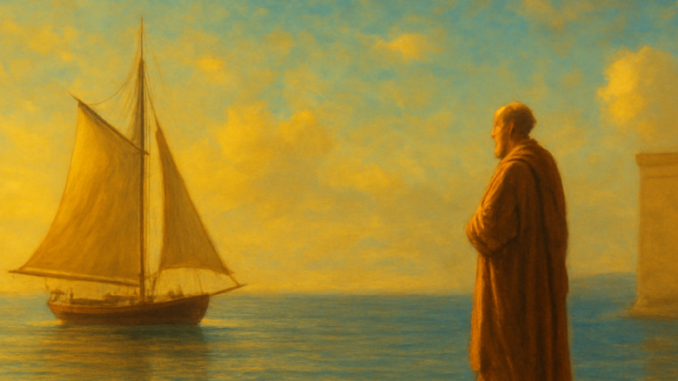
In 1580, Michel de Montaigne published his nineteenth essay under a provocative title: That to Philosophize Is to Learn to Die. Borrowed from Cicero, these words were not born of morbid fascination but served as an invitation to live more deeply. For this sixteenth-century thinker, contemplating death was never an endpoint — it was a starting point for meaning, human connection, and moral growth. These are precisely the elements that lie at the heart of Freemasonry.
The Historical Context of Montaigne’s Meditation
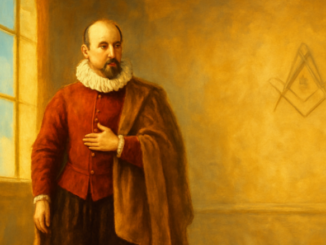
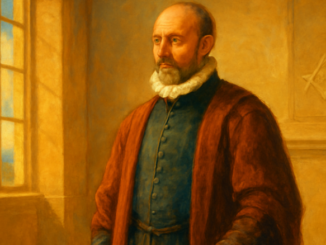
Montaigne composed his essays during an era of religious wars, plague epidemics, and political upheaval. France was torn apart by violent conflicts between Catholics and Huguenots. Death was not an abstract concept but a daily reality knocking on everyone’s door. Against this turbulent backdrop, Montaigne retreated to the tower of his château and began writing about what occupied his mind most urgently: how to live when the end is uncertain yet inevitable.
He drew inspiration from the Stoic philosophers — Seneca and Epictetus in particular — and from Cicero, who argued that philosophy is essentially a preparation for death. But Montaigne did not adopt this idea wholesale. He transformed it into something far more personal. The fear of death, he believed, should not be conquered through cold reason alone, but through familiarity. By facing our mortality each day, it loses its power to disrupt our lives.
Self-Reflection as the Foundation
What makes Montaigne’s approach so remarkable is his emphasis on self-reflection. He did not write from an ivory tower of abstract wisdom but from the ground level of his own experiences, doubts, and physical ailments. This honesty about the human condition aligns closely with a core value of Freemasonry: the continual examination of one’s inner self. The Freemason is invited to work upon the rough ashlar of character — a task that is only possible through unflinching self-observation.
He who learns to die, learns to live freely. True liberation lies not in denying our finitude but in embracing it as a source of connection with others.
Montaigne understood that self-knowledge is not a luxury but a necessity. Only when we acknowledge our own mortality can we truly cherish the present moment, our relationships, and the community to which we belong. This insight builds a bridge to Freemasonry, where the memento mori functions not as a threat but as a reminder of what truly matters.
Brotherhood in the Face of Finitude
One of the most moving aspects of Montaigne’s essay is its implicit emphasis on human connection. He describes how confrontation with death frees us from superficial concerns and draws us back to what is essential: love, friendship, and a sense of shared humanity. His legendary friendship with Étienne de La Boétie, who died young, profoundly colored his thinking about loss and connection.
A similar dynamic runs through Freemasonry. The fraternal bond is not a social network for personal gain — it is a space where men and women meet as travelers on the same road. The rituals continually remind us of the transient nature of earthly existence, not to discourage us, but to strengthen the bonds between brothers and sisters. Those who recognize that time is limited will not waste it on pettiness.
Virtue and Moral Growth
Montaigne was no moralist in the strict sense. He did not preach absolute truths but sought practical wisdom that could make life more bearable and richer. Yet a moral urgency permeates his work: if death can arrive at any moment, how do we wish to have lived? What traces do we want to leave behind?
These questions resonate deeply with the Masonic values of virtue and the pursuit of moral perfection. The rough stone we work upon is our own character. Every conversation in the lodge, every action in daily life, is an opportunity to move closer to our ideal self. Montaigne would likely have recognized this metaphor — he too saw life as a workshop where we continuously shape and reshape ourselves.
Lessons for the Modern World
What can a twenty-first-century reader learn from a sixteenth-century nobleman who wrote about death? Perhaps this: that our modern tendency to push mortality out of sight does not make us happier — it makes us shallower. The constant distraction of screens and stimuli keeps us from the questions that truly matter.
Montaigne invites us to adopt a different attitude. Not pessimistic, but realistic. Not fearful, but free. By accepting death as a companion, we can live each moment fully. And by sharing that way of living with others, we forge connections that run far deeper than superficial social interaction.
Consider the principles that unite Montaigne’s philosophy with Masonic practice: self-reflection as a daily discipline; awareness of finitude as a wellspring of meaning; brotherhood strengthened through shared vulnerability; and virtue as our answer to impermanence.
Freemasonry offers a framework within which these insights can come alive — in the silence of the temple, in the symbolism of the rituals, and in the conversations that follow. Montaigne’s essay is no historical curiosity. It is a living invitation to truly philosophize, truly live, and truly connect.
Michel de Montaigne taught us that philosophizing about death is not a somber pastime but the key to a free and connected life. His sixteenth-century insights find a powerful echo in Freemasonry, where self-reflection, brotherhood, and moral growth go hand in hand. Those who dare to acknowledge that life is finite will, paradoxically, discover the deepest sources of meaning and human connection.
Copyright text & image: devrijmetselaar.nl
Texts are based on the ideas and content of the author of devrijmetselaar.nl, reviewed, corrected, and supplemented with the assistance of OpenAI. Images are created based on the ideas of the author of devrijmetselaar.nl using OpenAI/DALL-E.
Frequently Asked Questions
What does Montaigne mean by 'to philosophize is to learn to die'?
Montaigne borrowed this phrase from Cicero to suggest that contemplating death is not morbid but rather a starting point for living more deeply and meaningfully. By familiarizing ourselves with our mortality through daily reflection, we lose our fear of death and can focus on what truly matters: present moments, relationships, and community.
How does Montaigne's philosophy relate to Freemasonry?
Both Montaigne's philosophy and Freemasonry emphasize self-reflection and inner examination as essential practices. The Freemason works upon the 'rough ashlar' of character through unflinching self-observation. Additionally, both traditions use memento mori (remembrance of death) not as a threat, but as a reminder of what truly matters and as a foundation for human connection and brotherhood.
Why did Montaigne write about death during the sixteenth century?
Montaigne lived during an era of religious wars, plague epidemics, and political upheaval in France. Death was a daily reality rather than an abstract concept. In response to this turbulent backdrop, he retreated to his château tower to explore how to live meaningfully when the end is uncertain yet inevitable, drawing inspiration from Stoic philosophers like Seneca and Cicero.

Be the first to comment