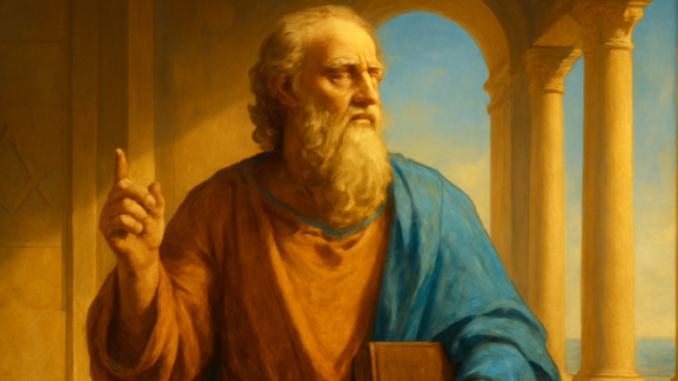
In fifth-century Athens, a battle raged that remains profoundly relevant to this day. It was not fought over land or wealth, but over something far more fundamental: whether words should serve truth or merely serve the power to persuade. Plato captured this tension in his dialogue Gorgias, a work that strikes at the heart of what it means to live a just life. For Freemasons — who place the pursuit of truth and moral perfection at the center of their craft — this ancient conversation offers remarkably timely insights into authenticity, virtue, and the true nature of human connection.
The Historical Context of a Philosophical Confrontation
Around 380 BCE, Plato composed the Gorgias, named after the celebrated orator from Sicily who had visited Athens. The dialogue is set during a period when the Sophists — itinerant teachers of eloquence — wielded enormous influence over public life. They taught the art of defending any position persuasively, regardless of its truth. Gorgias himself was renowned for his ability to make the weaker argument appear the stronger.
Socrates, Plato’s teacher and the protagonist of the dialogue, confronted this worldview head-on. Where the Sophists viewed rhetoric as a neutral technique, Socrates insisted that true eloquence is inseparable from knowledge of the good. This was no mere academic disagreement. In a democracy where citizens voted directly on matters of war and peace, the power of the spoken word literally determined the fate of the city-state.
The Distinction Between Appearance and Truth
In the Gorgias, Socrates unmasks conventional rhetoric as a form of flattery. He compares it to cookery, which merely pleases the palate, as opposed to medicine, which truly heals. The orator can sway the crowd without possessing any genuine understanding of justice. He produces belief without knowledge, appearance without substance. This critique touches on a timeless human temptation: the desire to impress rather than to truly be.
True eloquence is not the ability to convince others, but the ability to speak the truth so clearly that it convinces by its own light.
The dialogue makes the provocative claim that committing injustice is worse than suffering it. Callicles, one of Socrates’ interlocutors, pushes back fiercely. He champions the right of the strong and dismisses conventional morality as an invention of the weak. Socrates refutes him by demonstrating that true strength lies not in dominating others, but in mastering oneself. A person who cannot govern his own desires is enslaved by his passions, no matter how powerful he may appear to the outside world.
Parallels with Masonic Values
The themes of the Gorgias resonate deeply with the foundational principles of Freemasonry. The emphasis on inner truth over outward appearance mirrors the Masonic ideal of the rough ashlar that must be shaped and refined. What matters is not the facade one presents to the world, but the inner condition of one’s character. The lodge functions as a space where brothers and sisters hold each other accountable for authenticity — a place where the masks of social convention can be set aside.
The Masonic commitment to pursuing truth finds a clear echo in Socrates’ unwavering devotion to what is real and right. Where the Sophists used language as an instrument of power, Socrates saw it as a means of arriving at truth together. This dialogical ideal — in which partners in conversation seek insight collectively — also underpins Masonic practice. The ritual work of the lodge is not a one-way transmission of knowledge but a process of shared discovery.
Justice as a Way of Life
Plato has Socrates defend a radical proposition in the Gorgias: it is better to suffer injustice than to commit it. This defies common sense, yet it follows logically from the premise that the soul matters more than the body. Whoever commits injustice damages his own soul. Whoever suffers injustice can remain inwardly whole. The just person carries within an inner harmony that no external circumstance can disturb.
For Freemasons, this translates into the concept of moral perfection as a lifelong pursuit. The working tools of the Mason — the square and compasses — symbolize the constant measuring and adjusting of one’s conduct against objective standards of virtue. Like Socrates’ philosopher, the Freemason strives for a life of inner coherence, where word and deed, conviction and action, are brought into alignment.
From Ancient Athens to the Modern Lodge
The questions Plato raises in the Gorgias are no less urgent in an age of social media and manufactured public opinion. Today’s Sophists wield algorithms and framing techniques, influencers and viral messaging. The temptation to persuade without informing, to manipulate without genuine dialogue, is greater than ever. In this context, the Gorgias serves as a moral compass.
Freemasonry preserves spaces where the slow, deliberate conversation is still possible — where members listen to understand rather than to refute, where silence is respected as a precondition for depth. The lodge thus acts as a counterweight to the superficiality of public discourse, a place where the Socratic tradition remains alive. The brotherhood that emerges there is not founded on shared opinions, but on a shared dedication to the search itself.
Lessons for the Seeking Mind
Plato’s Gorgias teaches that the quality of our speech reflects the quality of our soul. Those accustomed to flattery lose the capacity for sincerity. Those who are always persuading forget how to listen. The dialogue invites genuine self-reflection: do my words serve the truth, or do they merely serve my own interests? This is not a rhetorical question — it is a practical call to honesty.
Consider these principles drawn from the dialogue and echoed in Masonic tradition: examine your motives before you speak; seek dialogue rather than debate; value truth above applause; and recognize that mastering yourself is the highest form of strength. These are not abstract ideals — they are daily practices that shape character over a lifetime.
Plato’s Gorgias remains one of philosophy’s most powerful meditations on the relationship between speech, justice, and the inner life. For Freemasons, its message is both a confirmation and a challenge: a confirmation that the ancient pursuit of truth and virtue lies at the heart of the Craft, and a challenge to embody those ideals not only within the walls of the lodge, but in every conversation, every decision, and every encounter with the world. The rough ashlar does not shape itself. It asks for the steady hand of someone willing to do the work — guided by the square of justice and the compass of self-mastery.
Copyright text & image: devrijmetselaar.nl
Texts are based on the ideas and content of the author of devrijmetselaar.nl, reviewed, corrected, and supplemented with the assistance of OpenAI. Images are created based on the ideas of the author of devrijmetselaar.nl using OpenAI/DALL-E.
Frequently Asked Questions
What is the main difference between Sophist rhetoric and Socratic truth according to Plato's Gorgias?
According to the article, Sophists viewed rhetoric as a neutral technique for persuading others regardless of truth, while Socrates insisted that true eloquence must be inseparable from knowledge of the good. Socrates compared conventional rhetoric to cookery, which merely pleases, as opposed to medicine, which truly heals. True eloquence is the ability to speak truth so clearly that it convinces by its own light, not simply the ability to convince others.
How does Plato's Gorgias relate to Freemasonry?
The article explains that Freemasons place the pursuit of truth and moral perfection at the center of their craft. The ancient philosophical conversation in Gorgias about authenticity, virtue, and human connection offers Freemasons remarkably timely insights into living justly and pursuing genuine wisdom rather than mere appearance or persuasive power.
What does Socrates argue about injustice and personal strength in the Gorgias?
Socrates makes the provocative claim that committing injustice is worse than suffering it. He refutes Callicles' argument about the right of the strong by demonstrating that true strength lies not in dominating others, but in mastering oneself. This suggests that moral self-discipline is the foundation of genuine power.

Be the first to comment