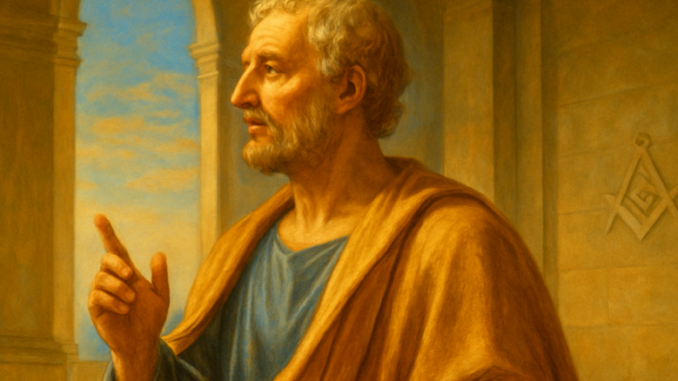
You know the feeling: after a day spent in traffic, crowds, or back-to-back meetings, you come home feeling drained and irritable. Lucius Annaeus Seneca described this exact phenomenon two thousand years ago in his seventh letter to Lucilius. But where did his ideas come from? Which philosophical traditions shaped his thinking about the influence of the crowd on our inner life? This article uncovers the intellectual roots behind Seneca’s warning — and shows how these insights remain remarkably applicable today, not least within the practice of Freemasonry.
The Stoic Foundation: Mastery Over the Inner World
Seneca wrote from within the Stoic tradition, a philosophical school founded by Zeno of Citium around 300 BCE. At the heart of Stoicism lies a simple but powerful distinction: some things are within our control, and others are not. Our thoughts, judgments, and responses belong to the first category. The behavior of others — the crowd included — belongs to the second.
In Letter VII, Seneca applies this principle to an everyday situation. He describes how attending gladiatorial games left him morally damaged. The excitement of the mob, the cries for blood, the collective cruelty — all of it invaded his mind without his consent. Here we see Stoic doctrine in action: while Seneca could not control how the crowd behaved, he could choose not to expose himself to it again.
Epicurus: An Unexpected Ally
Remarkably, Seneca quotes the Epicurean philosopher Epicurus in several of his letters, despite the long-standing rivalry between the two schools. Epicurus counseled his followers to live in small, close-knit communities of like-minded individuals, far from the noise of the city and the turbulence of politics. This idea of selective social contact resonates powerfully in Letter VII.
Seneca writes that we must choose carefully whom we spend time with, because character traits are contagious. This is not a purely Stoic idea. It shows how Seneca was a pragmatist, drawing from multiple philosophical sources whenever they strengthened his argument. The practical takeaway is clear: consciously surround yourself with people who cultivate your better qualities, not those who feed your worst impulses.
The Cynic Legacy: Independence as an Ideal
Before Stoicism even existed, the Cynics — with Diogenes of Sinope as their most famous representative — laid the groundwork for radical inner freedom. The Cynics lived in deliberate defiance of social conventions and public opinion. They refused to conform to whatever the crowd expected of them.
True freedom begins where the opinion of the crowd ceases to govern your choices.
Seneca was no Cynic. He lived as a wealthy Roman at the imperial court, a far cry from Diogenes’ barrel. Yet he adopted the Cynic ideal of inner independence and adapted it for people who function within ordinary society. His message is nuanced: you don’t need to become a hermit, but you must guard what enters your mind.
Plato’s Crowd in the Cave
The Platonic tradition also casts light on Letter VII. In Plato’s famous Allegory of the Cave from the Republic, prisoners sit chained in darkness, staring at shadows on a wall. They mistake these shadows for reality. The one who breaks free and sees the sunlight returns with a transformed perspective — but is not understood by the others.
Seneca’s description of the arena spectators bears a striking resemblance to these prisoners. The crowd is captive to collective emotions and loses the capacity for individual judgment. The philosopher — the one who withdraws to think — sees what the masses cannot. In practical terms: regularly step back from group dynamics to recalibrate your own perspective.
Practical Steps You Can Take Today
This philosophical background is far more than academic knowledge. It offers concrete guidance for daily life:
Evaluate your media consumption. Which platforms function as modern arenas, stoking collective emotion and outrage? Social media feeds, 24-hour news cycles, and viral content are today’s gladiatorial games — designed to hijack your attention and your judgment.
Choose your company deliberately. Who do you spend your time with, and which traits are you unconsciously absorbing? Seneca’s warning about the contagious nature of character applies as much in the office, at the dinner table, or in an online group as it did in ancient Rome.
Schedule moments of silence. Seneca regularly withdrew from society to reflect. When do you create space for undisturbed thought? Even brief periods of solitude can restore clarity that hours in the crowd erode.
Examine your reactions. When you notice yourself swept up in group emotion — whether it’s outrage, euphoria, or disdain — pause and ask yourself: is this truly my own judgment, or have I borrowed it from the crowd?
The Lodge as a Counterweight
Within Freemasonry, we find a remarkably practical application of Seneca’s philosophy. The lodge functions as an enclosed space where brethren withdraw from the chaos of the outside world. Here, there is no shouting of the mob — only structured dialogue. Here, there are no impulsive mass reactions — only ritual silence and reflection.
This is precisely what Seneca meant by choosing your company wisely. The lodge offers a community of like-minded individuals who support one another in moral growth, comparable to the Epicurean circle of friends or the Stoic school. The contrast with the arena is fundamental: where the arena brings out the worst in people, the lodge strives to cultivate the best.
The Masonic emphasis on self-improvement through reflection and brotherly dialogue echoes across these ancient traditions. The lodge is not an escape from the world but a place to sharpen the tools of discernment before returning to it. Every degree, every ritual, every moment of contemplation within the temple walls reinforces the same lesson Seneca drew from centuries of philosophical thought: protect your inner space.
Seneca’s Letter VII is not an abstract philosophical treatise. It is a practical guide rooted in centuries of wisdom. From Zeno’s distinction between what we can and cannot control, through Epicurus’ emphasis on selective social contact, to Plato’s warning against collective blindness — these traditions converge in one clear piece of advice: protect your inner world by consciously choosing what you expose yourself to and whom you spend your time with. Start today. Notice when the crowd begins to dictate your mood, and then choose again. That choice is the first step toward genuine freedom.
Copyright text & image: devrijmetselaar.nl
Texts are based on the ideas and content of the author of devrijmetselaar.nl, reviewed, corrected, and supplemented with the assistance of OpenAI. Images are created based on the ideas of the author of devrijmetselaar.nl using OpenAI/DALL-E.
Frequently Asked Questions
What is the main philosophical principle Seneca uses in Letter VII to explain how we maintain inner freedom?
Seneca applies the core Stoic principle that distinguishes between what is within our control and what is not. While we cannot control the behavior of crowds or other external circumstances, we have complete control over our thoughts, judgments, and responses. In Letter VII, he uses the example of gladiatorial games to show how we can choose not to expose ourselves to morally damaging influences, even when we cannot control the crowd's behavior itself.
How does Seneca incorporate ideas from philosophers outside the Stoic tradition?
Despite the rivalry between Stoicism and Epicureanism, Seneca quotes Epicurus and adopts his practical wisdom about living in small, close-knit communities away from urban chaos. Seneca demonstrates pragmatism by drawing from multiple philosophical sources when they strengthen his arguments. He also builds upon the Cynic legacy of radical inner freedom and independence from social conventions, showing that he was willing to integrate ideas from different schools to support his teachings on inner freedom.
What is Seneca's warning about our social relationships and character development?
Seneca emphasizes that character traits are contagious and we must choose carefully whom we spend time with. He advocates for consciously surrounding yourself with people who cultivate your better qualities rather than those who feed your worst impulses. This selective approach to social contact is essential for maintaining inner freedom and moral integrity, as our associations directly influence our character and well-being.

Be the first to comment