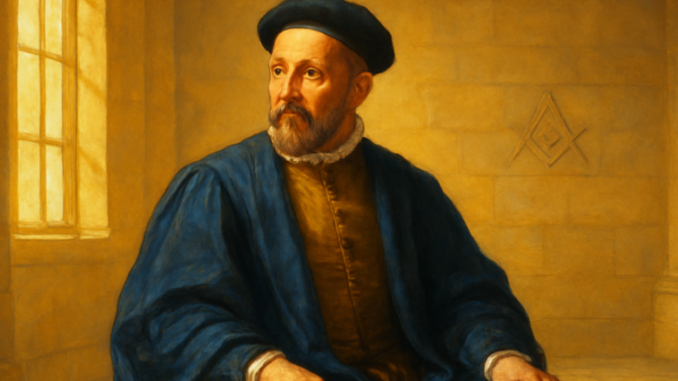
A coach rolls through the landscape. The wheels turn, the wood creaks, and the road unfolds ahead. For Michel de Montaigne, this everyday mode of transport became the starting point for profound reflections on human vanity, encounters with the unfamiliar, and the way we move through the world. In his essay On Coaches, the sixteenth-century thinker touches on themes that lie at the very heart of Freemasonry: the journey as metaphor, the meeting with the other, and the never-ending quest for authentic connection.
The Coach as a Symbol of Life’s Journey
Montaigne opens his essay with a disarmingly personal confession: he suffered from motion sickness and far preferred riding on horseback to being jostled inside a coach. But beneath this candid anecdote lies a richer symbolism. The coach represents the way human beings move through life — sometimes in luxury, sometimes in discomfort, but always in motion. Any Freemason will recognize in this image the initiation that marks the beginning of a journey, not toward a geographical destination, but toward inner refinement.
In the lodge, brethren speak of the rough ashlar that must be shaped and polished. That work happens along the way, in the very movement of existence. Montaigne understood this intuitively: stagnation was foreign to him, both physically and intellectually. His essays form a continuous voyage through thoughts, doubts, and insights. The coach itself is never the destination — it is the vehicle that enables us to reflect on where we have been and where we are headed.
The Encounter with the New World
A substantial portion of On Coaches is devoted to the Spanish conquests in the Americas. Montaigne describes with a mixture of wonder and horror the way European conquerors treated the indigenous peoples they encountered. Here, he reveals himself as an early advocate of what we might now call cultural humility. He poses a question that still resonates: who, exactly, are the real barbarians?
True connection is not born from dominating the other, but from the willingness to see with open eyes what we can learn from one another.
This attitude speaks directly to a fundamental Masonic value: brotherhood transcends boundaries of origin, culture, and creed. The lodge is a space where men from diverse backgrounds meet as equals. Montaigne’s critique of colonial arrogance reminds us that genuine connection is only possible when we have the courage to examine our own prejudices. The search for truth requires a willingness to let go of our certainties — a principle every Freemason encounters from the very first degree.
Splendor and Vanity: Looking Beyond Appearances
Montaigne devotes vivid passages to the lavish processions and ornate carriages of emperors and kings. He catalogues Nero’s golden chariots, the extravagant parades of Rome, the costly fabrics and precious gems. Yet his admiration remains deliberately superficial. Beneath the description, a deeper question shimmers: what does all this magnificence truly mean?
Freemasonry knows a similar tension between the outward and the inward. The apron a brother wears is simple in material yet rich in meaning. It speaks of the labor that must be performed, not the status that has been acquired. Montaigne would have appreciated this distinction. He distrusted display and sought what lay beneath it: the human being in his nakedness, with all his shortcomings and potential. In both Montaigne’s philosophy and Masonic teaching, the ornamental facade matters far less than the quality of the stone underneath.
Self-Reflection as the Foundation of Virtue
What makes On Coaches so remarkable is the way Montaigne weaves the personal and the universal together. He begins with his own motion sickness and ends with the fate of civilizations. This movement from the small to the great, from the self to the world, mirrors the movement of the Freemason. In the silence of the lodge, a brother turns inward, but the goal is always also directed outward: building a better world, one stone at a time.
Montaigne famously asked: “Que sais-je?” — What do I know? This question is not an expression of nihilism but of intellectual honesty. The Freemason who seeks the light understands that full illumination remains a horizon, never a final destination. It is precisely in acknowledging our limitations that the possibility of growth resides. Virtue does not arise from possessing the truth, but from the ongoing willingness to seek it.
The Coach Stops, but the Journey Continues
Montaigne’s essay invites us to contemplate our own movement through life. The coach may be a historical means of transport, but the questions it raises remain strikingly current. How do we move through the world? With arrogance or with humility? Do we seek genuine connection or merely confirmation of what we already believe? Do we dare to truly meet the other?
Consider the themes Montaigne raises and their Masonic parallels:
- The journey as a metaphor for personal development
- Humility toward other cultures and perspectives
- The distinction between outward splendor and inner worth
- Self-reflection as the foundation for moral growth
In Freemasonry, the temple is never finished. It is built continuously, stone by stone, thought by thought. Montaigne built in his own way — with words, with doubts, with an indefatigable curiosity about what it means to be human. His essay on coaches is an invitation to set ourselves in motion, not in order to arrive somewhere, but to be on the way with attention, openness, and a readiness for connection.
Michel de Montaigne wrote about coaches, emperors, and distant peoples more than four centuries ago. Yet his essay still speaks to anyone willing to listen. The Freemason finds in it a deep sense of recognition: the inward journey that is simultaneously a journey outward, the critical examination of one’s own prejudices, the search for what is truly valuable beyond mere appearances. The coach may come to a halt, but the journey toward light and connection knows no final station.
Copyright text & image: devrijmetselaar.nl
Texts are based on the ideas and content of the author of devrijmetselaar.nl, reviewed, corrected, and supplemented with the assistance of OpenAI. Images are created based on the ideas of the author of devrijmetselaar.nl using OpenAI/DALL-E.

Be the first to comment