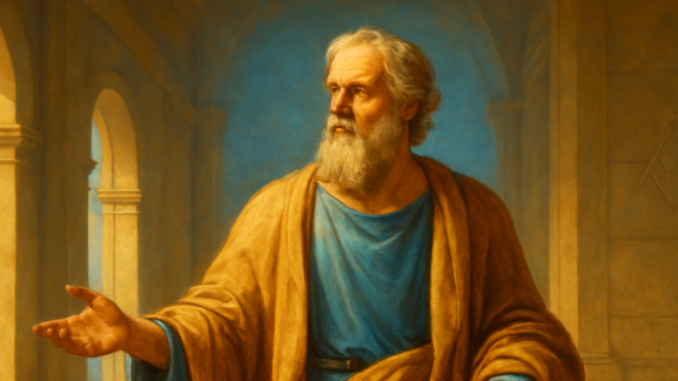
In fifth-century Athens, an intellectual battle was raging that would permanently reshape Western civilization. On one side stood the Sophists — traveling teachers of wisdom who claimed they could teach virtue for a fee. On the other stood Socrates, a man who questioned every certainty. Their clash, immortalized by Plato in the dialogue Protagoras, touches on a question that remains central to Freemasonry today: can a person truly learn to become virtuous, or is moral excellence something that must grow from within?
The Sophists and the Teaching of Virtue
To understand the Protagoras, we need to return to Greece around 450 BCE. Athenian democracy was flourishing, and with it arose a new demand: citizens wanted to learn the arts of rhetoric, persuasion, and political participation. The Sophists stepped in to fill this gap. Protagoras of Abdera was the most famous among them. He openly claimed that he could teach young men political virtue — the art of good citizenship.
This was revolutionary. Traditionally, the Greeks believed that virtue was inherited through noble birth or bestowed by the gods. Protagoras broke with this view entirely. He argued that virtue was a skill, comparable to carpentry or playing music, that anyone could learn. His famous dictum — “man is the measure of all things” — reflects this human-centered perspective: it is not the gods but we ourselves who determine what is good and just.
Socrates as the Voice of Doubt
Against the confident optimism of the Sophists, Socrates posed his characteristic skepticism. In Plato’s dialogue, we see Socrates interrogating Protagoras using his famous method of question and answer. Can virtue really be taught like a craft? If so, why do good fathers so often fail to raise virtuous sons? Pericles, the great statesman, could lead Athens brilliantly, yet his own children turned out to be morally weak.
Socrates’ position was subtle. He did not deny that people can improve themselves, but he challenged the assumption that virtue could simply be transferred from teacher to student. For Socrates, virtue was bound up with knowledge — but a very particular kind of knowledge: self-knowledge. The famous inscription “Know Thyself” carved above the Temple of Apollo at Delphi became, for Socrates, the key to all moral inquiry.
Influences from Earlier Philosophical Traditions
Plato did not write the Protagoras in a vacuum. He drew upon diverse philosophical traditions that already existed. The Pythagoreans, followers of Pythagoras, had already reflected deeply on the soul and its perfection through discipline and study. Their emphasis on harmony and inner order would echo through Plato’s later ideas about the tripartite soul.
The pre-Socratic thinkers also played a crucial role. Heraclitus, with his emphasis on the logos — the underlying rationality of the universe — and Parmenides, with his search for eternal truth, shaped the intellectual climate in which Plato came of age. The tension between change and permanence, between appearance and reality, permeates the Protagoras as well: is virtue something stable and teachable, or something in constant flux?
Virtue is not a package to be handed over, but a path to be walked — every step demands personal insight and personal choice.
A Legacy That Echoed Through the Centuries
The question Plato raised in the Protagoras continued to resonate for centuries. Aristotle, Plato’s most famous student, developed a more nuanced answer: virtue is formed through habit and practice, but also requires rational insight. The Stoics — Seneca, Marcus Aurelius, and others — built upon this foundation. They regarded virtue as the only true good, attainable by anyone willing to do the inner work.
During the Renaissance, humanists like Erasmus and Montaigne rediscovered these classical texts and posed the question anew: is the human character truly malleable? Montaigne, whose essays continue to inspire thoughtful readers today, wrestled with whether education and upbringing can genuinely transform character, or whether we remain prisoners of our inborn nature.
The Connection to Freemasonry
Freemasonry inherited this philosophical tension in a profound way. The rituals and degrees of the lodge are explicitly designed as a school for moral development. The rough ashlar that must be polished into a perfect cube symbolizes the conviction that a person can improve himself. At the same time, the tradition acknowledges that this improvement cannot be forced or simply handed down. Every Brother must perform his own inner work.
Here, the Socratic lesson resounds clearly: a master can point the way, ask questions, and challenge — but he cannot complete the transformation for someone else. Masonic rituals function much like the Socratic dialogue: they confront the participant with questions about himself, about his place in the world, about what it means to live a good life. Just as Socrates challenged Protagoras, the rituals challenge every Brother to find his own answers.
A Question That Endures
The dialogue Protagoras ends without a definitive answer. Plato leaves the reader with the uncomfortable realization that both positions have genuine merit. Perhaps that is precisely the point. The question of whether virtue can be taught is not a riddle to be solved once and for all, but a tension that every generation, every community, and every individual seeker must live with.
For anyone entering a lodge today, that tension remains as relevant as ever. Freemasonry offers no ready-made moral answers. It offers a method, a space, and a brotherhood within which the ancient question can be asked anew: what makes a person good, and how do I become that myself?
The philosophical background of Plato’s Protagoras stretches from the Sophists and Socrates through the Stoics and into the very heart of Freemasonry. It reminds us that the pursuit of virtue is not a destination but a lifelong journey — one that demands both the guidance of others and the courage to look honestly within. In the lodge, as in the ancient dialogues, the question is never fully closed. And perhaps that open question is itself the greatest teacher of all.
Copyright text & image: devrijmetselaar.nl
Texts are based on the ideas and content of the author of devrijmetselaar.nl, reviewed, corrected, and supplemented with the assistance of OpenAI. Images are created based on the ideas of the author of devrijmetselaar.nl using OpenAI/DALL-E.
Frequently Asked Questions
What is the central question about virtue that connects Plato's Protagoras to Freemasonry?
The dialogue explores whether virtue can be taught as a skill by others, or if moral excellence must develop from within a person. This question remains central to Freemasonry's approach to personal development and moral improvement.
What was Protagoras's revolutionary claim about virtue?
Protagoras argued that virtue was a learnable skill comparable to carpentry or music, not something inherited through noble birth or bestowed by the gods. This human-centered perspective challenged traditional Greek beliefs about the nature of moral excellence.
How did Socrates challenge the Sophists' teaching of virtue?
Socrates questioned whether virtue could truly be transferred from teacher to student like a craft. He pointed out that even great men like Pericles failed to raise virtuous sons, and he argued that true virtue was bound to self-knowledge rather than external instruction.


Be the first to comment