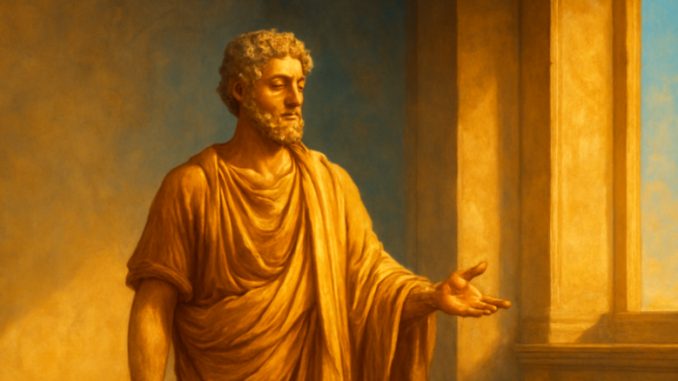
What did Marcus Aurelius actually mean when he wrote about living in accordance with nature? And why does this ancient idea resonate so deeply with what Freemasons strive for? In the third book of his Meditations, the Roman emperor unfolds a vision of the good that remains strikingly relevant today. These are thoughts worth exploring together — as seekers of truth have always done.
What Did Marcus Aurelius Mean by ‘Nature’?
This is perhaps the first question that arises when reading Book III. Marcus Aurelius speaks constantly about living according to nature, but he does not mean the romantic ideal of untouched forests and flowing rivers. For the Stoics, nature carried a far deeper meaning: the rational order that permeates the universe, the logos that connects all things.
The emperor saw each person as part of a greater whole. When we act in harmony with our rational nature, we act rightly — almost by definition. This may sound abstract, but its practical implication is remarkably clear: to live virtuously means to recognize and fulfill your role in the larger fabric of existence. Is this not precisely what a Freemason pursues when working on his rough ashlar?
The Connection Between Stoic Philosophy and Freemasonry
Let us be straightforward: Marcus Aurelius was not a Freemason. The Craft emerged many centuries after his death. Yet the resonance between his philosophy and the Masonic tradition is remarkably strong. Both traditions emphasize that human beings do not exist in isolation but are always connected to something greater than themselves.
The good is not some abstract ideal floating in the ether — it reveals itself in every act of connection, every choice to serve the higher self over the lower. In the lodge, a Freemason works on himself, but never solely for himself. The brotherhood forms a chain of fellowship that extends far beyond the individual ego. Marcus Aurelius would have recognized this immediately: for him, it was inconceivable that anyone could truly live well in complete isolation from others.
Virtue and the Path of Inner Growth
Here we touch upon a central question that occupies both Stoics and Freemasons. In Book III, Marcus Aurelius writes that we face a choice in every moment: do we yield to our baser impulses, or do we choose what is rational and good? This daily struggle is not a weakness — it is the very essence of being human.
Freemasonry expresses this theme through the working of the rough ashlar. No one enters the lodge as a perfected being. The journey toward moral refinement is exactly that — a journey, not a destination. What Marcus Aurelius offers is a compass for the road. Not a map that prescribes every step, but an inner orientation toward what is truly valuable.
Impermanence: Pessimism or Liberation?
A recurring theme in Book III is the transience of all earthly things. The emperor constantly reminds himself that fame, wealth, and even the body will eventually turn to dust. Is this pessimism? Quite the opposite.
By acknowledging the impermanence of external things, we bring the internal into sharper focus. What remains when everything passes away? For Marcus Aurelius, the answer is clear: the quality of our choices, the virtue with which we have lived. This echoes powerfully in Masonic symbolism of light and darkness. The light we seek is not the light of temporary glory but of enduring wisdom.
Practical Lessons from Meditations Book III
Let us be concrete. Marcus Aurelius offers several clear guidelines in Book III that any thoughtful person — and any Freemason — can apply immediately:
Begin each day by asking: what is my task today, and how can I fulfill it well? Do not allow yourself to be swept along by other people’s opinions about what matters. Remind yourself that you are connected to all people — including those who irritate you. Practice daily self-reflection, not as self-punishment, but as a loving inquiry into your own character.
For the Freemason, these points are immediately recognizable. The lodge provides a space for exactly these practices: self-reflection in silence, connection with brethren, and a constant reminder of what truly counts. The rituals are not empty forms — they are invitations to this inner work.
Is the Search for the Good Ever Complete?
Marcus Aurelius would probably smile at this question. The search is the way, he might answer. There is no moment at which you can declare yourself finished, fully virtuous, and complete. But it is precisely in this continual movement that the beauty of human existence lies.
Freemasonry shares this vision wholeheartedly. The journey from darkness to light has no definitive endpoint. Each degree opens new perspectives; each meeting offers fresh insights. The point is not to arrive, but to travel with mindfulness and dedication.
The thoughts of Marcus Aurelius in Book III invite us into a way of life that is truly timeless. Living according to nature means living from a place of connection — with ourselves, with others, and with the greater whole of which we are a part. For Freemasons, this Stoic wisdom serves as both a mirror and a compass. The question is not whether we choose this path, but how consciously we walk it. And perhaps that ongoing conversation — with ourselves and with others — is precisely where the good begins.
Copyright text & image: devrijmetselaar.nl
Texts are based on the ideas and content of the author of devrijmetselaar.nl, reviewed, corrected, and supplemented with the assistance of OpenAI. Images are created based on the ideas of the author of devrijmetselaar.nl using OpenAI/DALL-E.
Frequently Asked Questions
What did Marcus Aurelius mean by living 'according to nature'?
Marcus Aurelius did not refer to romantic ideals of forests and rivers, but rather to the rational order that permeates the universe, which the Stoics called the logos. He believed each person is part of a greater whole, and living virtuously means recognizing and fulfilling your role in the larger fabric of existence by acting in harmony with your rational nature.
What is the connection between Stoic philosophy and Freemasonry?
Although Marcus Aurelius lived centuries before Freemasonry emerged, both traditions share a fundamental belief that human beings are not isolated but connected to something greater than themselves. Both emphasize that the good reveals itself through acts of connection and service to a higher self, and that individual growth occurs within a community or brotherhood rather than in isolation.
How does Marcus Aurelius' view on virtue relate to Masonic practice?
Marcus Aurelius taught that humans face a daily choice between yielding to baser impulses or choosing what is rational and good. Freemasonry expresses this same theme through the work of the rough ashlar, symbolizing the ongoing personal struggle and inner growth that defines the human experience and the Masonic path.

Be the first to comment